Tromso
Returning from Paeskatun the Viking Vela set off from Alta at midnight thereabouts for Tromso. We collapsed into bed around 1am after a nice warm shower, followed by a couple of sandwiches and pastries left for us in our room by a steward (much appreciated).
It was going to take the night to sail to Tromso through the Inland Passage between the two cities. Tromso has about 70,000 people and regards itself as the big brother of Alta.
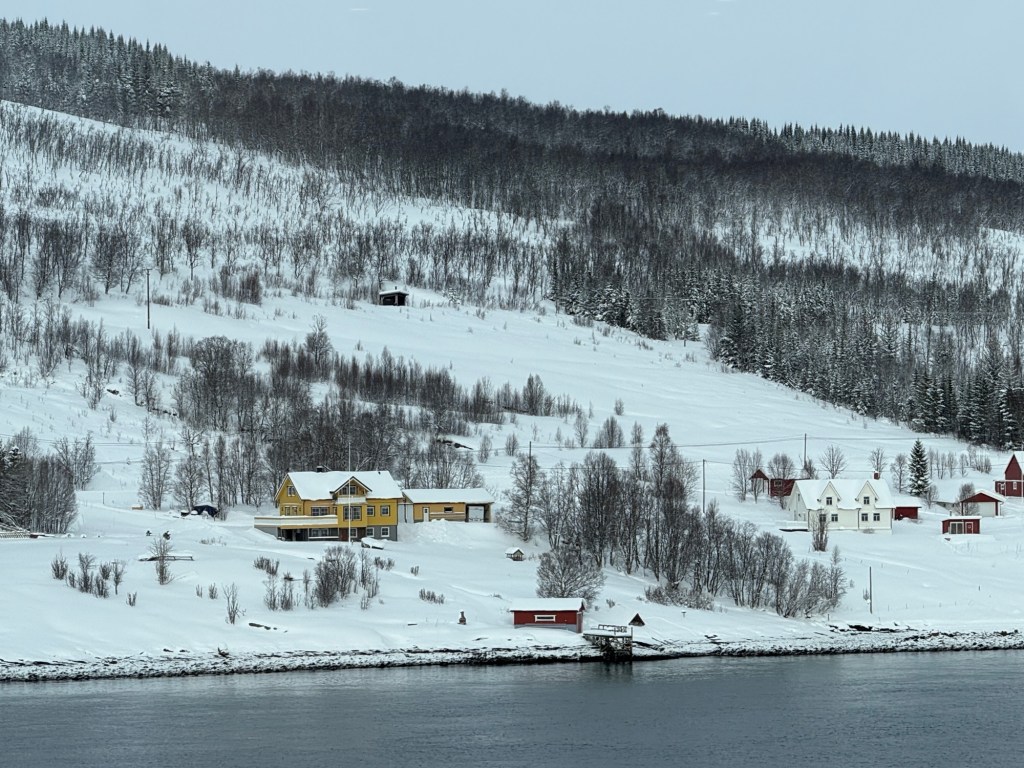
It was about this time though that the weather gods decided to influence things and we arrived in Tromso much later than planned at around 12.30pm. The morning excursions were called off, fortunately our 2pm town tour was ok. The weather was sort of terrible, if you like snow and sleet then it was great!
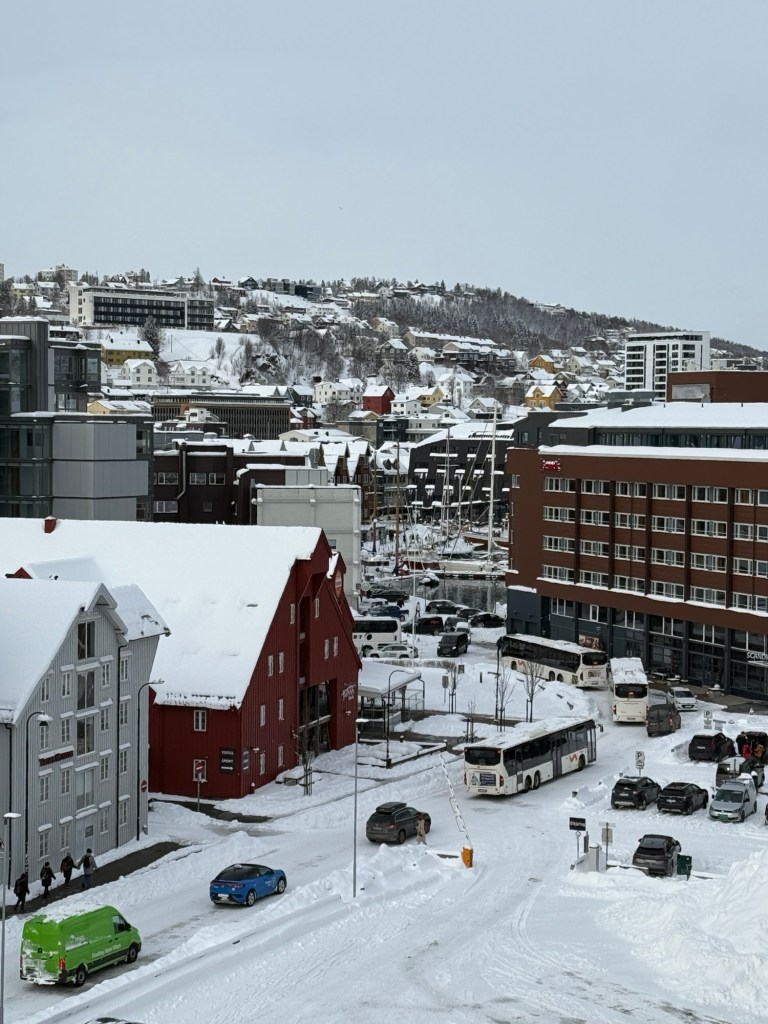
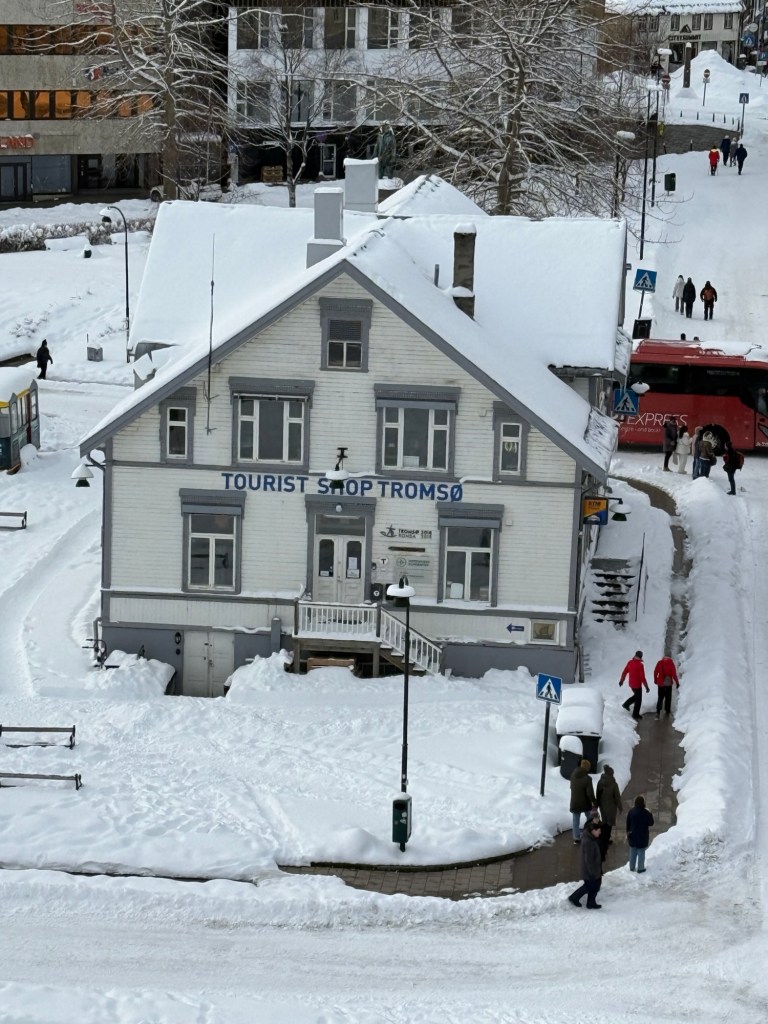
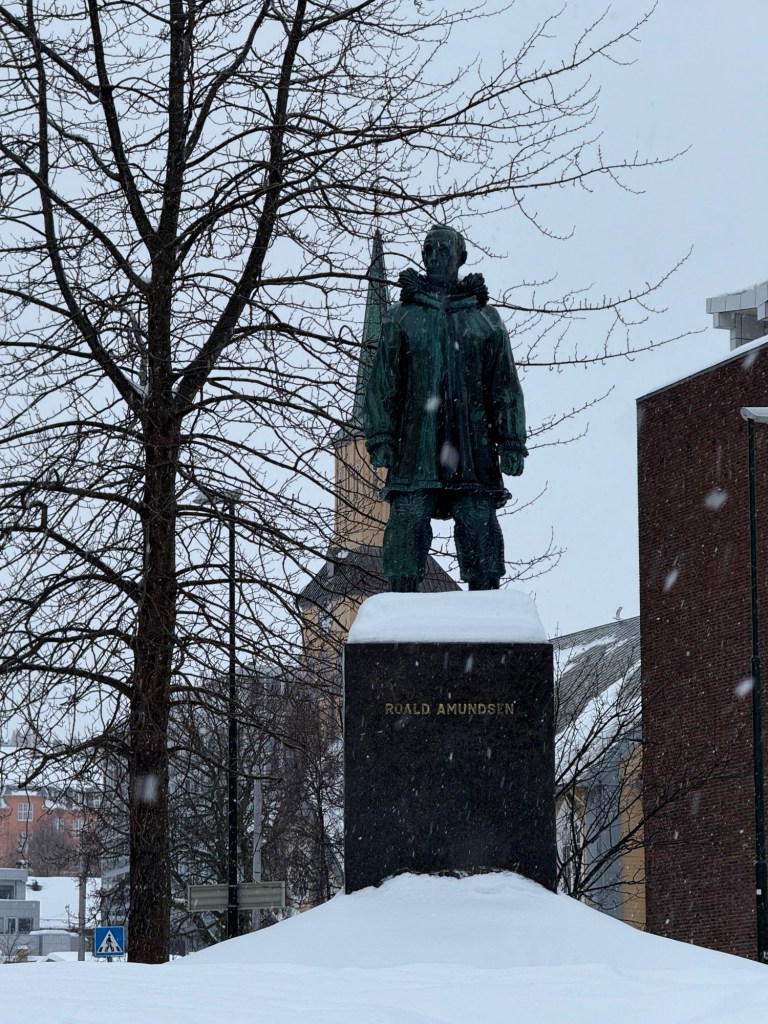
Tromso is on an island and the bus took us around the town and some of the highlights buildings wise. A statue of Amundsen, a favourite of the people here, looks over a snow covered park.
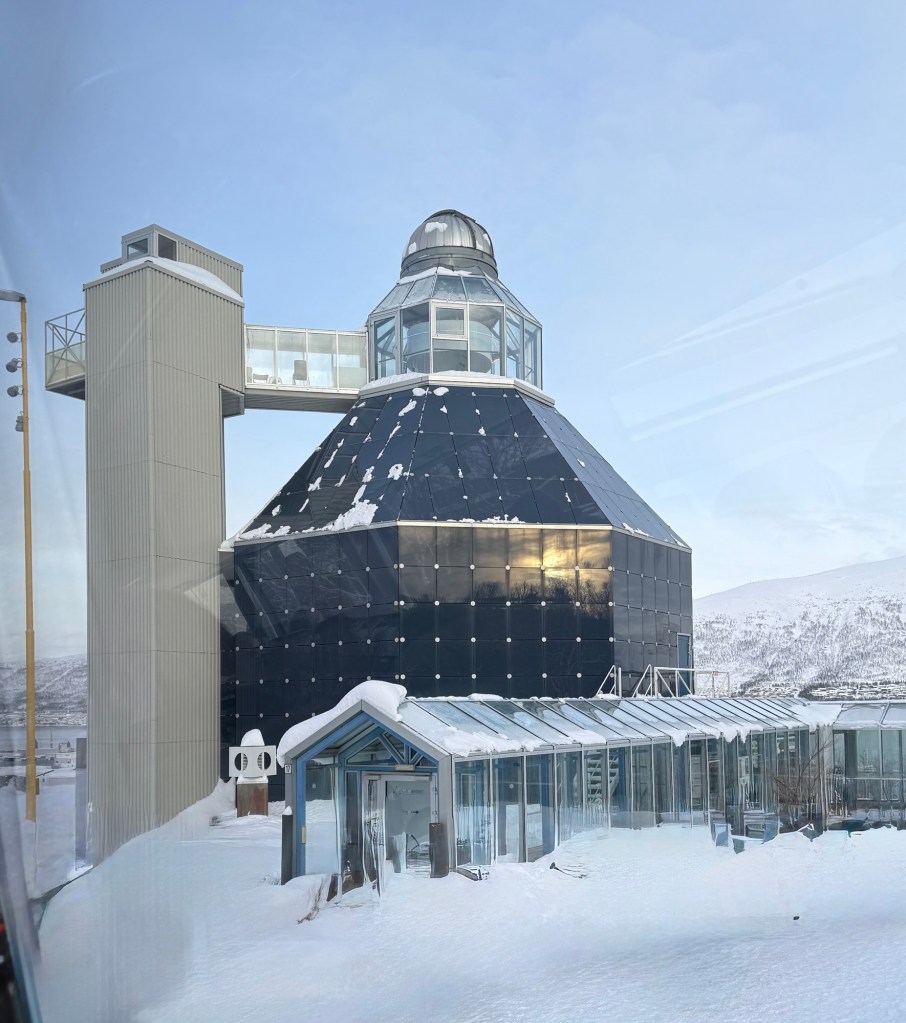
Our first major stop was the local University’s planetarium where the by now obligatory Northern Lights presentation takes place. This one was pretty good with the tremendous videos played across the high domed ceiling. It is unlikely that we will see the real thing given the weather conditions forecast. But that is the luck of the draw in these parts!
Moving on from here the bus entered a tunnel under the fjord and popped up on the mainland. Tromso is spreading out! On this side is the Arctic Cathedral, a modern triangular construction that overlooks the fjord. A bit of blue sky!
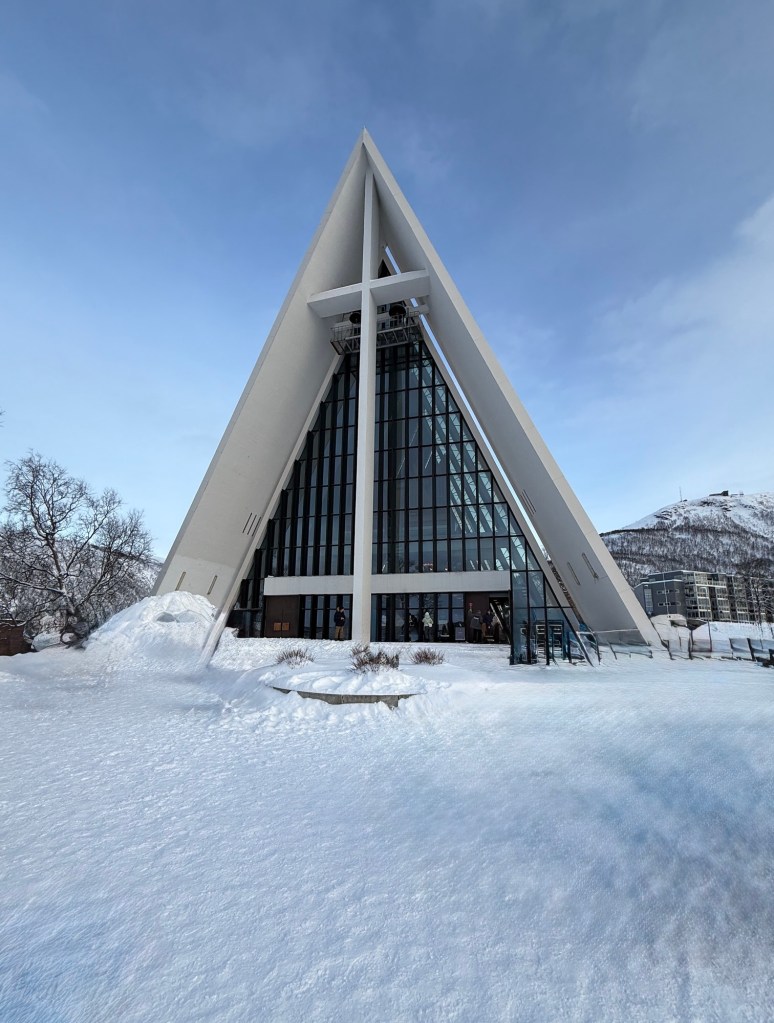
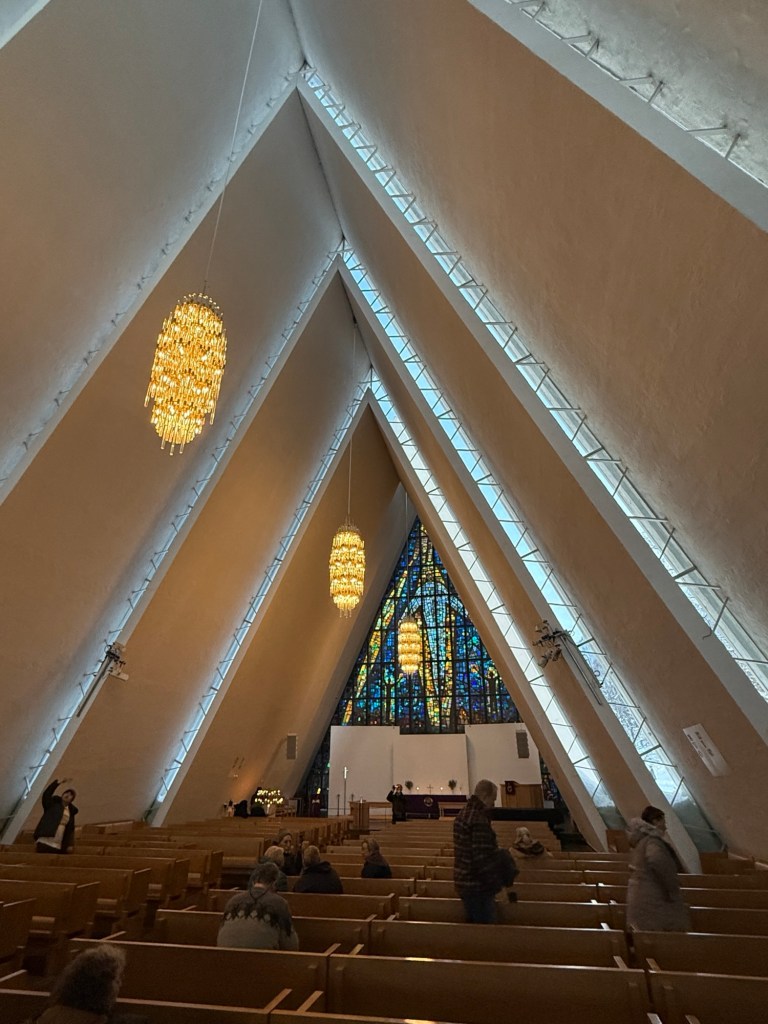
It has a spectacular stained glass window. It was added after the initial construction of the Cathedral to help disperse sunlight spilling into the Cathedral that unintentionally silhouetted the priest, who couldn’t tell whether the congregation were asleep or not.
Back on board the bus we returned to the ship. Here we learned that the itinerary was to change and we would be lurking in Tromso for another night and consequentially having to miss the planned stop at Narvik. This was all in the cause of getting a head start on incoming nasty weather from the north sea.
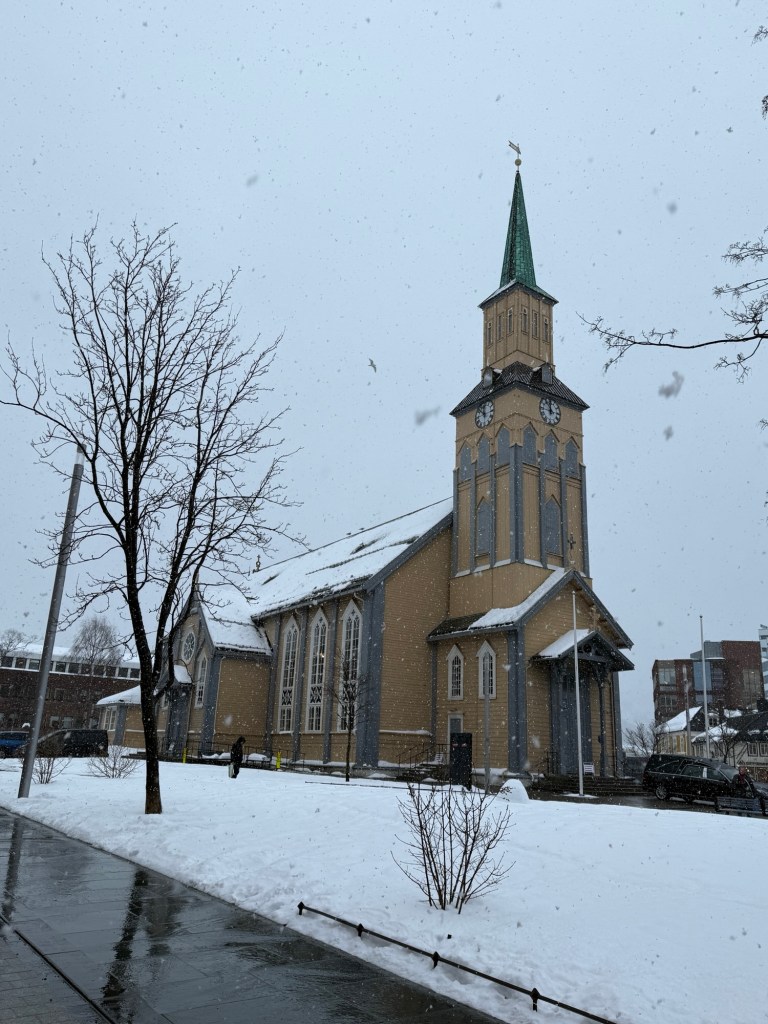
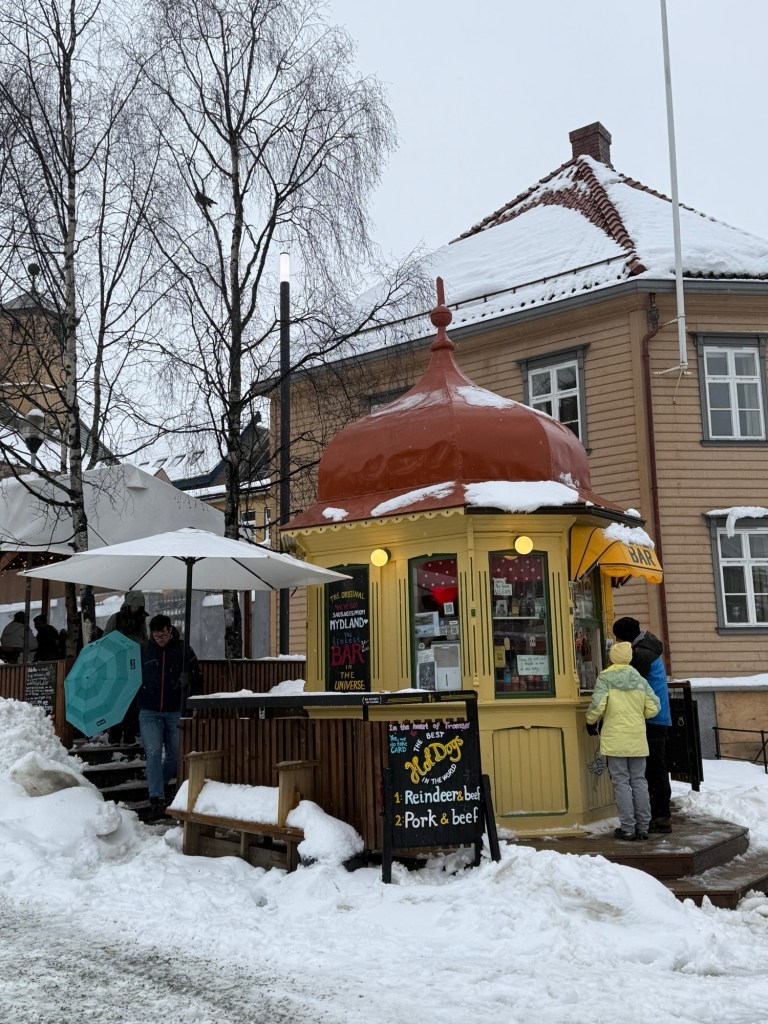
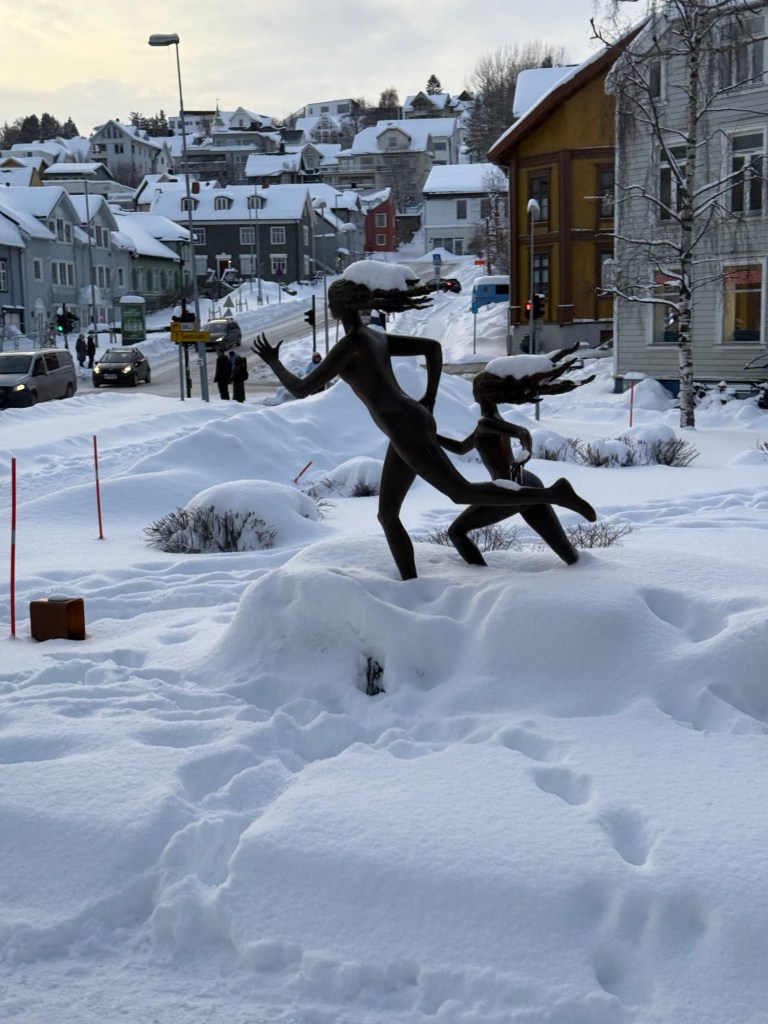
Next morning the weather was no better and we went out for a short stroll around town. Many of the roads and footpaths are heated and are free from snow, plenty of slush around though to get into footwear. Heaped up are small icy in parts ‘snow drifts’ one has to navigate around. Many people wear slip on/off spikes to avoid tumbles. There are numerous arctic memorabilia joints, all with very similar products and prices.
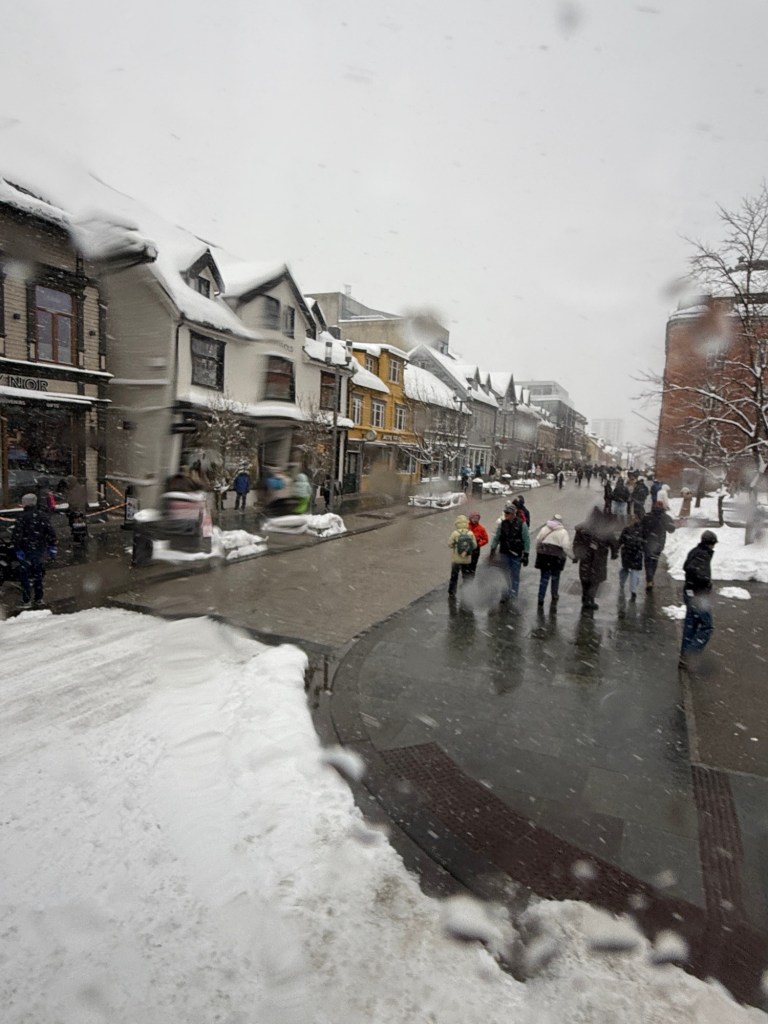
Norway seems to be a proudly expensive place no matter where you go. Largely powered by hydro electricity it has a large take up of electric vehicles, buses, trucks etc. and promotes its green credentials. Ironically, the largess (health, education, public transport) in social services support for the locals is funded by a very large Sovereign wealth fund built from the proceeds from the sale (to the rest of the world) of abundant oil and gas found in the North Sea!
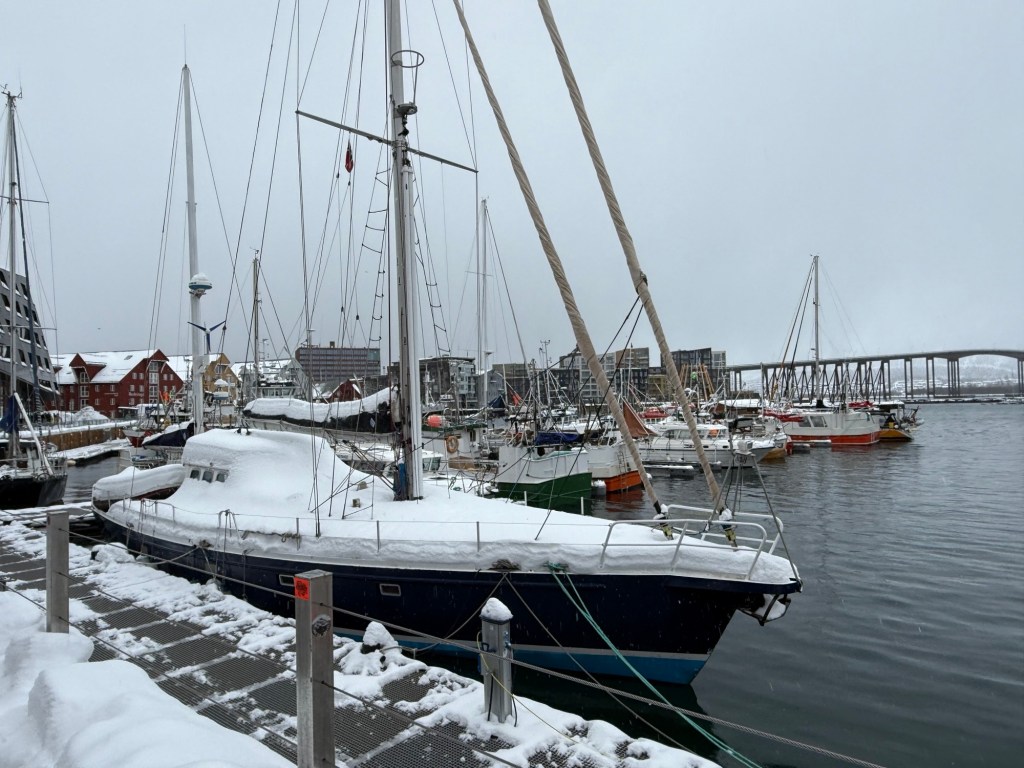
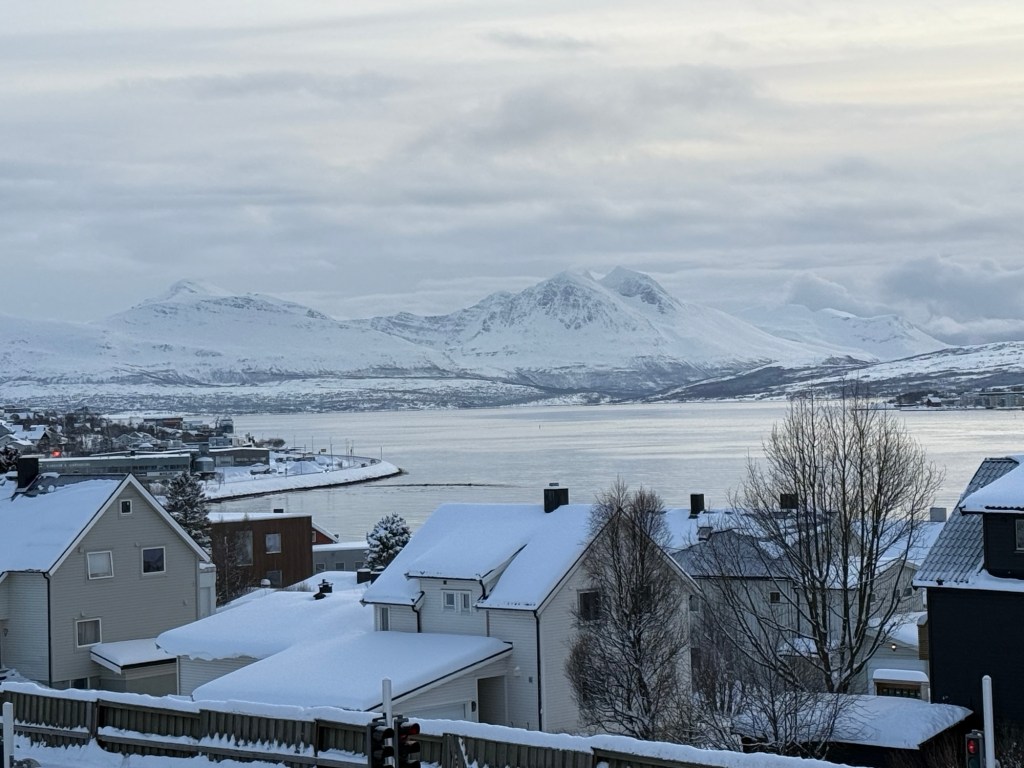
The planned sail away from Tromso was brought forward to early in the morning. The sail out along the fjord was quite smooth before we headed out into open ocean. We were to now have three clear sea days sailing south to Amsterdam. As we sailed south the seas did indeed get up a little. A swell of 3-4 metres had us rocking and rolling a little with some snow and sleet flurries. The ‘sicky bags’ appeared in the lifts, didn’t see any in use!
The Tromso weather had not been to order but nonetheless it had been a great stopover in snow country! Brought back memories for Allthego from many moons ago skiing in Australia’s alps down Perisher way!
Alta
The search for the Northern Lights now starts in earnest. But the weather outlook doesn’t look good.
Alta is 400km north of the Arctic Circle and 2200 km short of the North Pole. There are 20,000 or so people living here and it is the largest city north of the Arctic Circle.
In contrast Tasmania is 5,400km north of the South Pole and there is nothing except penguins, seals and whales etc between there and the Pole. A few scientists and the like huddle in expedition accommodation during the year.
We were due to arrive around midday, but fortunately we were three hours early and the sun was out. Some blue sky as well. So we headed ashore for a wander. Not a lot seems to happen in Alta tourist wise. The tourist bureau has some town maps and an array of souvenirs, Allthego picks up the usual couple of postcards and an Alta stamp to go on them! Bit different to the usual stamp.
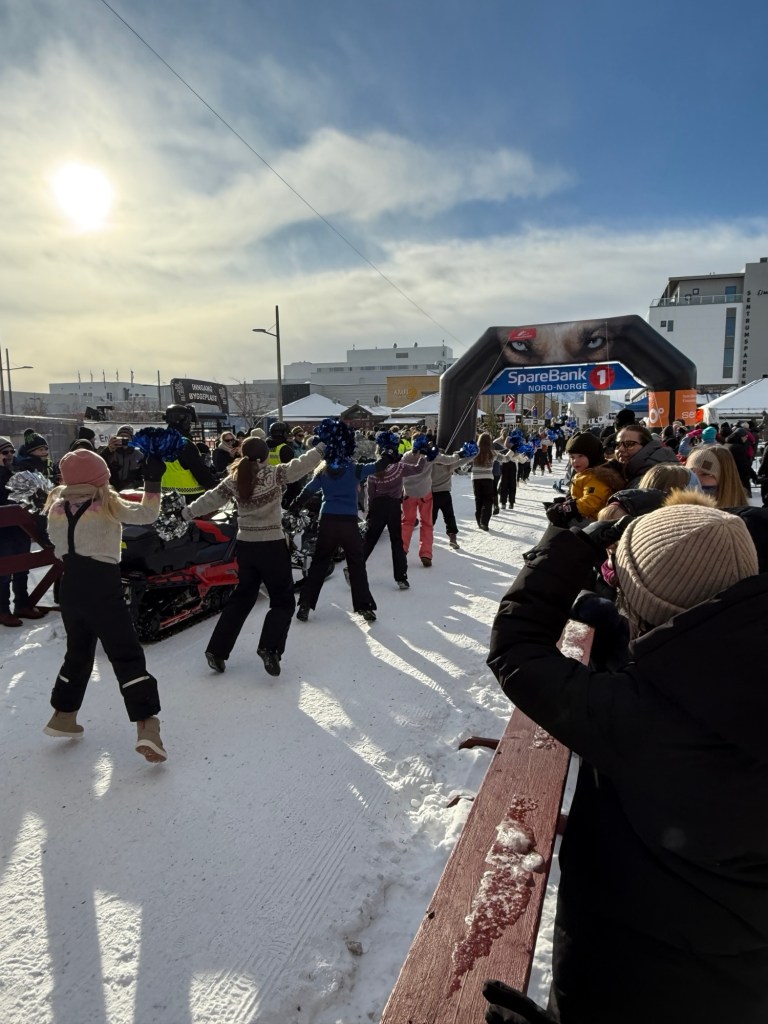
We happen to stumble onto the start of day two of the annual dog sled races. Day before was the big race, 1600 km. Day twos’ races are shorter, one of 600km and the other 400km (these distances are from recall may not be exact).
People line the race way start, seems to be a very popular event! Bit of dancing, cheerleader type stuff to introduce the races.
As the morning went on the clouds began to come in, there was a threat of snow overnight. We headed back to the ship for a late lunch and ready ourselves for our own dog sledding experience up in the hills in the late afternoon. This was really super stuff, we were broken into three groups that went off for 40 minutes or so sledding along behind teams of 8 dogs, fortunately we had a dedicated musher.
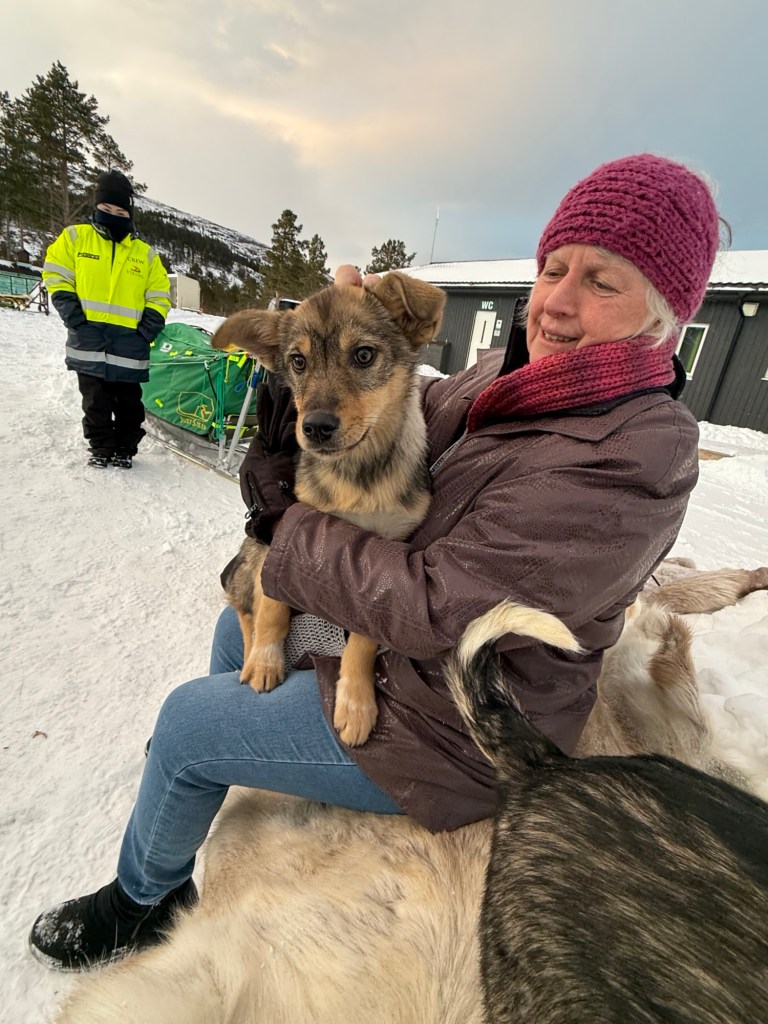
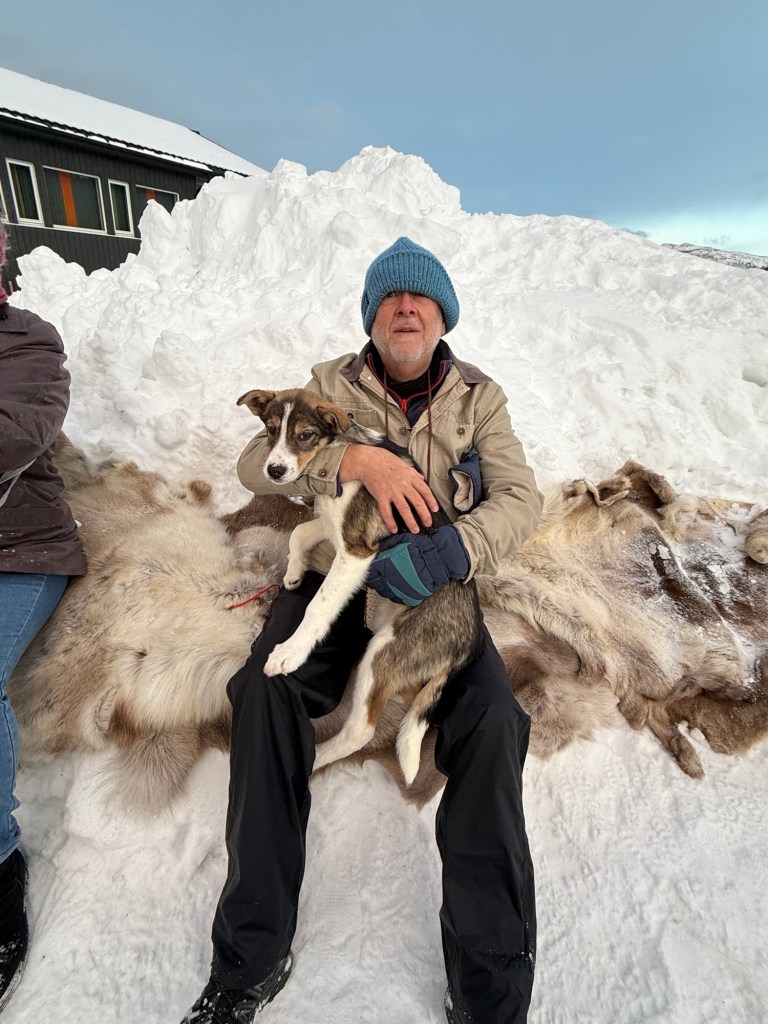
Back and forth along some tracks through a lightly treed valley beside a river, curiously a golf course in Summer! The dogs were really special, very sociable and excited to be pulling the sleds.
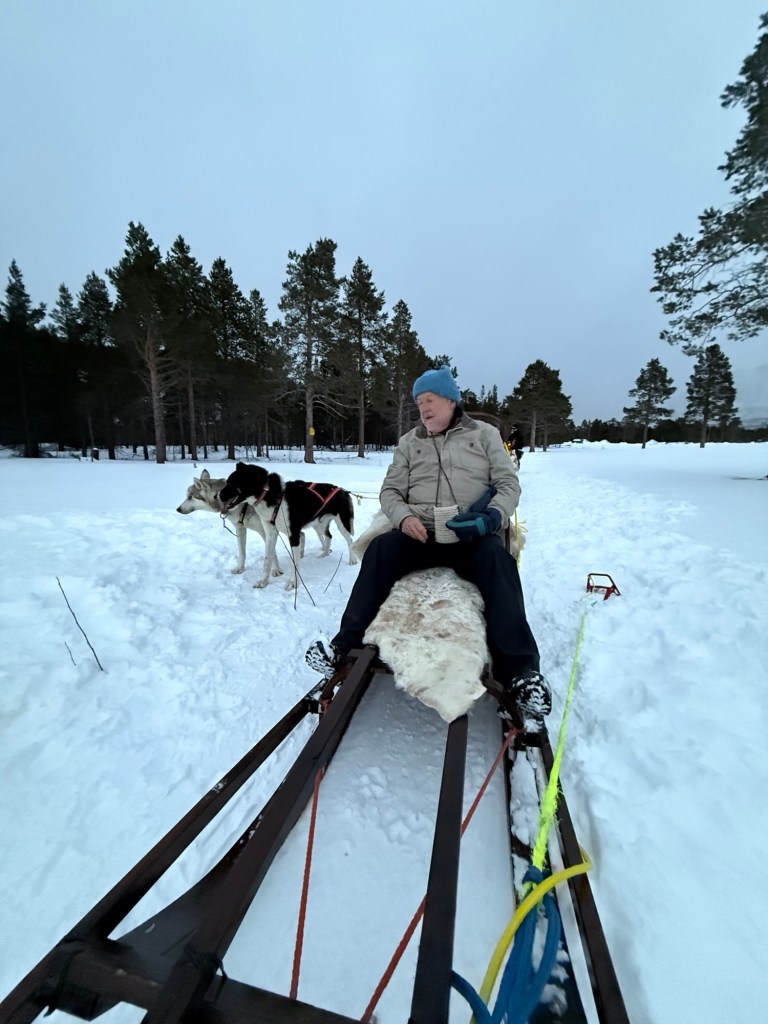
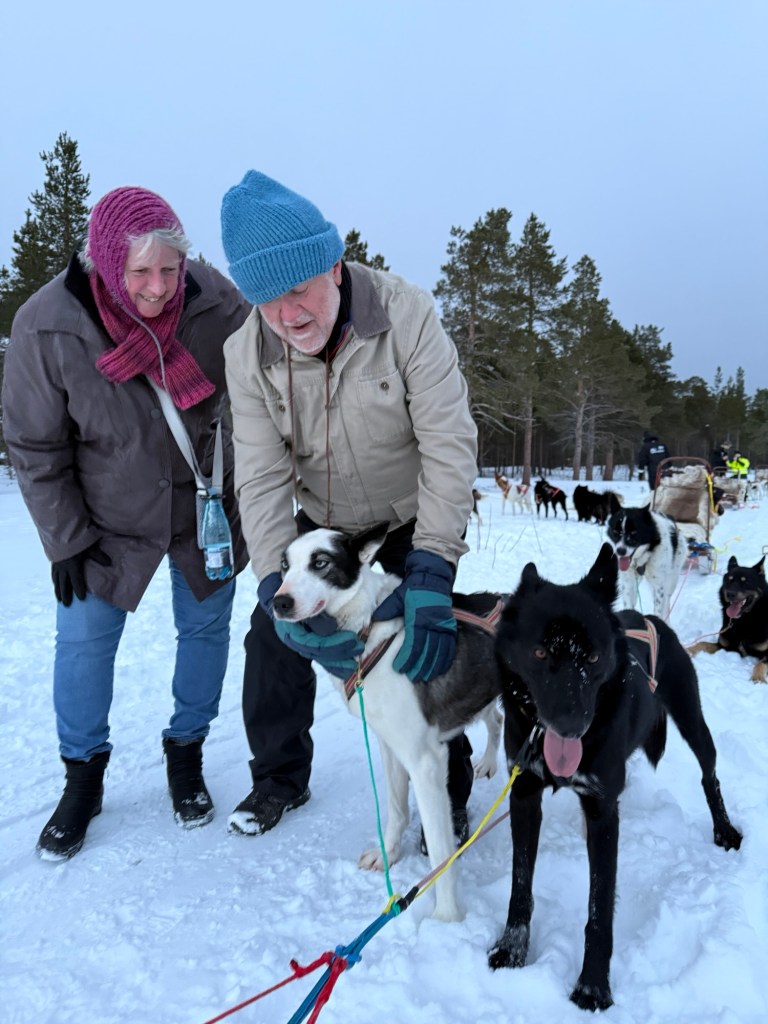
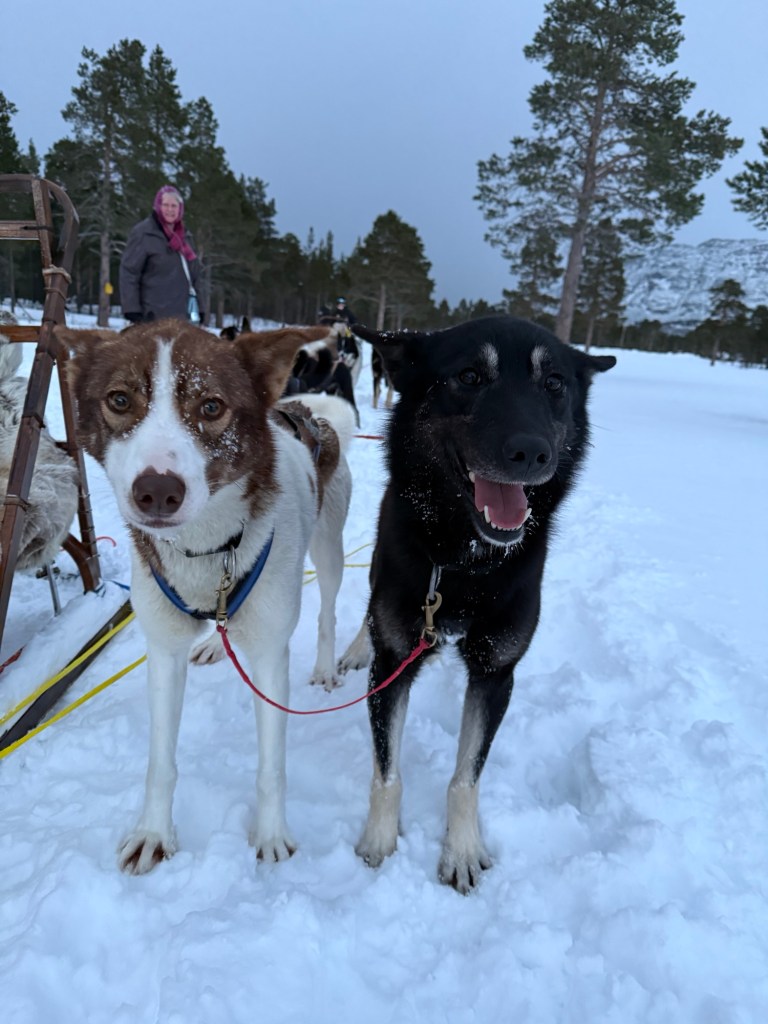
Would do it again. We finished up at dusk, about 7pm. Quite cold and the snow had started to blow around.
Next day we took in a short tour around the town and visited the local museum, focussed particularly on some old rock carvings/engravings dating back for 2,000 to 7,000 years. Pre viking times. Little is known about who did them and where the people ultimately went.
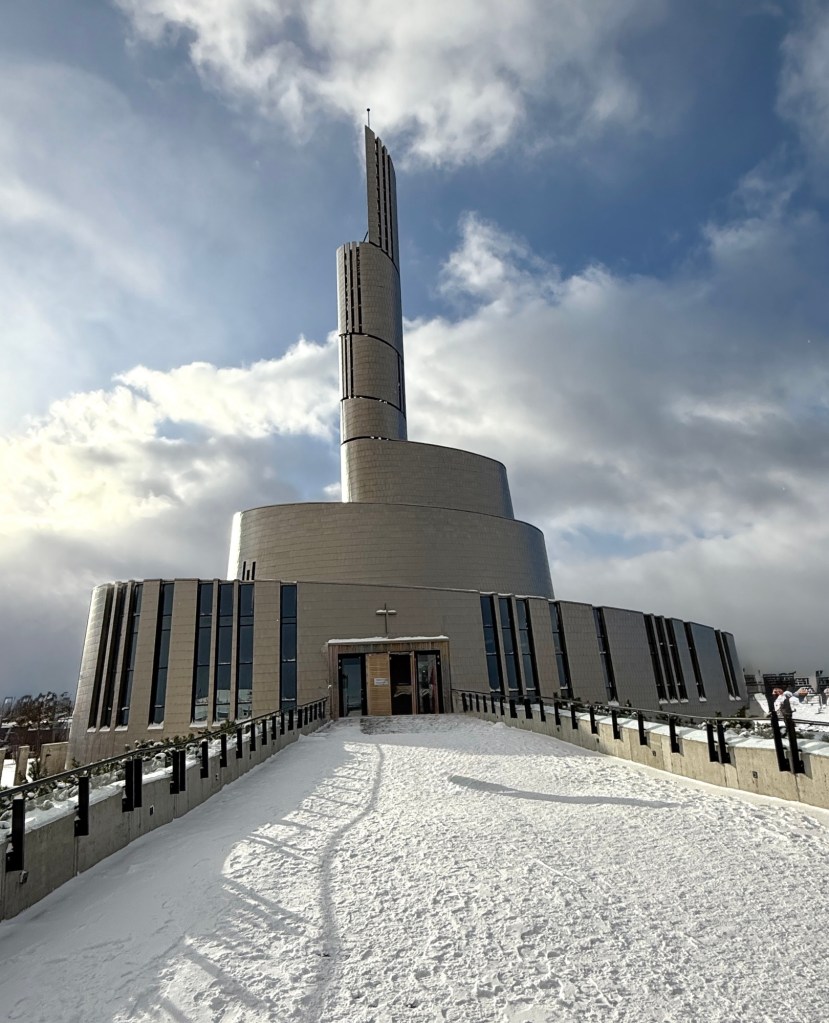
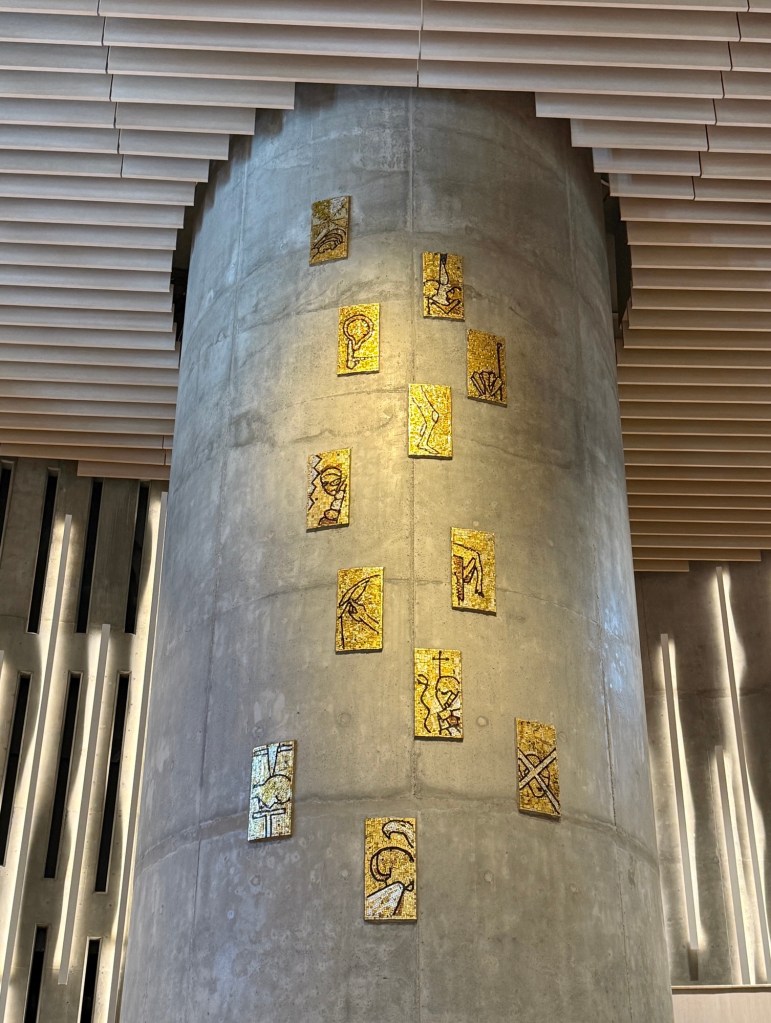
Later the Alta Cathedral called, a Lutheran church, which has a focus on engaging with visitors. A really good video was shown on the Northern Lights, some great photography.
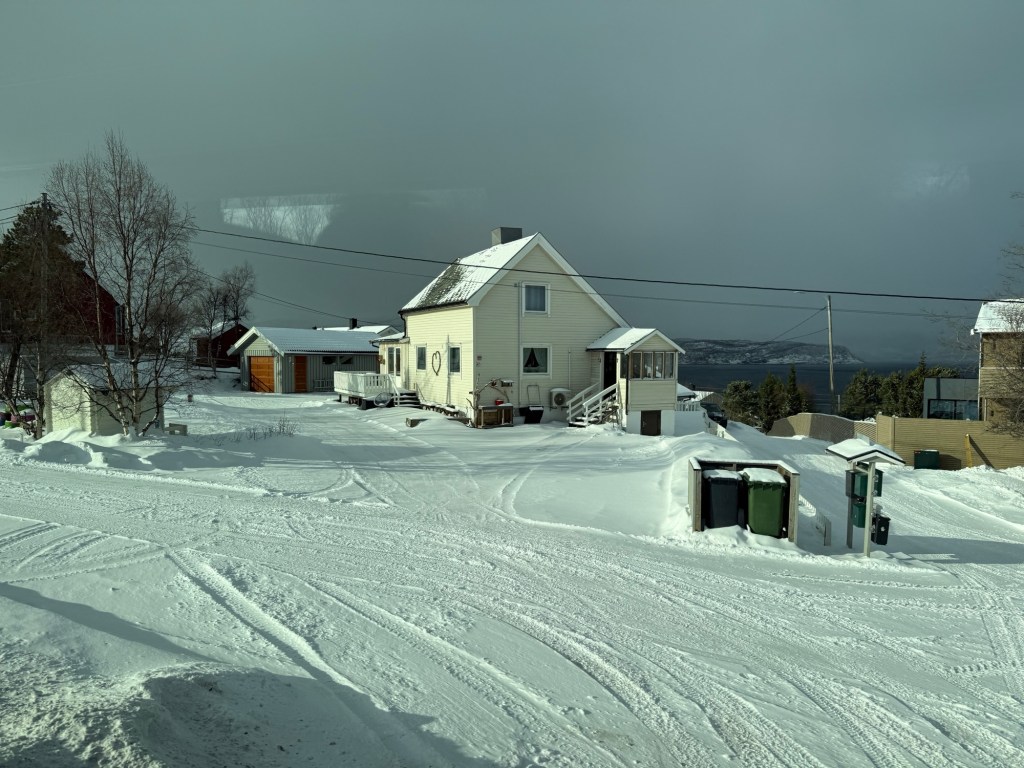
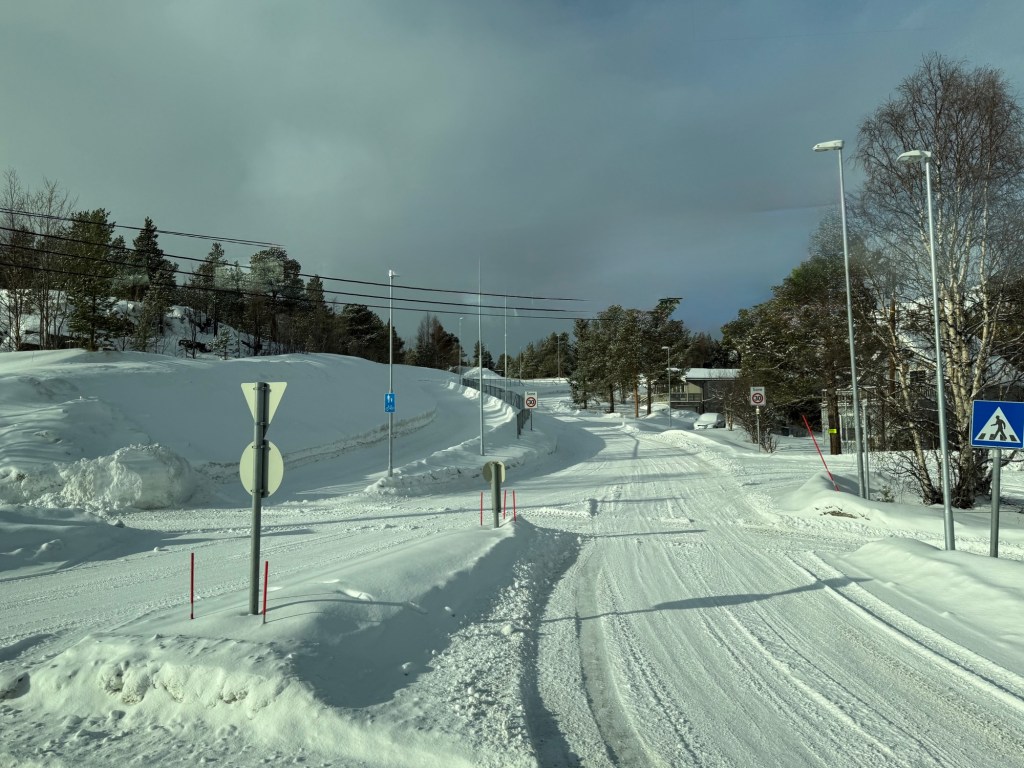
Back at the ship we had dinner before leaving for Paeskatun at 8pm. This was probably the last throw of the dice for seeing the Northern Lights. Paeskatun is up in the mountains behind Alta and is famous for its slate….. best slate in the world some say. But this time we hope to see the lights, not the slate.
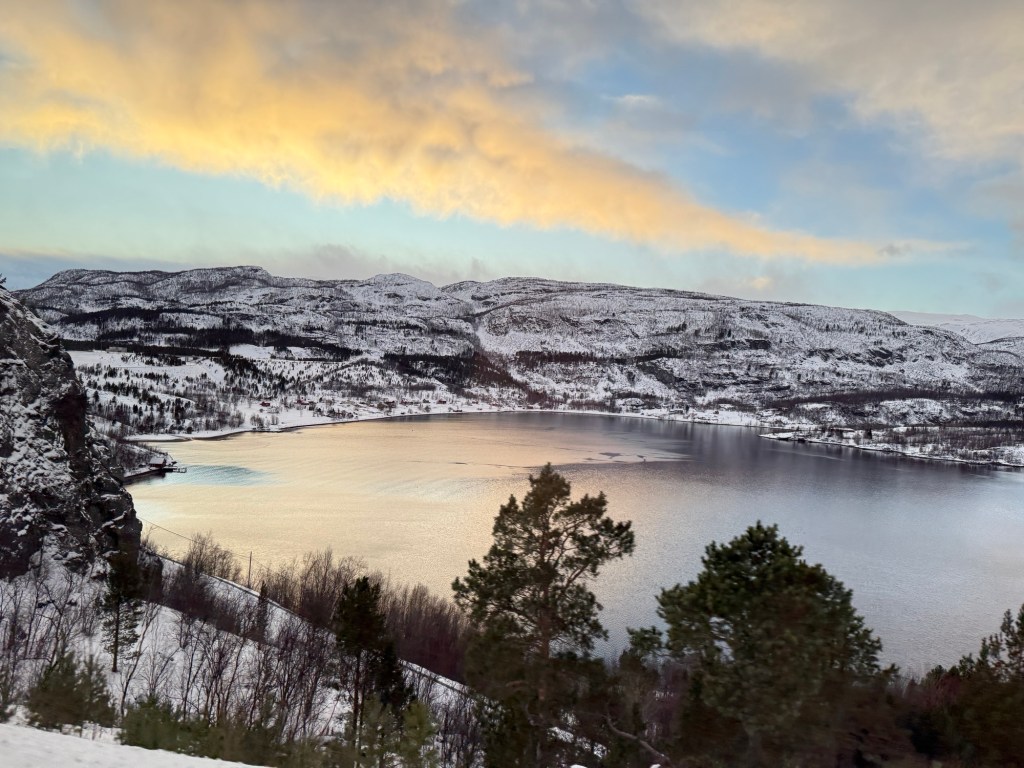
It’s cold up on the mountain, sleet is interrupted by snow and the skies remain clouded. Little chance of seeing any lights. Instead we huddle in some huts and hear tales from the past about slate and the lights. Have a couple of hotdogs and coffee while we wait. A local Sami chap visits for a look and brings a reindeer, poor animal seems to have no interest in amusing the onlookers!
The night drew to an end with more sleet and snow and no lights, all a little disappointed.
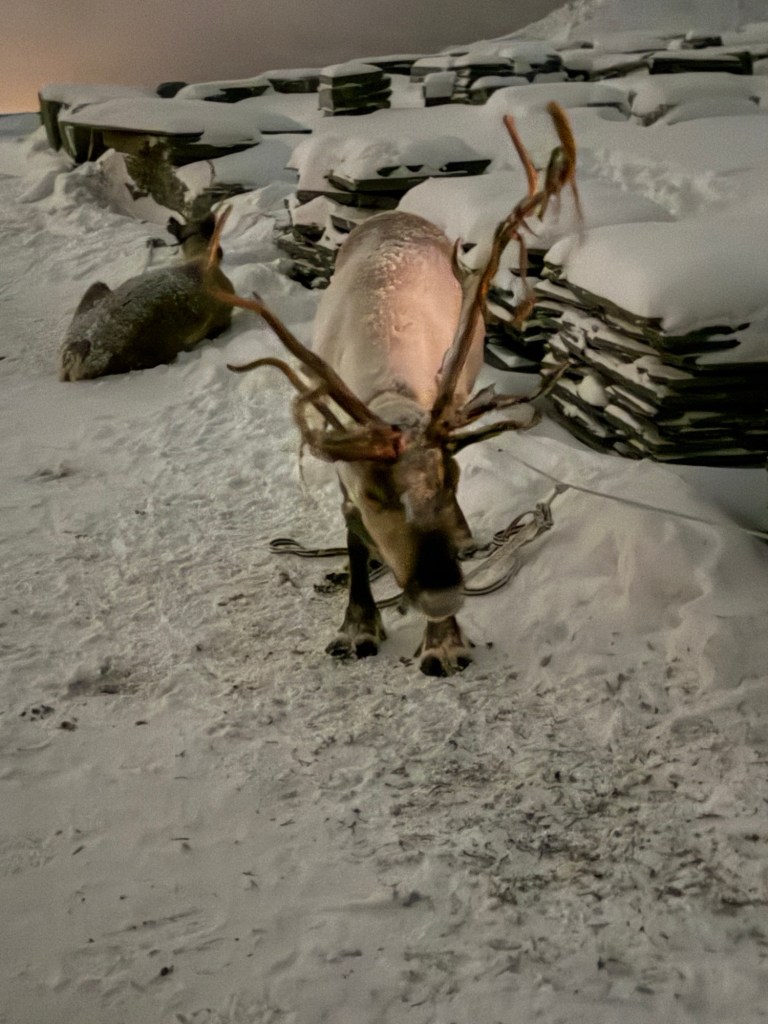
Back to the ship for a midnight sail away for Tromso.
Bergen to Alta
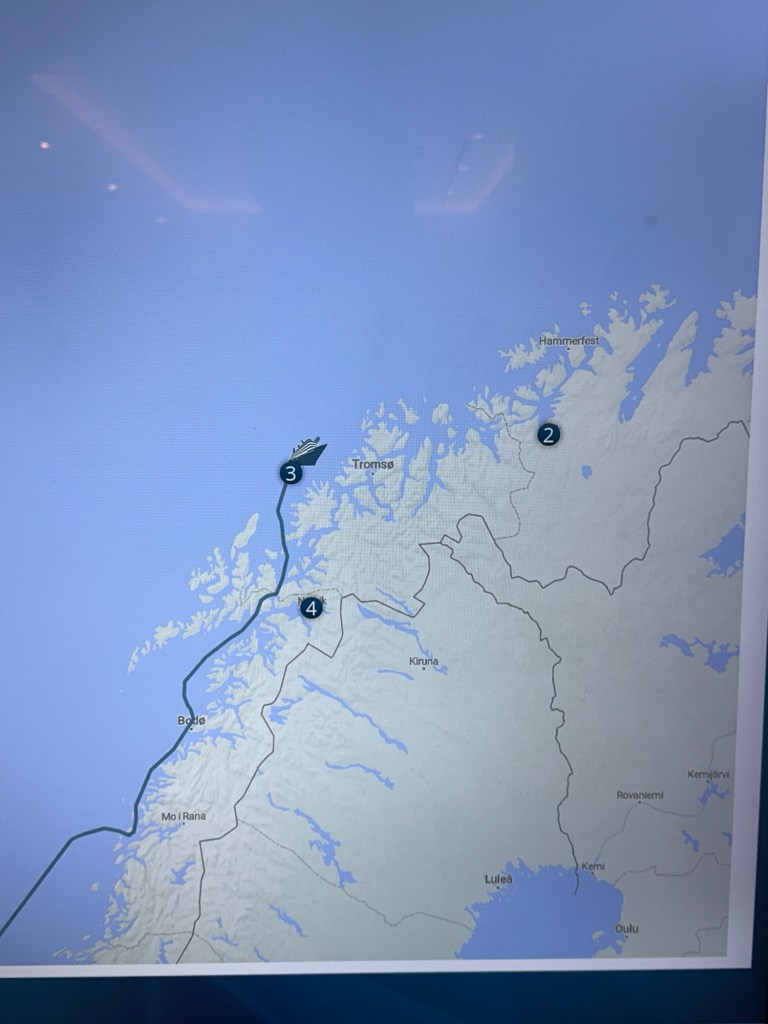
We left Bergen around 4.30pm and were due to arrive in Alta sometime before noon in three days. It’s more like three nights and two days cruising time. Depending upon the exact route it is 900-1000 km. The Captain has chosen to seek the open sea earlier than first planned. The seas are calm and we can make good time, we will join the Inside Passage further north.
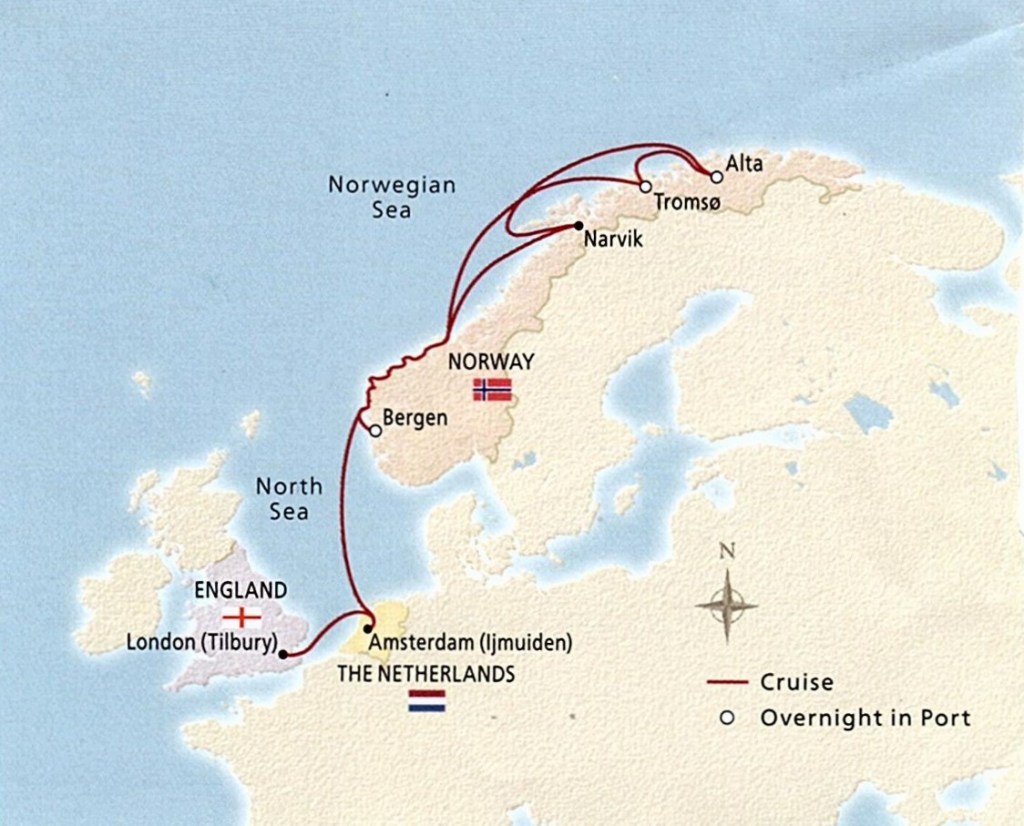
The previous cruise north by the Viking Vela had to abort at Trondheim and head back because of storms and rough seas in the Norwegian Sea. We had encountered the VV in port at Flam and had a brief chat with some passengers that were disappointed in the call made, but appreciative of the focus on safety.
The weather along the way was quite good, but rather chilly. Some sunny patches but plenty of snow flurries.
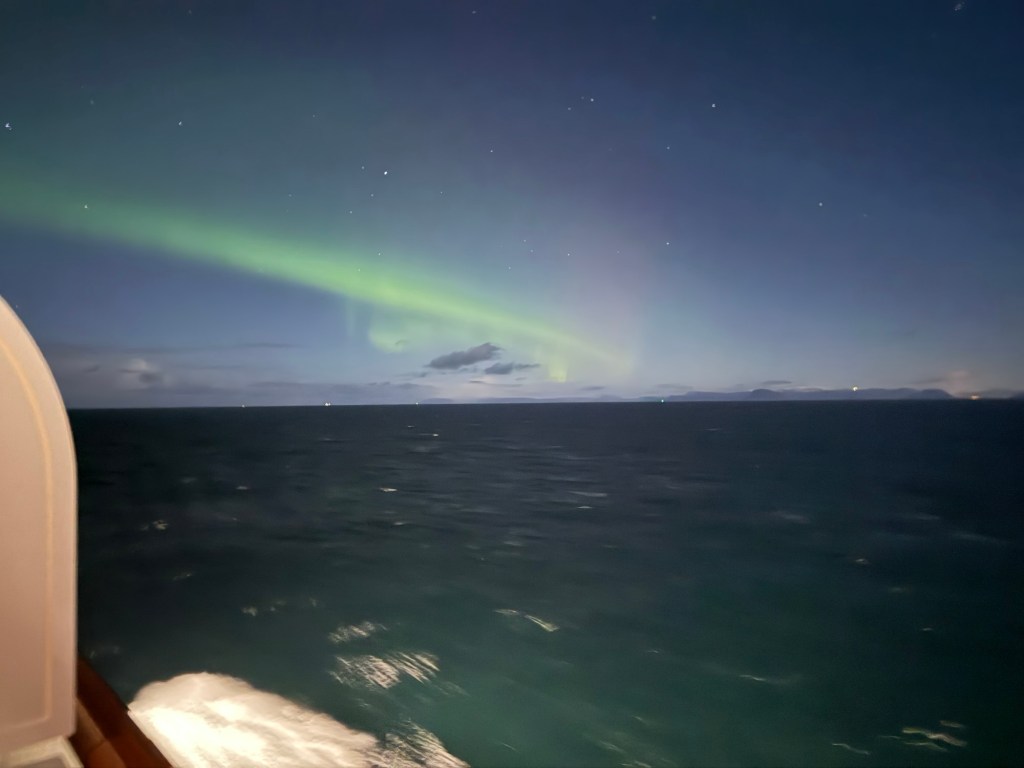
Late on the first evening we had our first Northern Lights sighting. A brief moment in time! We have had the call a couple of other times, but in the early hours. We have arose from slumber and joined some ‘masses’ of rugged up fellow passengers. In our case no sighting, either too late or they disappeared on us before sighting (I suppose that is too late, but not our problem!).
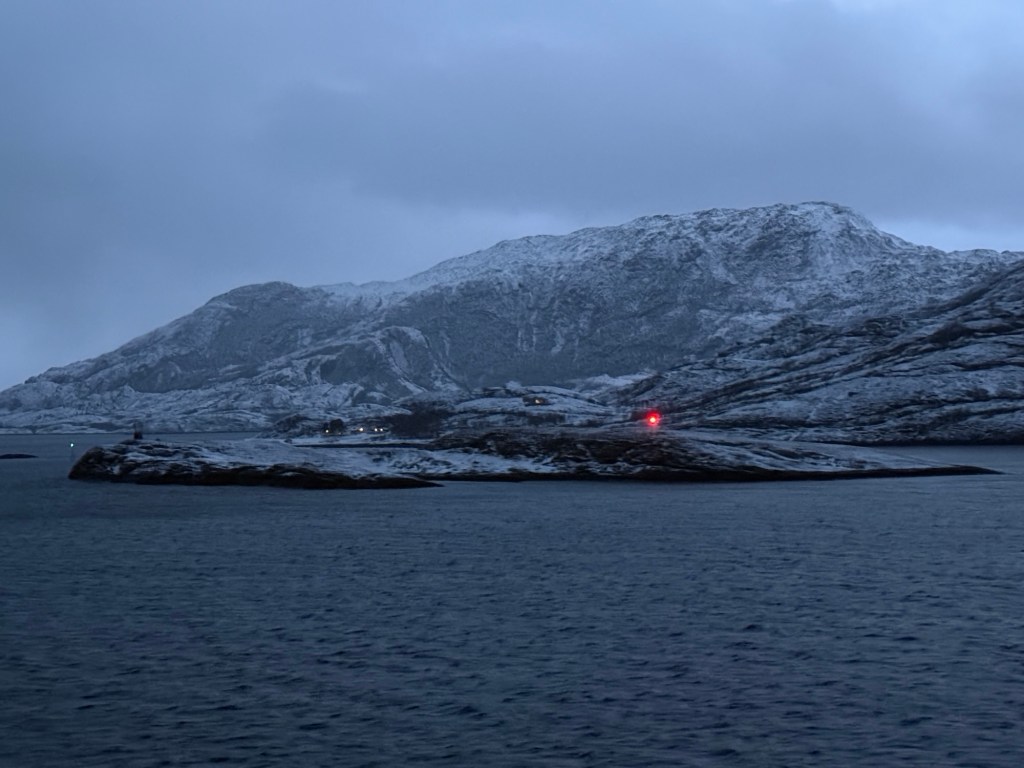
A highlight was passing Vikingen Island through which the Arctic Circle passes. Even if it was about 6am at the time. Interestingly, the Arctic Circle is moving very slowly north and since the island was marked as ‘the spot’ back in the past the Arctic Circle is now about a kilometre further north (a stat Allthego is keen to check on!). It is not so much the geographical Circle but the magnetic north pole that is moving around, about 14 metres a year. This is not a new phenomena or a by product of global warming or cooling whatever. I think the above is an ok summary, obviously a bit more complex.
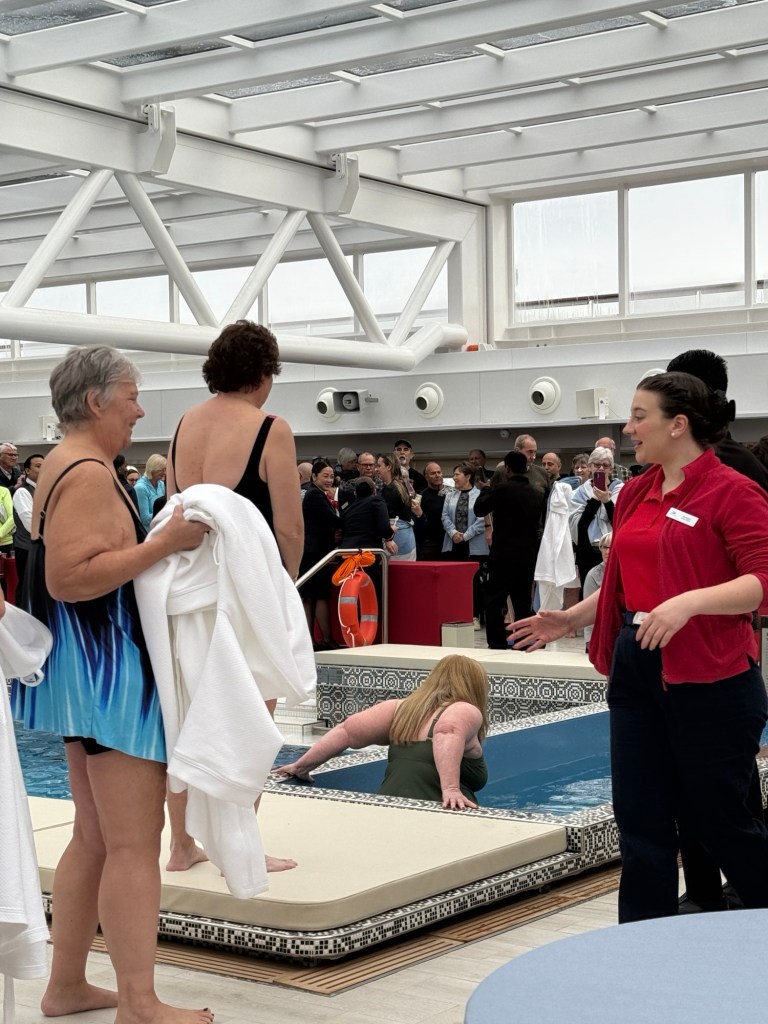
At this time there is also the celebration of the ‘Order of the Blue Nose’, passengers have a plunge in the pool spa that has been topped up with bags of ice. An interesting display of flesh took the plunge. Survival did not appear to be of concern. Allthego was tempted, but it was very cold!! Gave it a miss this time.
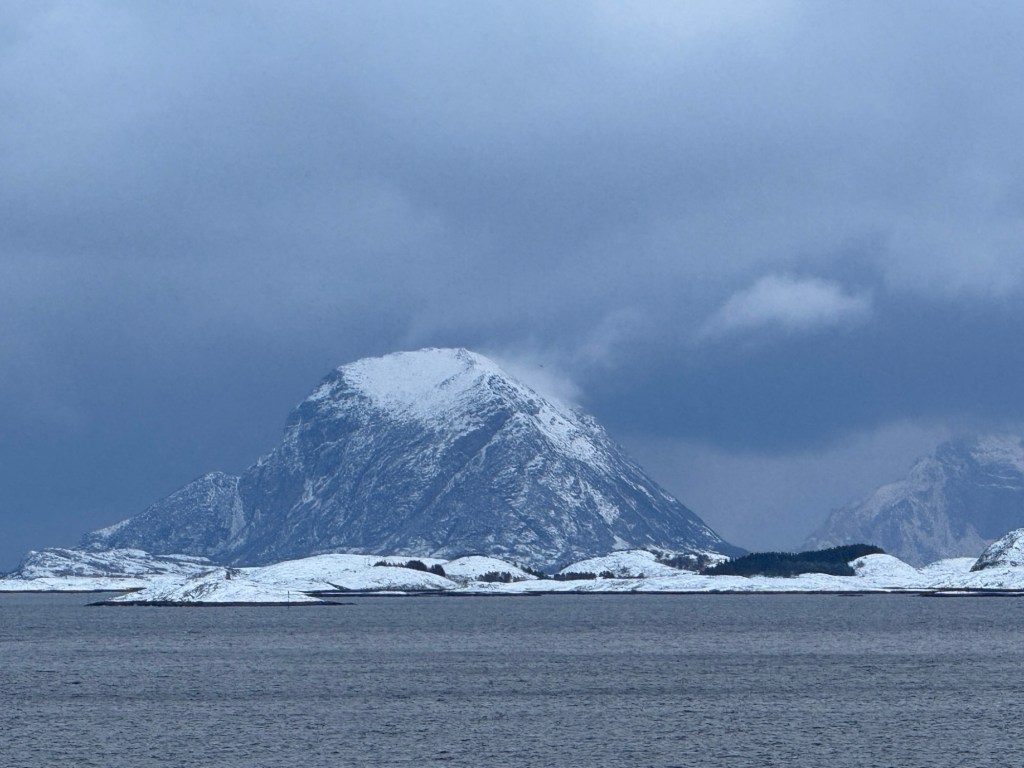
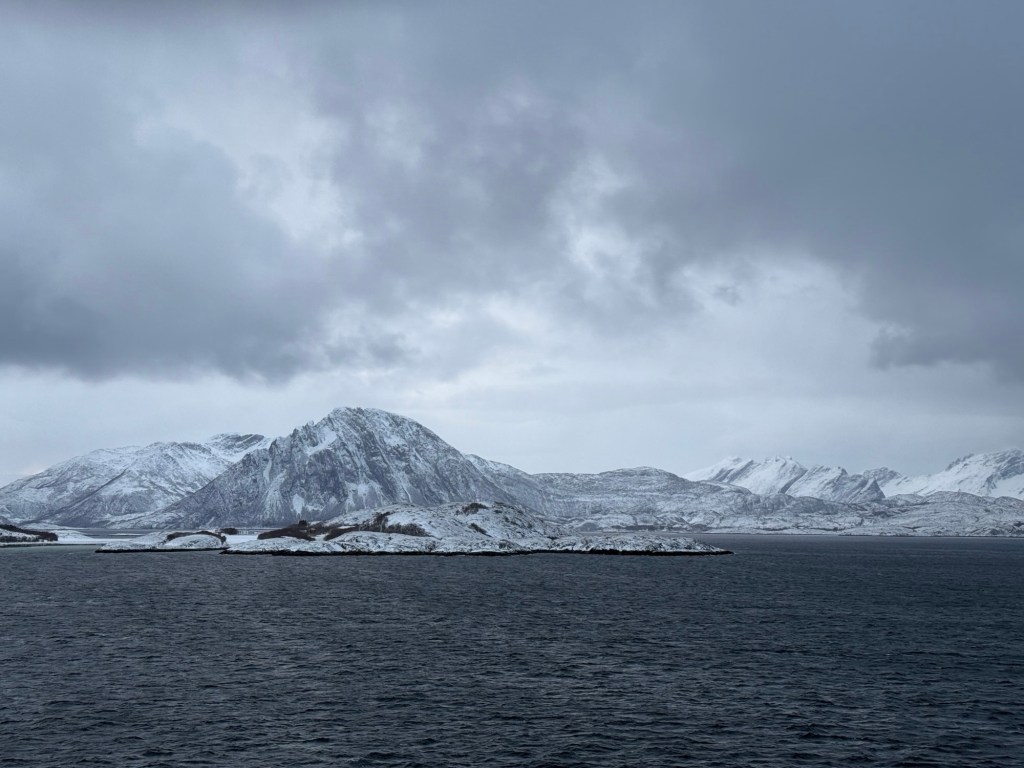
Not long after the Blue Nose event we returned to the Inside Passage route, have made good time and we were going to be a few hours early in Alta.
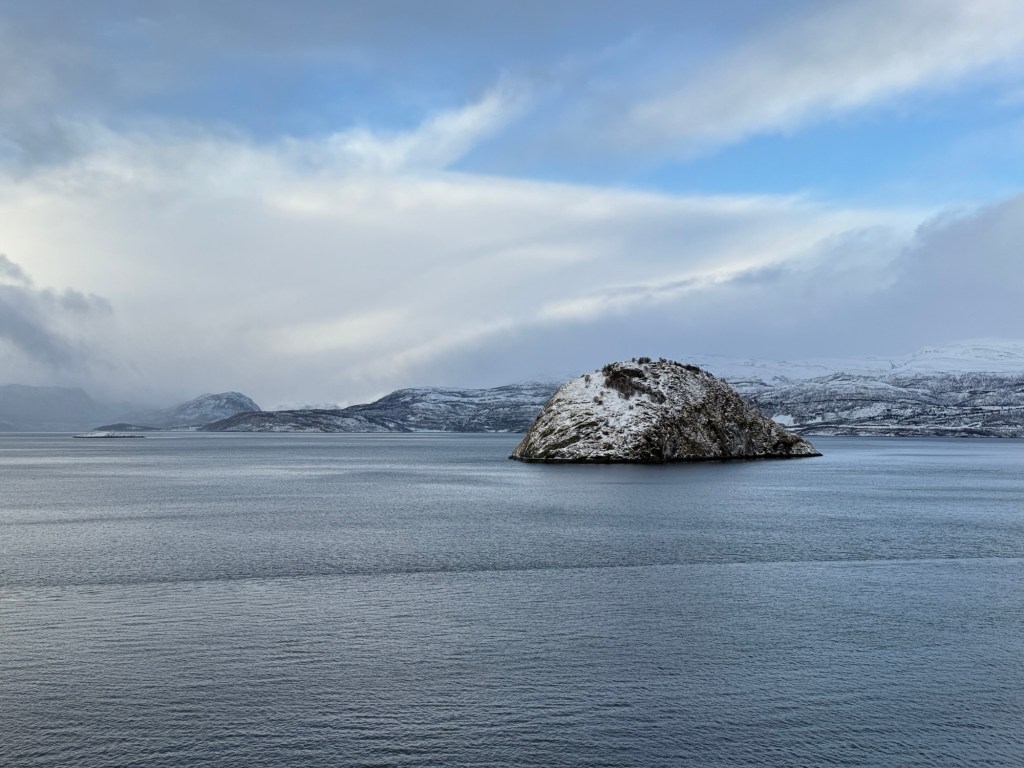
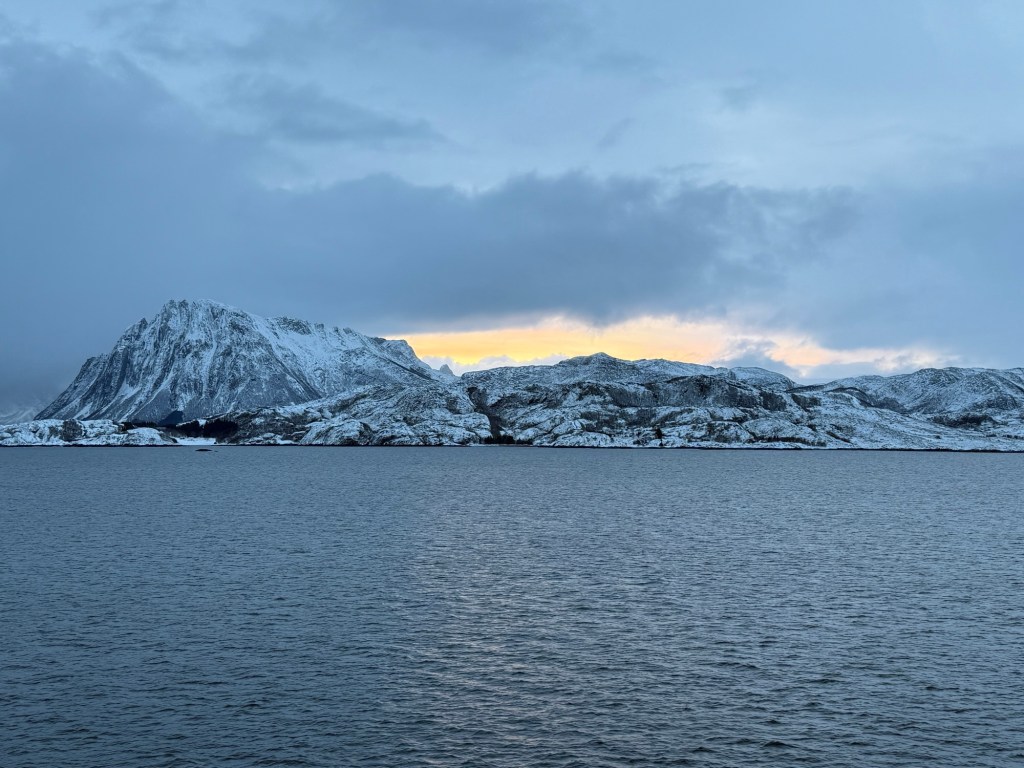
Some great scenery along the way. Allthego had expected it to be a bit less winterish as we were into Spring. But apparently, winter can go on through March. There has been less snow this year and some late rains.
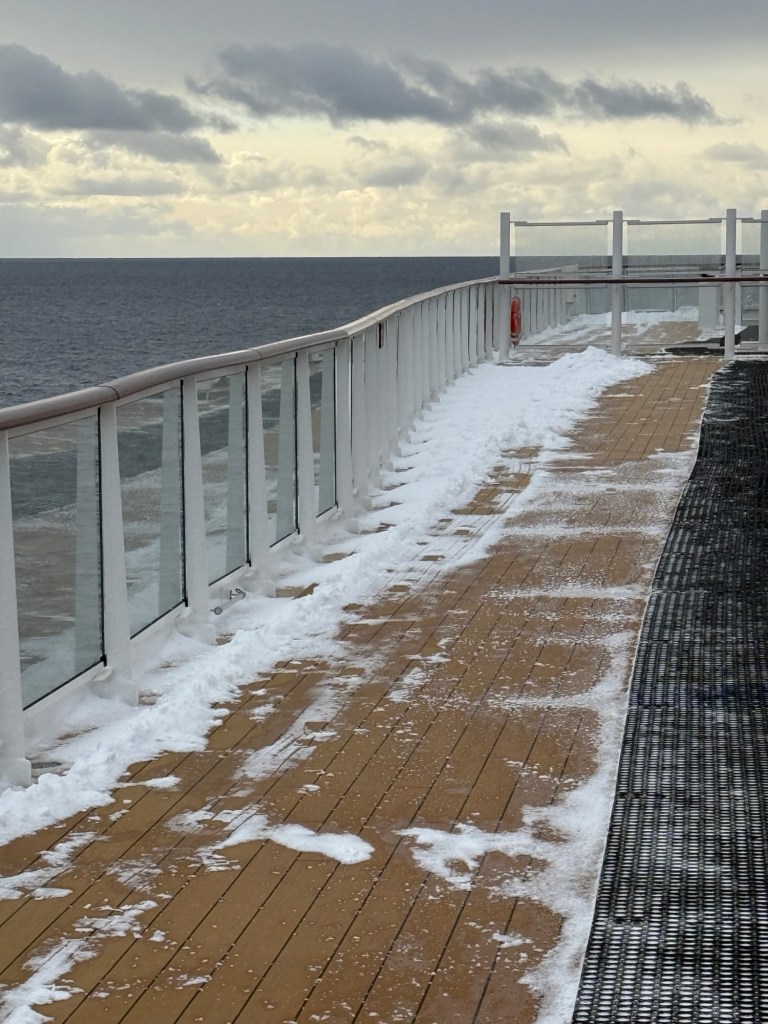
So we have snow and ice on the sun deck and across our balcony, temperatures are sub zero and barely getting to 5 or 6 during the day. Still it is ‘nice’ and a bit sunny from time to time, no need for sunblock.

We get into Alta a bit after 9 am, sun and blue sky greet us. Looks to be a good day ahead!
Bergen
Bergen is Norway’s second largest city after Oslo, the greater Bergen area has about 400,000 people. Just on 300,000 of them live in or around the city, clinging to the shore land and a little way up the mountainside. The old town was founded around 1100, so it is not an old Viking town, post dating the viking era.
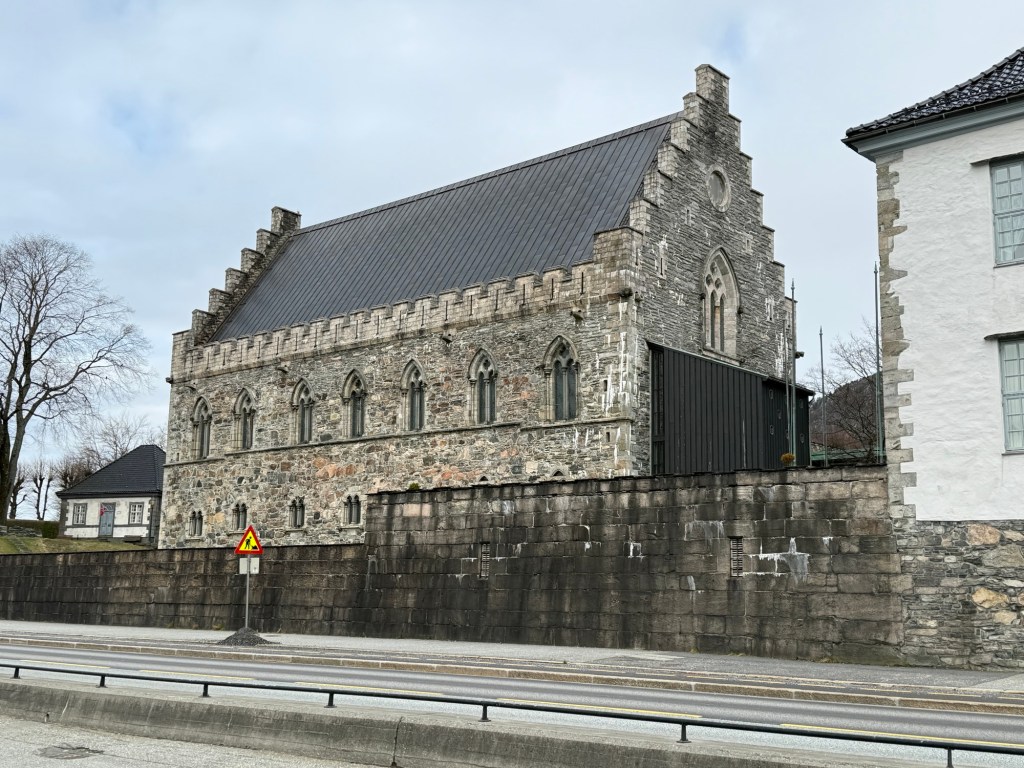
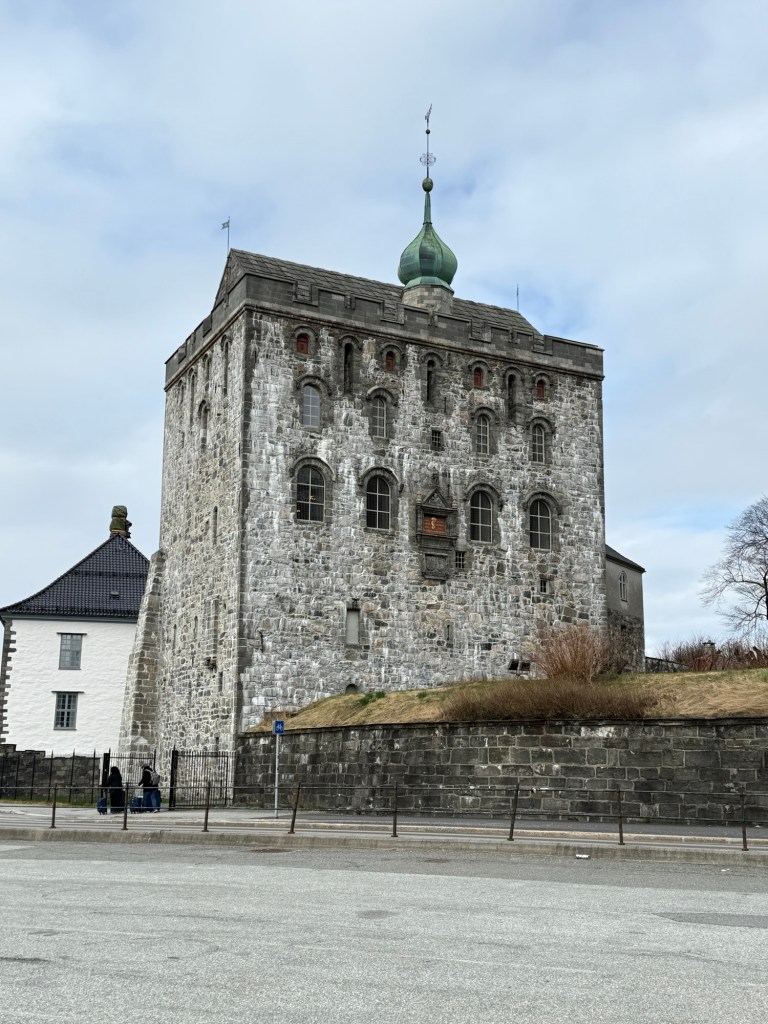
The town had its origins in 1070 when it was founded by King Olav. He was the son of the Viking leader who was defeated by the Anglo Saxons at Stamford Bridge in 1066. This was just a few months before the Normans (who are of old viking stock) invaded England and defeated the English at the Battle of Hastings. Enough English history!
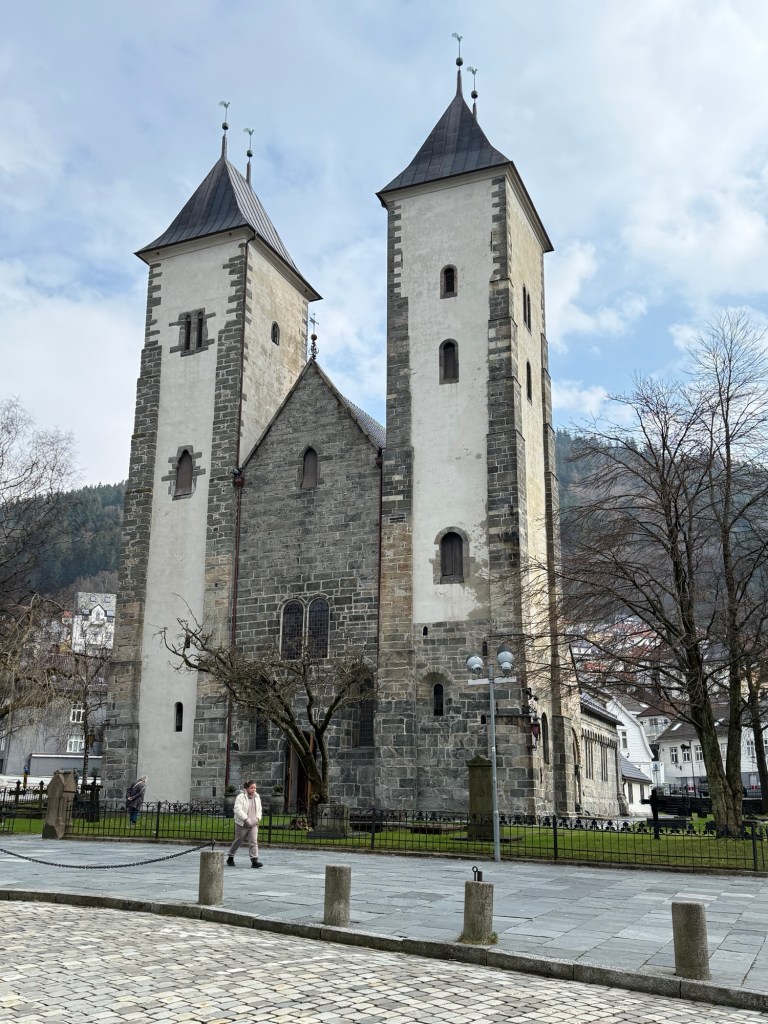
St Mary’s is the oldest building in Bergen, formally a Catholic Church it is now Lutheran. The Anglicans are let in these days, probably pay a premium.
From the 1400s it became an important trade centre for dried cod.The trade being controlled by German merchants for several centuries.
We are here for three days before leaving on the cruise aboard Viking Vela up the Norway coast as far as Alta. We plan to take it easy.
One of the prominent features of Bergen is its wooden houses. The wooden houses and fire we were told is one of the prime architectural drivers of the city. There have been a lot of fires over the last thousand years. Many destroying large swathes of the city scape, by necessity buildings were replaced by more wooden ones. Not a lot of stone available for house building. Only the wealthy and important could do it in stone.
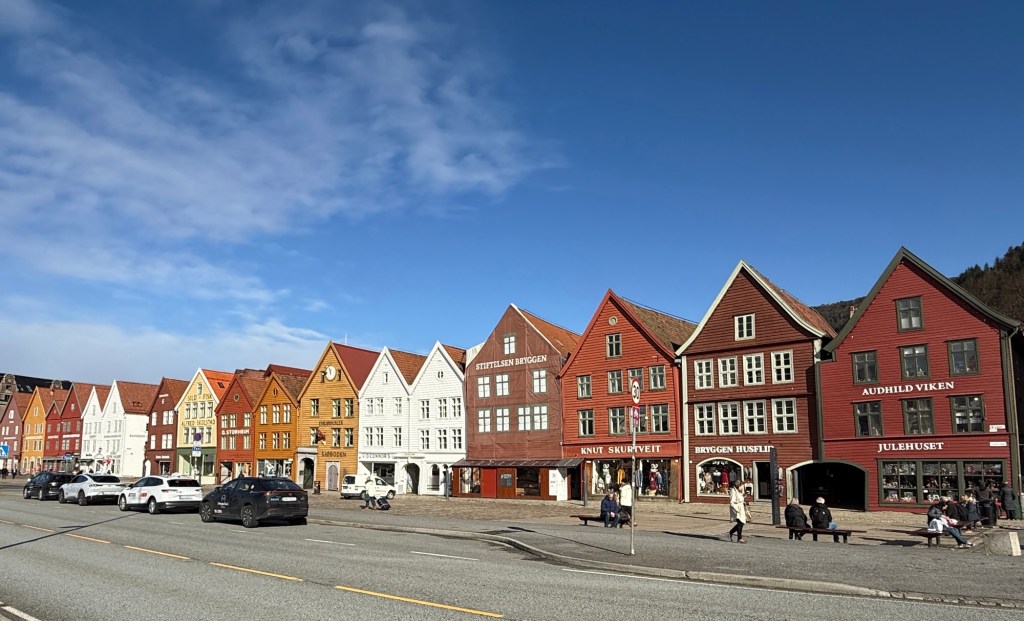
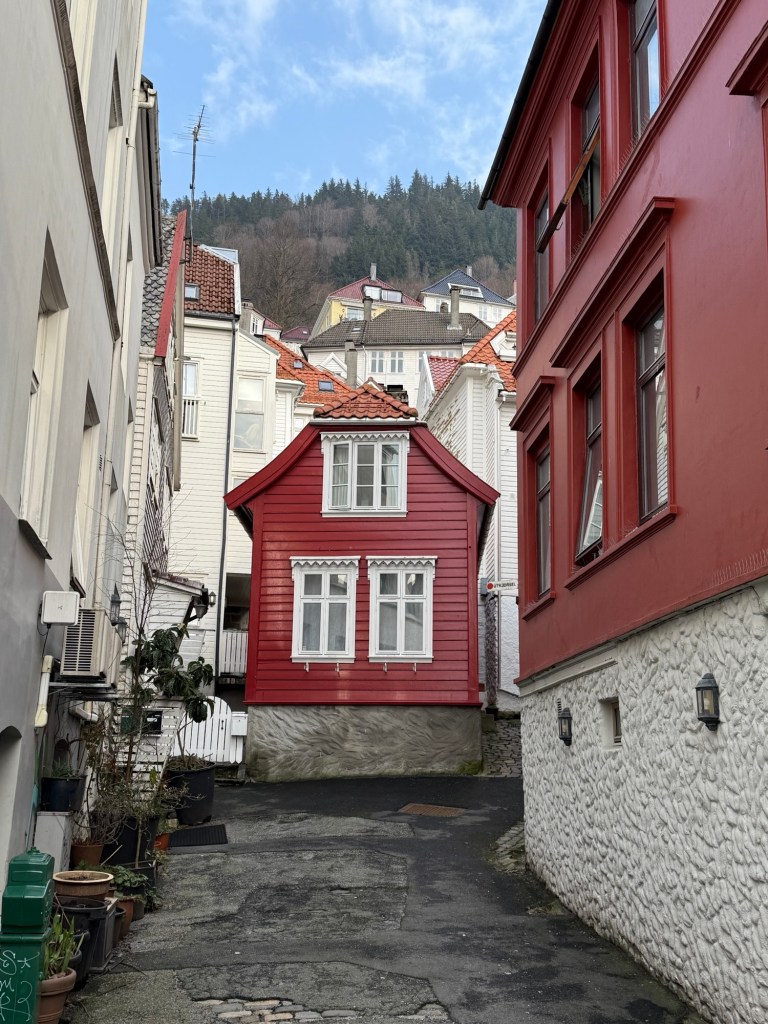
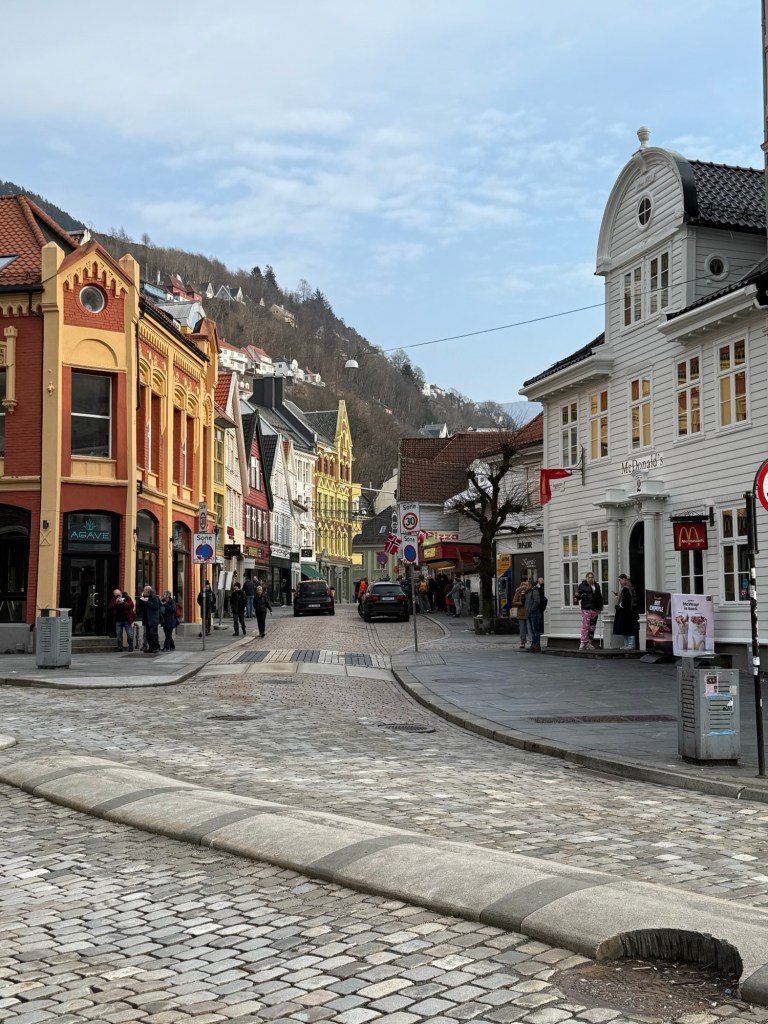
We had several strolls around the old port area. Lots of cobbled footpaths and roads. The residents though don’t seem to have garbage bins like us. The streets are narrow and large dumpster type bins are dropped here and there for people to throw their refuse in. It makes for a rather messy neighbourhood.
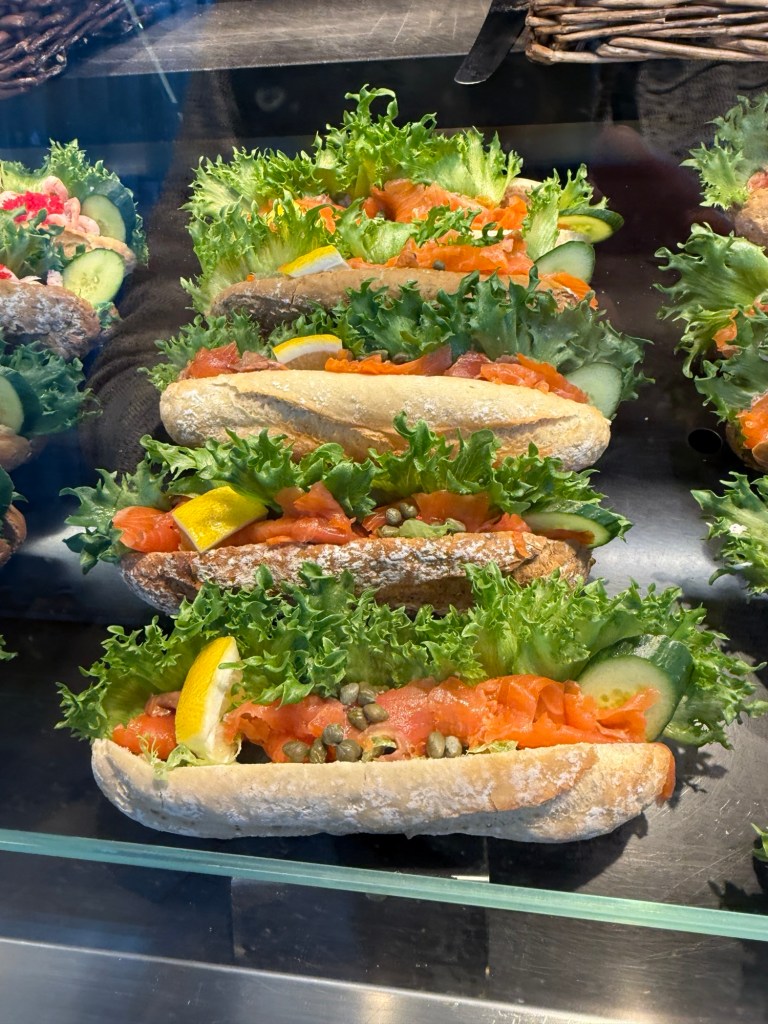
The Fish Market is a must stop off point to see the great array of fresh local product available to the residents. Some less than appetising items were on display, plenty of crabs of all shapes and sizes.
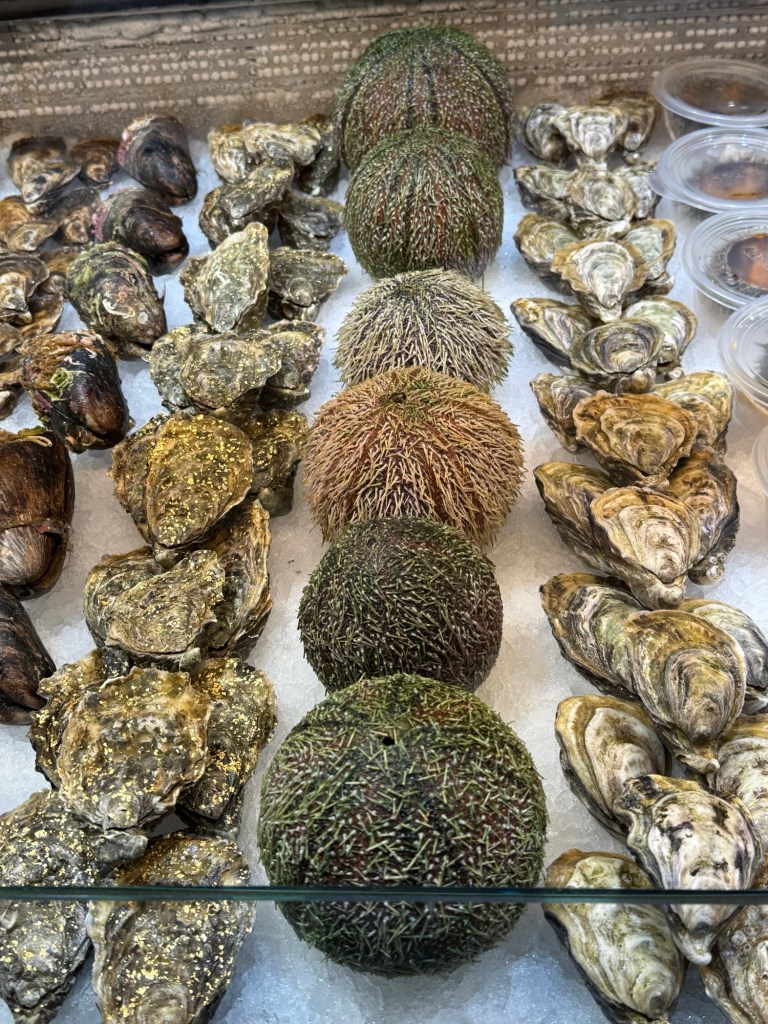
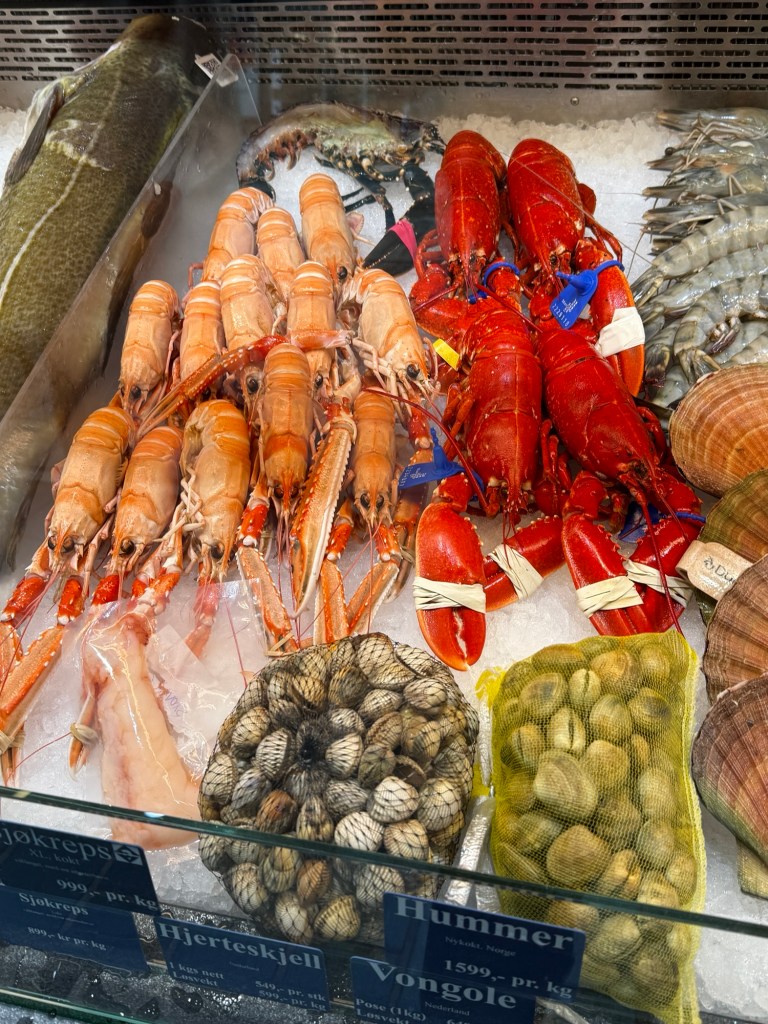
Bergen is also famous for its weather and is the rainiest city in Europe. Two in every three days have rain, we have been lucky as two of our three days have been sunny.
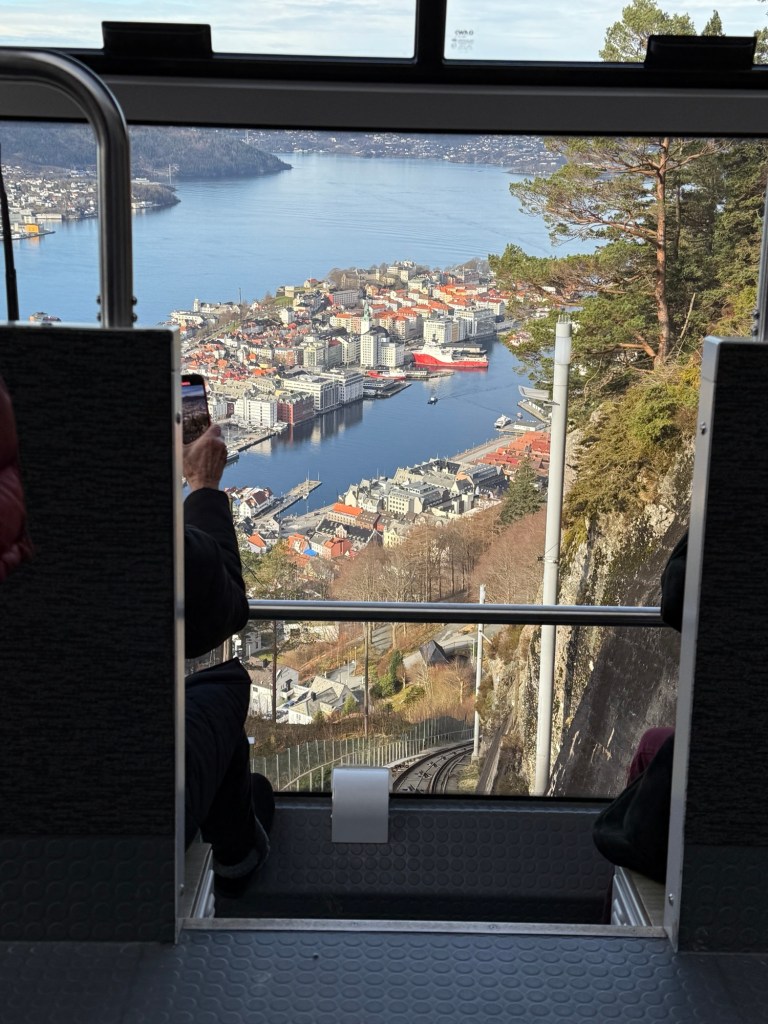
Allthego has been waiting for some clear skies to ride the Funicular up Mt Floyen, one of the seven mountains that lie behind Bergen.
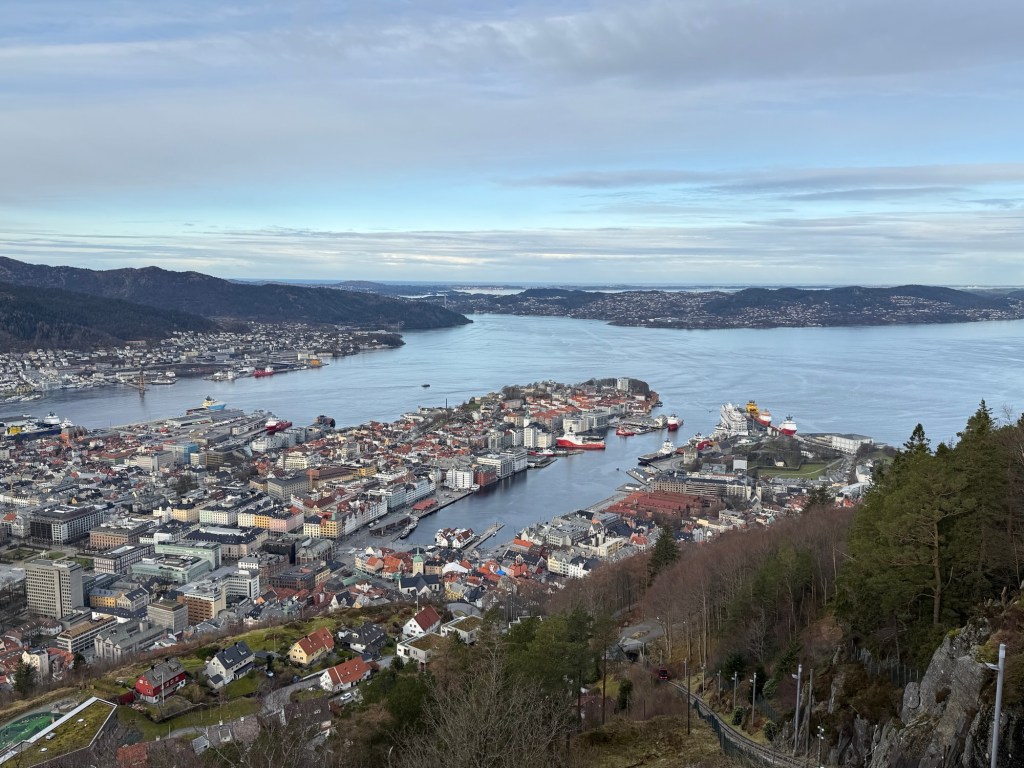
Some great views from the top. Homealone did not join him, a rather steep ascent in glass windowed cars allowed great views as we ascended and descended the track.
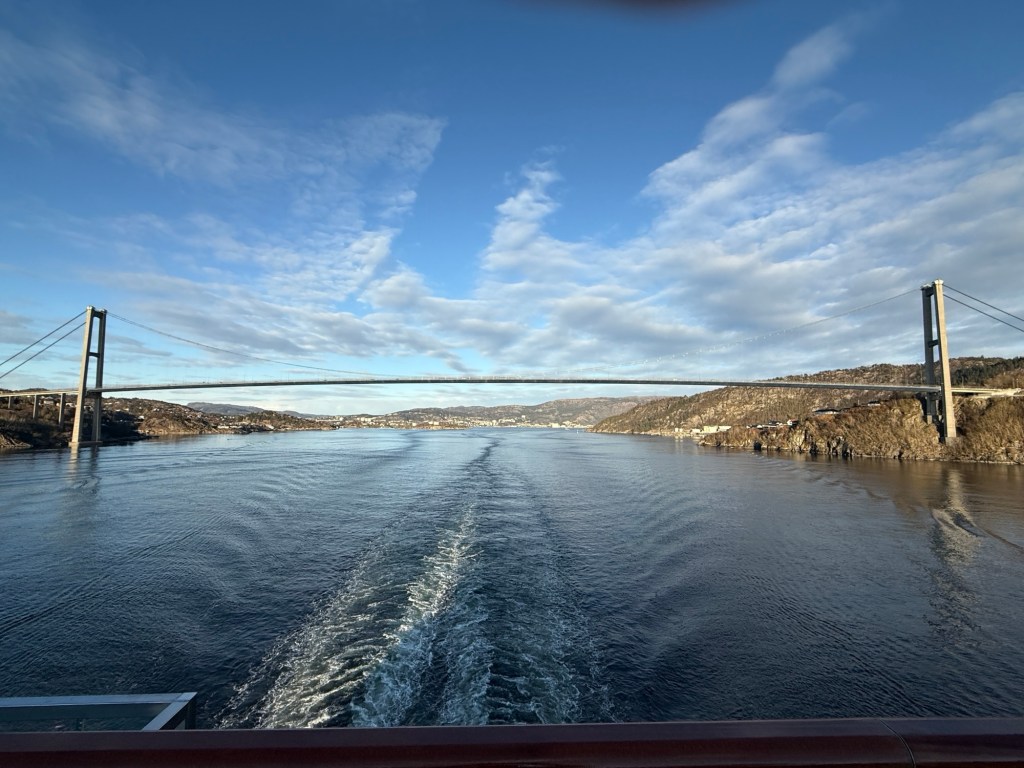
We had a night in Bergen aboard the Viking Vela before leaving the port late in the day and headed up the coast. It was a bit chilly, but not as cold as it would be in Alta.
Fram to Bergen from Flam
Back in Oslo we had spent some time in the Fram Museum. Allthego just recalled after having been advised by Homealone that ‘Fram’ means ‘forward’. So, we are now ‘Fram to Bergen from Flam’. Has a nice ring to it!
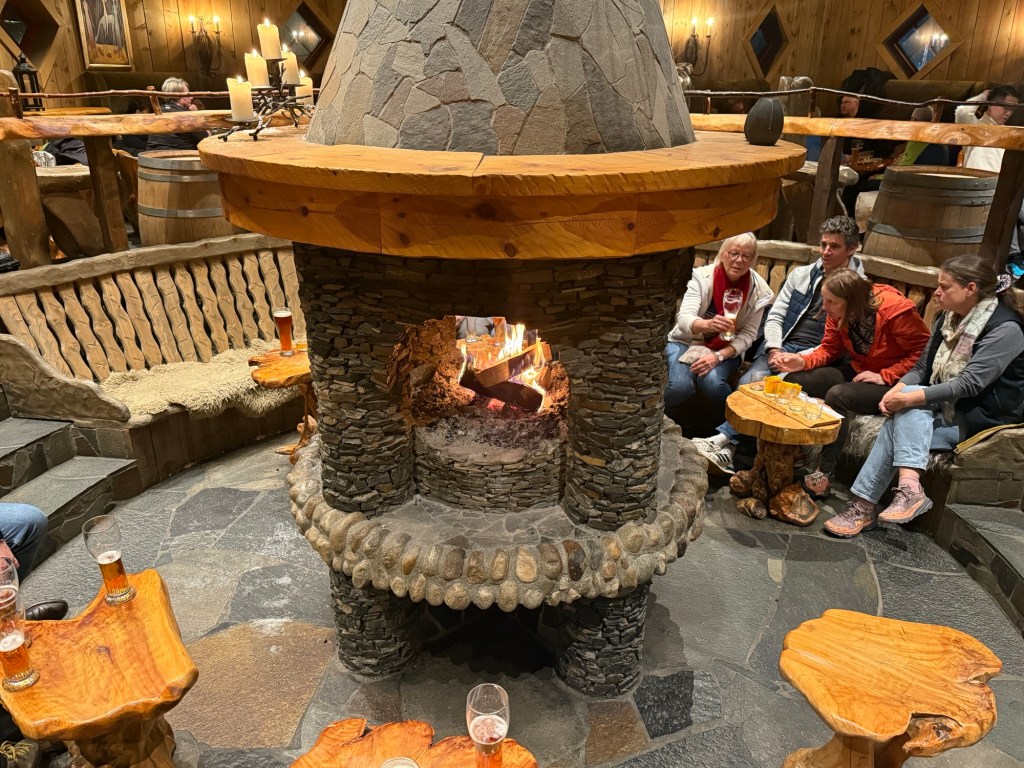
We spent the next day in Flam holed up somewhat in our room. Weather not great, scatty rain and chilly. In between we had a wander in the town shops, not that there are many! The train museum was closed, it is being ‘reimagined’ and restocked for the upcoming busy season. Nice little bakery provided lunch for us. We enjoyed dinner in the Flamsbrygga artisan brewery.
Little disappointed that we couldn’t get out and about the near parts of the Flam Valley for a closer look.
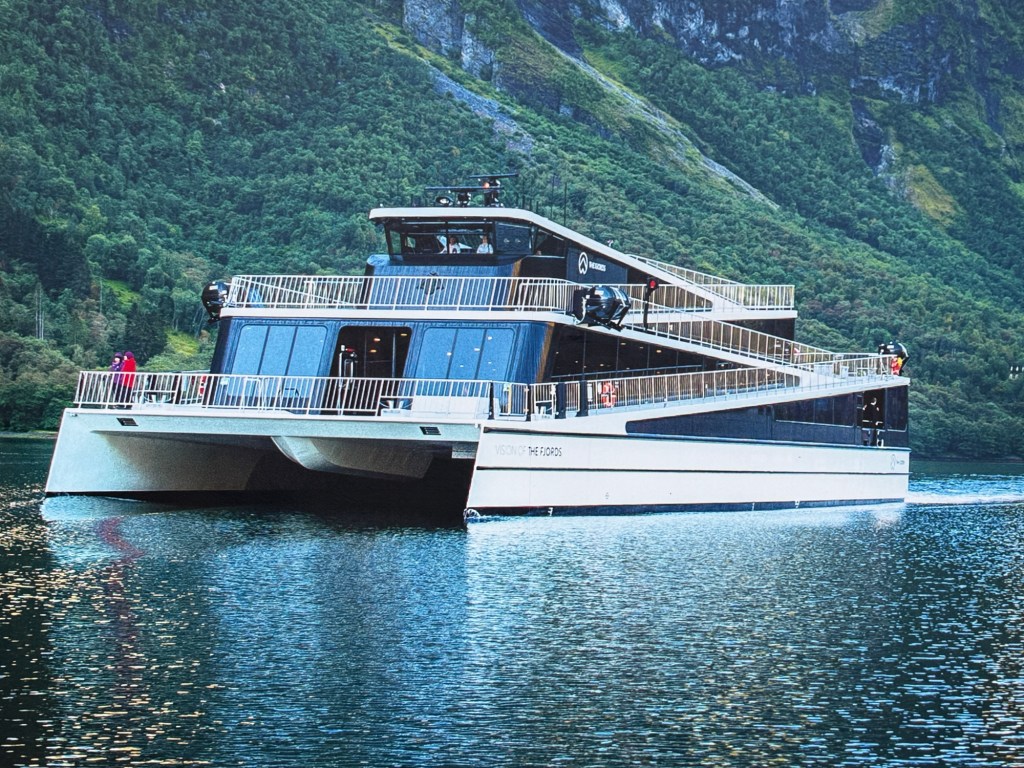
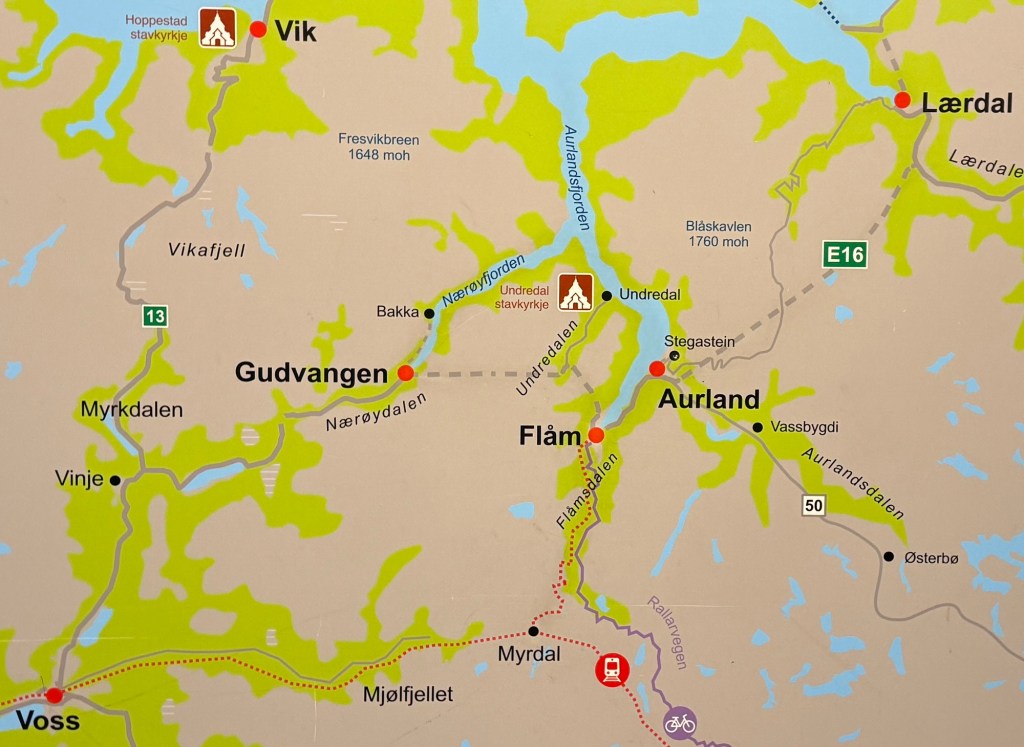
Next morning we had to be ready at 9.30am for the next stage of the journey. This being a ferry ride along the fjord to Gudvagen, which is up around a corner into another branch of the Sognefjord, the Naeroyfjord.
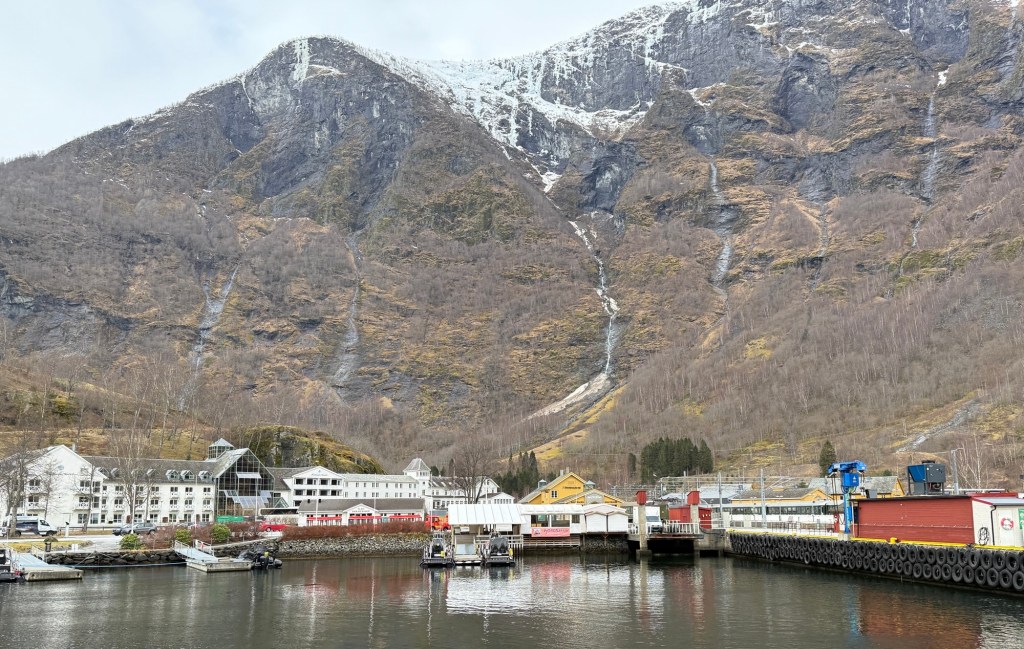
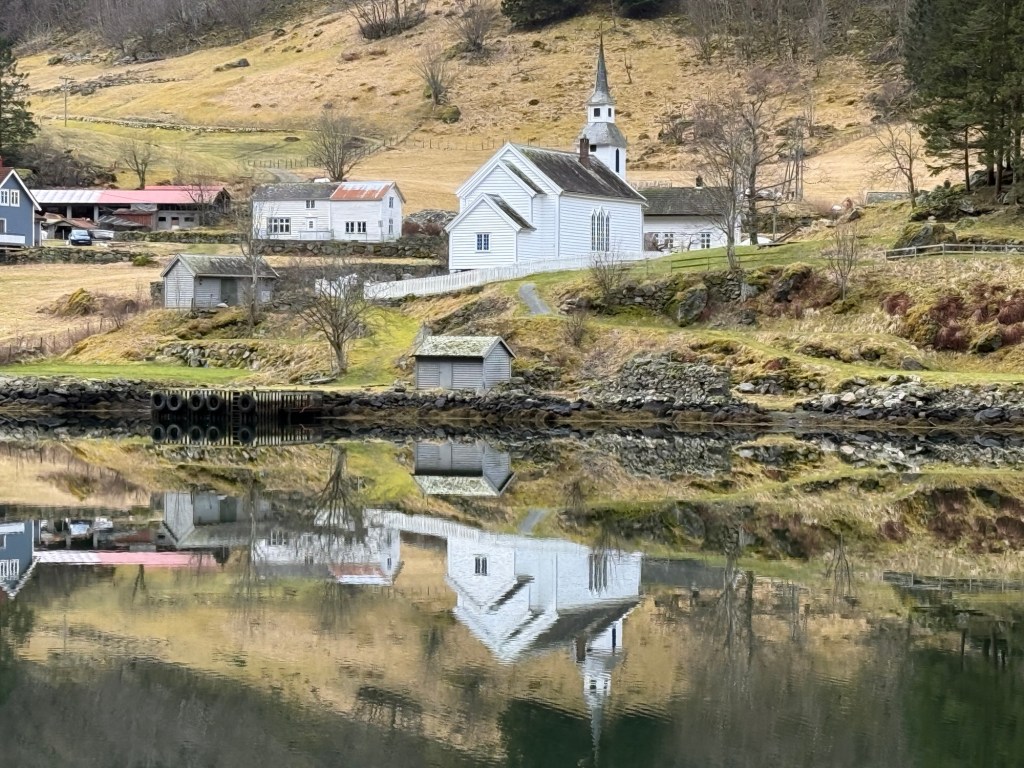
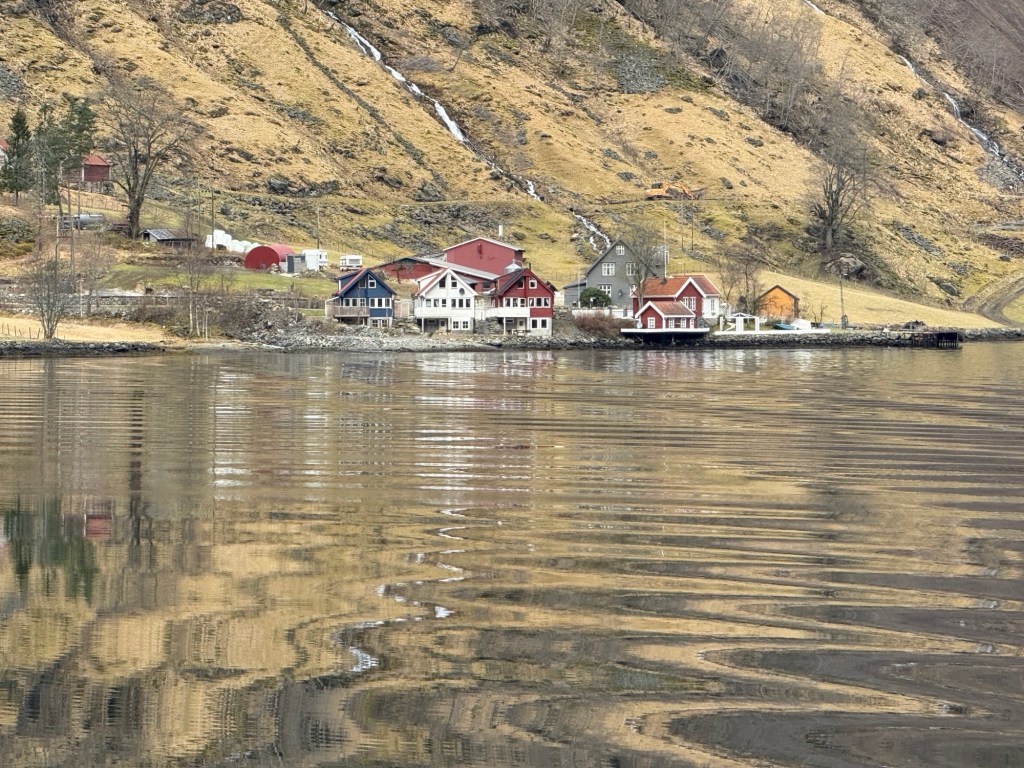
This was a wonderful two hour trip on an electric ferry (‘Future of the Fjords’) that holds 400 people, we probably had only 150 for this trip. Plenty of room and silent, except when side thrusters went on. Big racket! The map below shows the trip from Flam.
The vessel is fairly advanced and a full battery charge will take it 40km. Not far, just far enough for us! Might need to do some more work on the distance for a full charge!
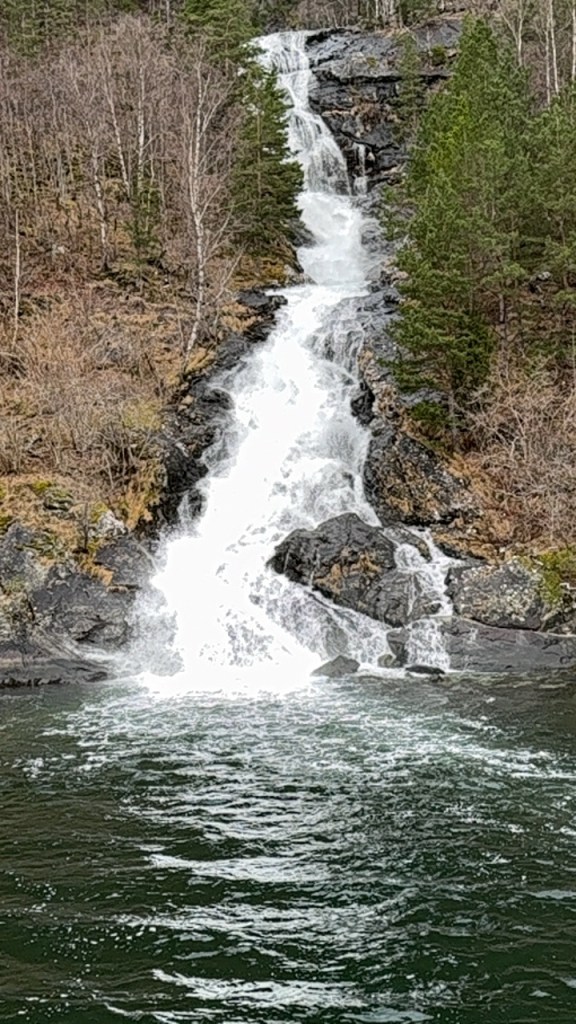
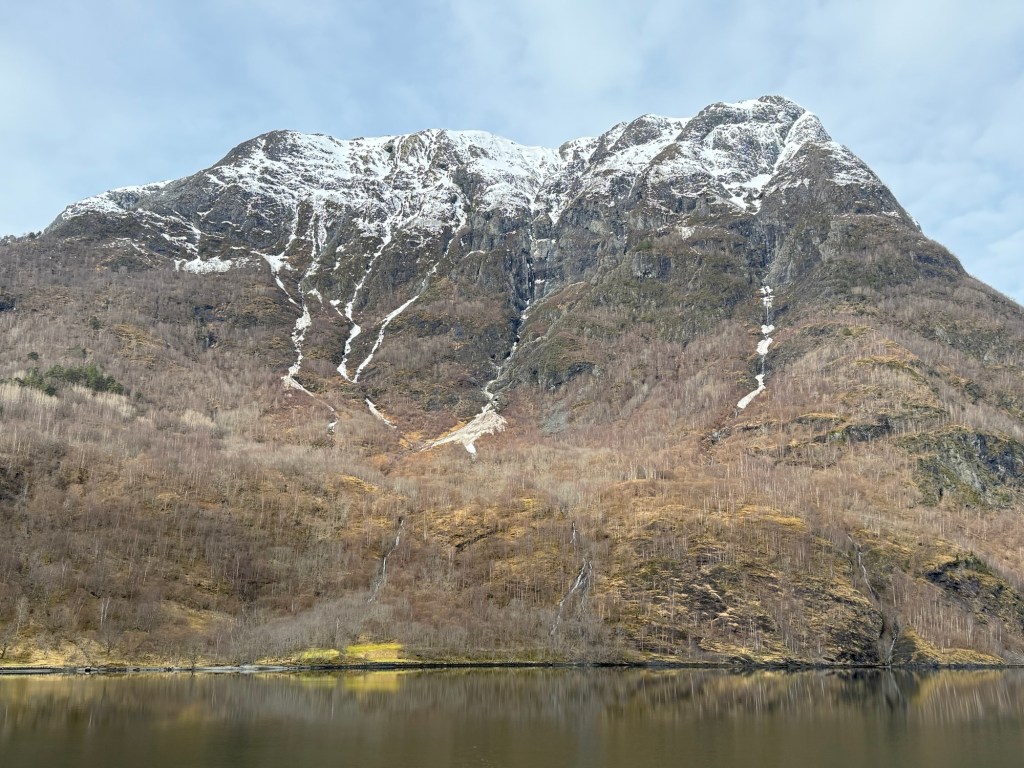
After disembarking at Gudvagen we only had a few minutes to board the bus that would take us up the mountains to Voss. A rather steep drive in places and a couple of long tunnels.
On the road to Voss we followed the course of the Vosser River (got to check that name) that feeds a couple of large lakes. The river is quite unpredictable, in parts very narrow and filled with rapids in other areas it widens out and is quite peaceful. After passing through the lakes and Voss it flows down into a fjord.
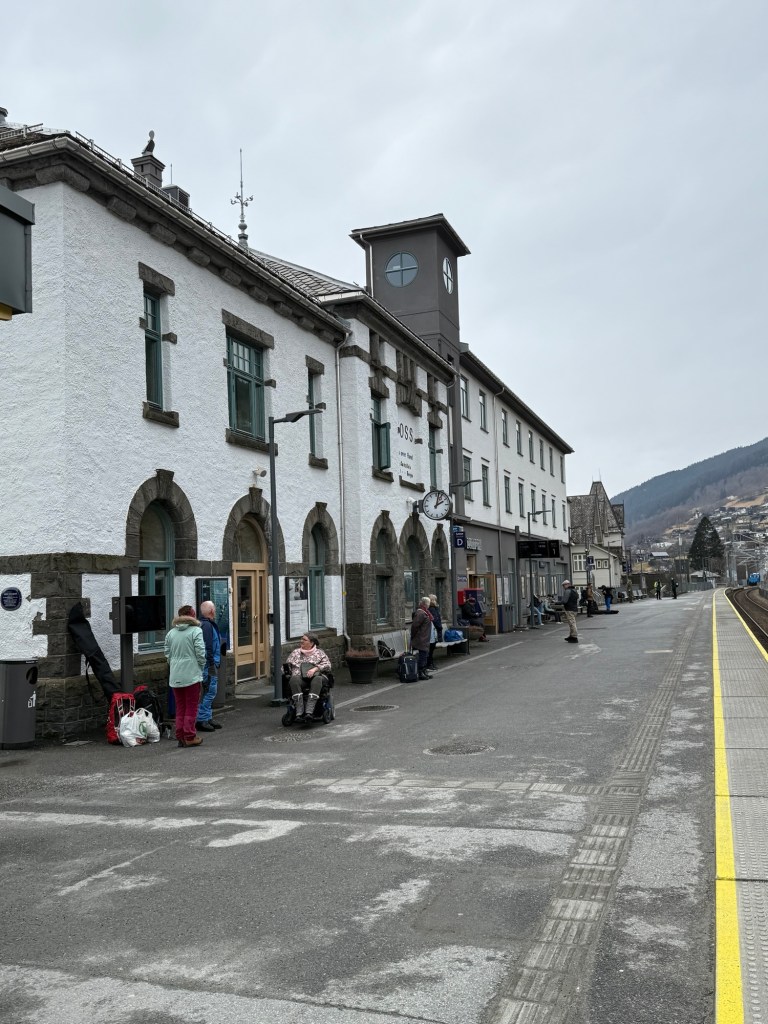
At Voss we have an hour to fill in before the train to Bergen arrives. The Voss gondola leaves from the station and it was tempting to take a ride up….. Homealone reluctant (probably a good idea) so we sat and waited for the train. Along it came, no booked seats this time. We did get a good window seat though, the river continued to be the main attraction. The train got along at a fast pace, so photos didn’t work. Eventually, we pulled into Bergen Railway Station.
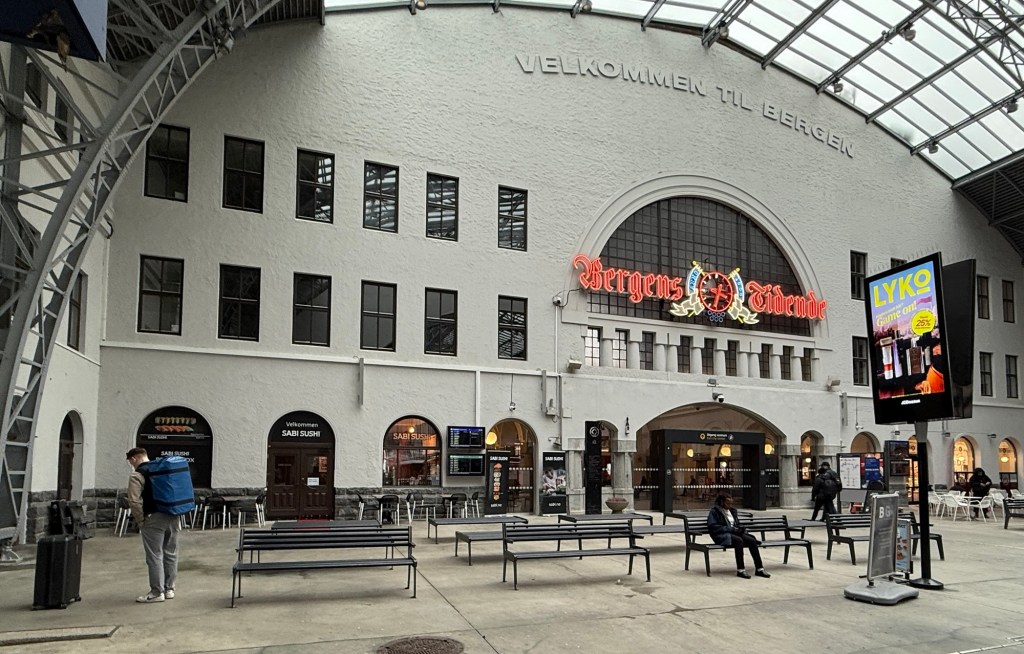
This is where the fun started. Allthego had the hotels name but no idea where it was, the one place we didn’t have directions for of course. And it was drizzling a bit too. After a bit of aimless wandering directions were sought. This happened several times and each time we seemed to get a little closer to the target, albeit going backwards and forwards a bit. At last a young lady suggested we get a tram for a couple of blocks and then catch a bus for another few blocks and lo we would be there! But alas no, the right brand of hotel but not our particular one, which we were told we had passed a block or so back but up the hill in another street. So it was!
We are now in Bergen for three nights before the cruise sets sail.
Oslo to Bergen
We are now starting the overland trip from Oslo to Bergen. Along the way we are stopping for two nights at Flam to break the trip up. Many do it all in a day as the ‘Norway in a Nutshell’ journey. Generally, you might do that in the summer months when the days are longer. But everyone does it then and there are a lot of people looking for seats on trains, ferries and buses. Bit of a mad rush too we think.
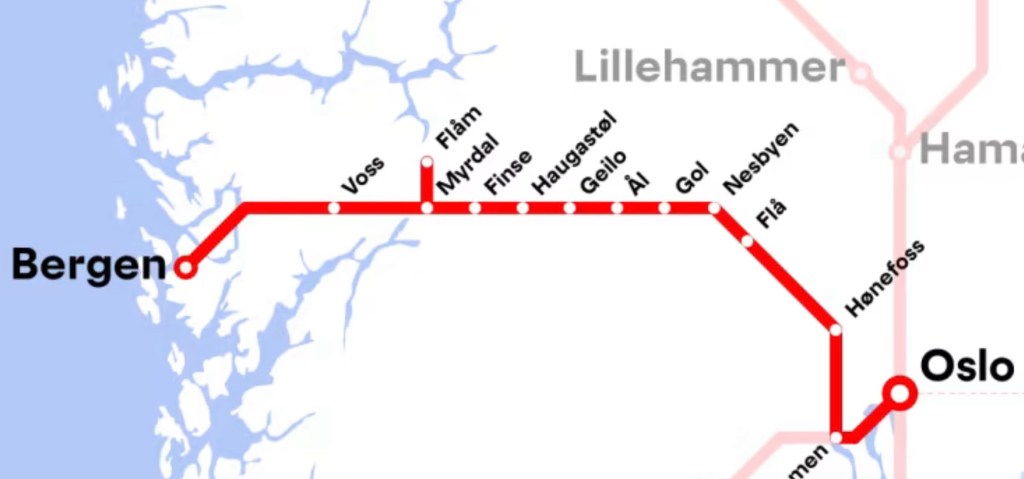
Of course one of the advantages of ‘Norway in a Nutshell’ is that someone buys all the train, bus and ferry tickets for you! But at a very big premium price. Allthego is a bit stubborn when it comes to price. So he hit the internet before leaving Aus and mapped out the itinerary and bought the tickets. Got the dates and times all lined up ok as well. Big saving, can recommend it. Of course we are at the end of winter and it was all pretty easy with availability. Maybe different in summer.
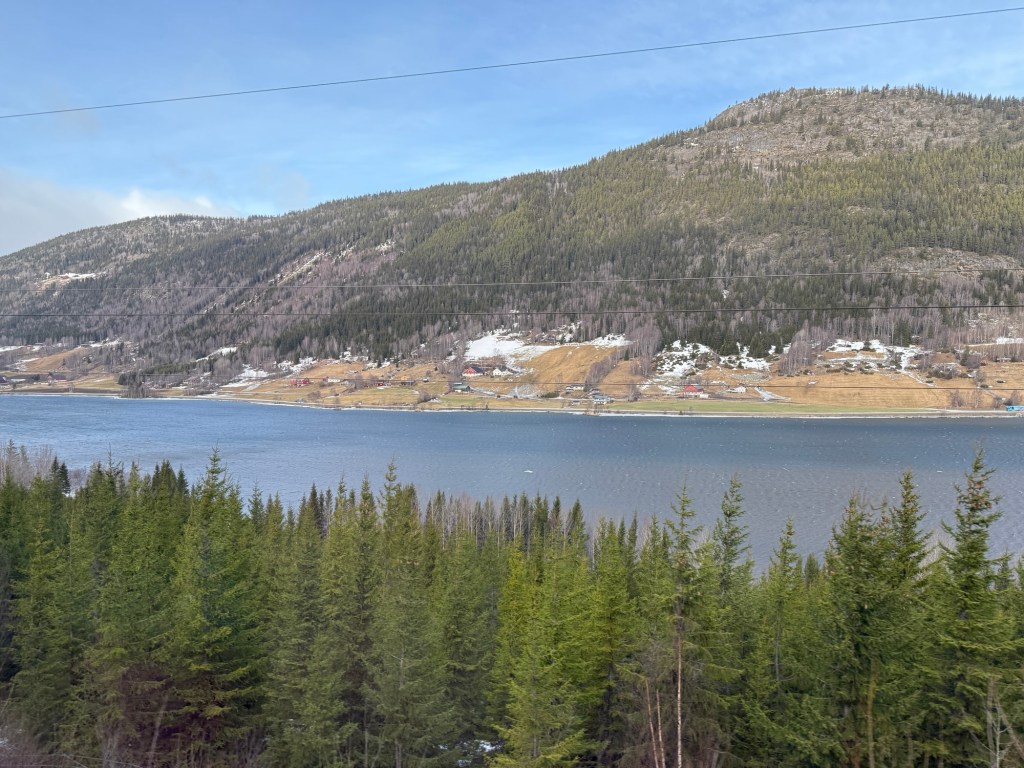
At the appointed hour of 6.25am our train from Oslo departed the station. As planned we were aboard!Fortunately, it was only a 10 min stroll from the hotel to the platform with our overnight bags. The main bags had been taken direct to Bergen by a porter service. Saved a lot of bag hassles. A bit of sun and blue sky to start but it all clouded up as we headed higher into the mountains.
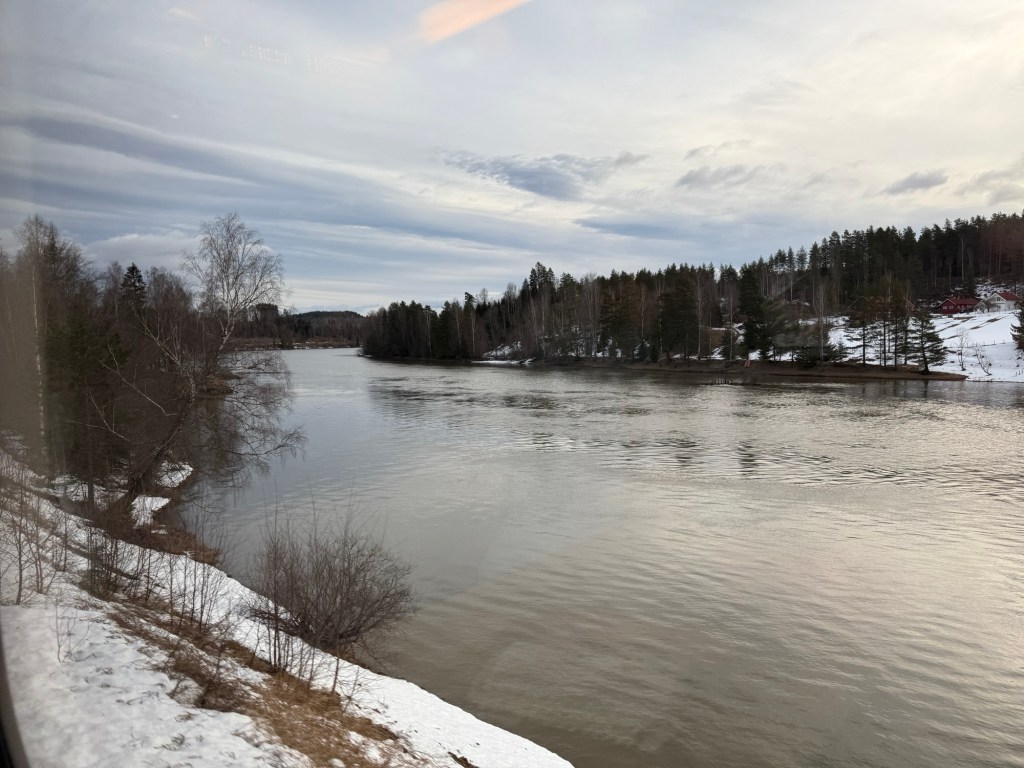
This section of the trip takes us to Myrdal and arrives at 11.15am, a four and three quarter hour trip through the countryside. Myrdal is 866 metres above sea level (Oslo) so it is a steady upward journey, some great scenery and snowy landscapes.
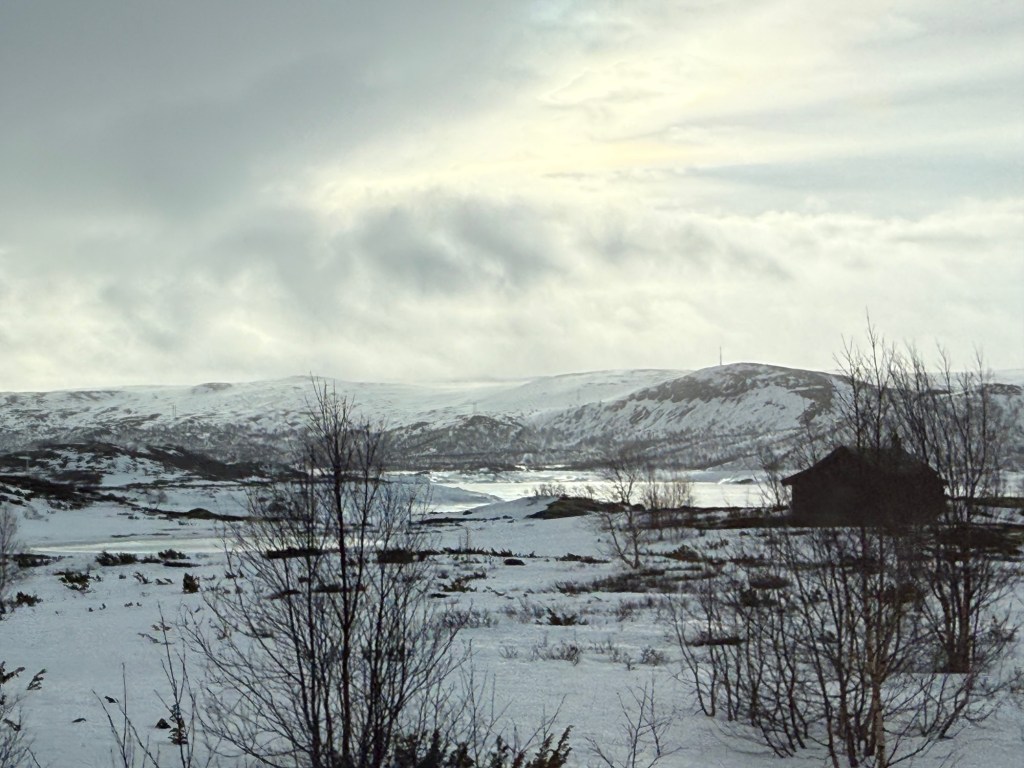
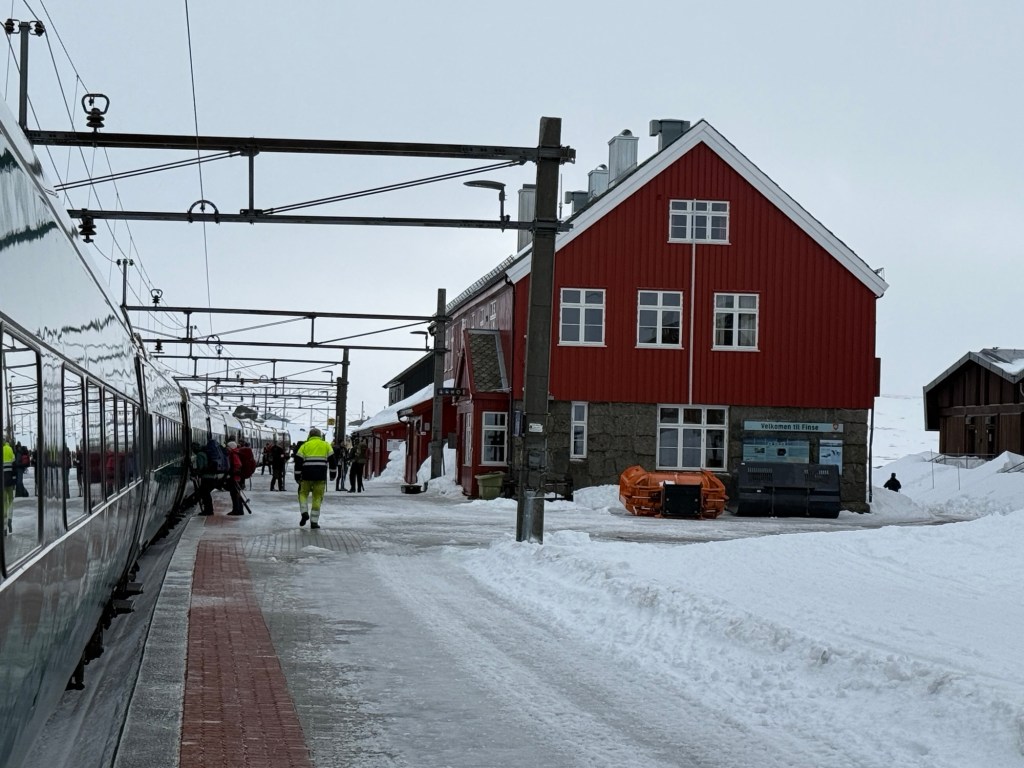
The highest point on the line is at Finse which is 1,222 metres above sea level. Finse is actually the highest railway station in northern Europe, it is really a ski resort. So the line rises and falls along the way.
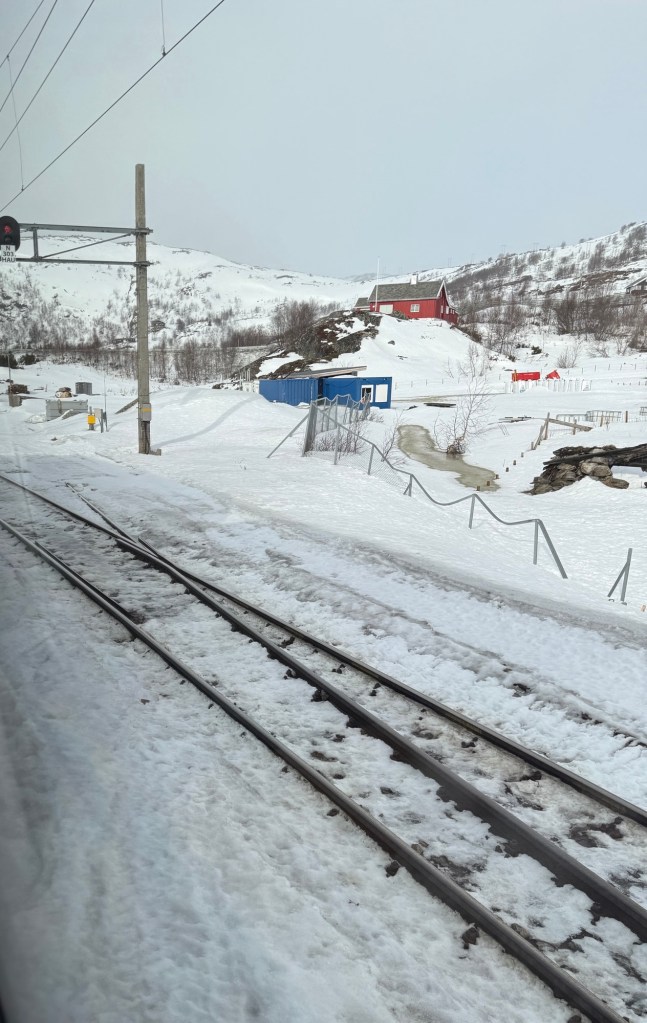
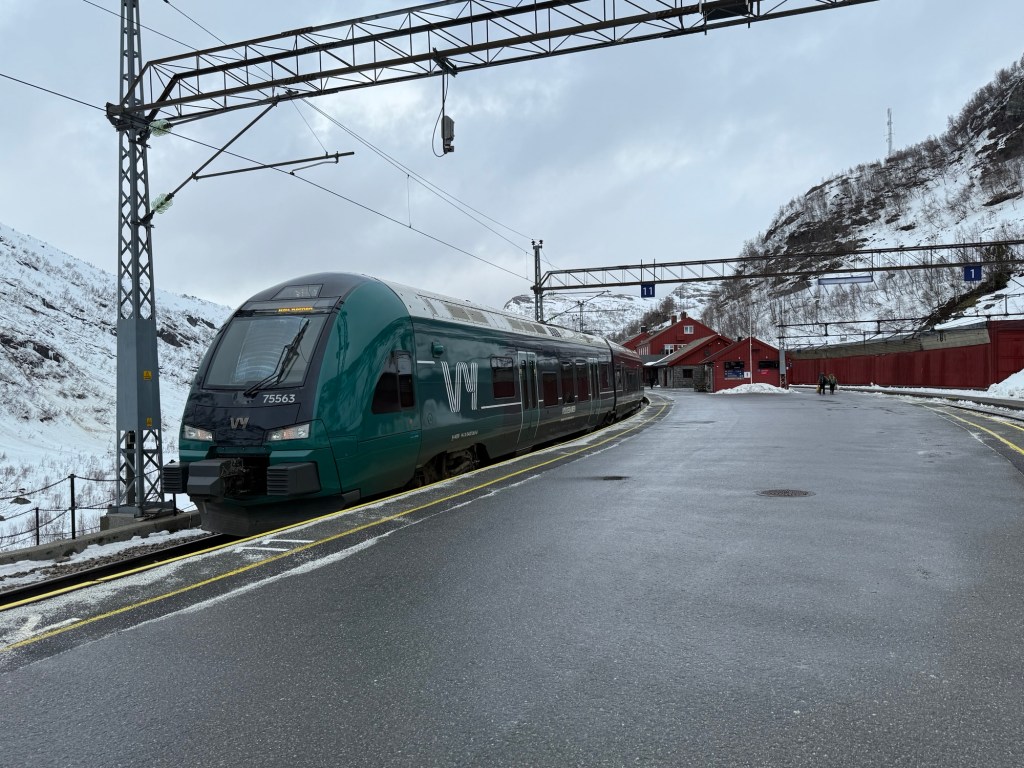
Myrdal is where we got off the train, it would continue along the main line to Bergen. We had a two hour stop over here awaiting the train to Flam on a different line. The train is called the ‘Flamsbana’. The train journey from Myrdal down to Flam on the Auriandsfjorden (I’ll call it ‘A’ next time) and has been included in a list of the ten great train journeys in the world. ‘A’ is a branch of Norway’s longest Fjord, the Sognefjord.
This is where we had to get out our tickets for the Flam train trip and show them to the conductress who strolled through the cabin calling out ‘tickets’. Just prior to this Allthego had checked the tickets and found out that the Brown home computer had put the wrong date on them! Sunday 16th February, not Thursday 6th March. This was a potential problem. A bit of talking got us through ok, no drama, might have been different if the train had been full of bodies. It was only about a third full for the trip. Just got to triple check dates in future not just the times!
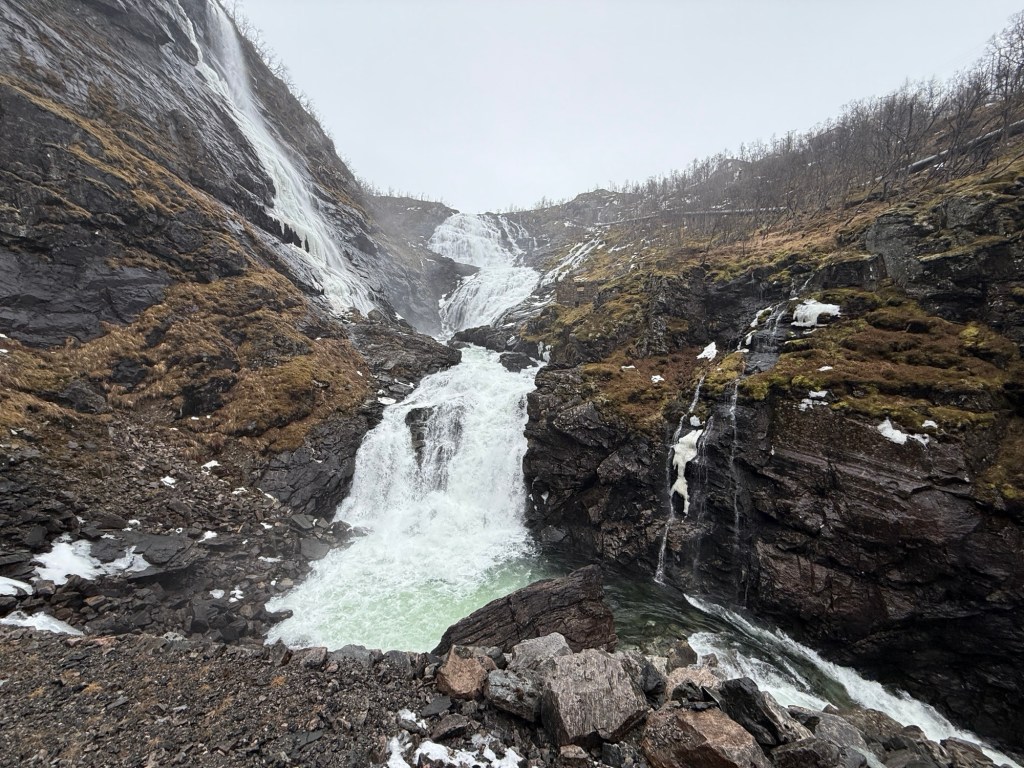
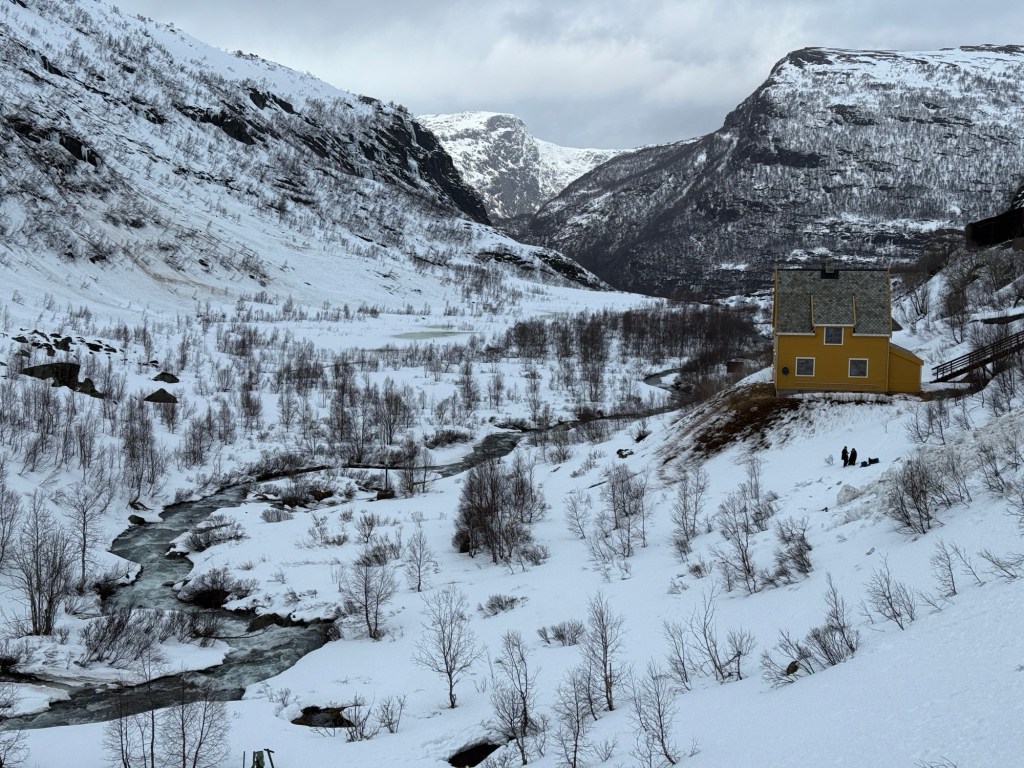
It takes 45 minutes for the train to descend 866 metres over approximately 20 km.
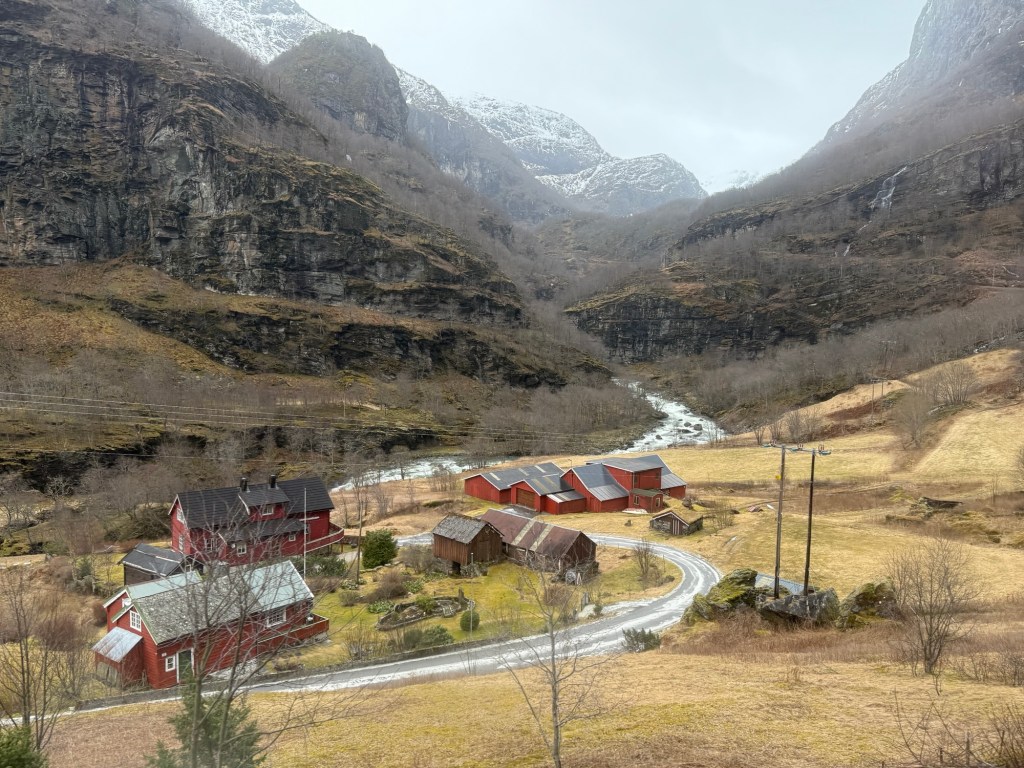
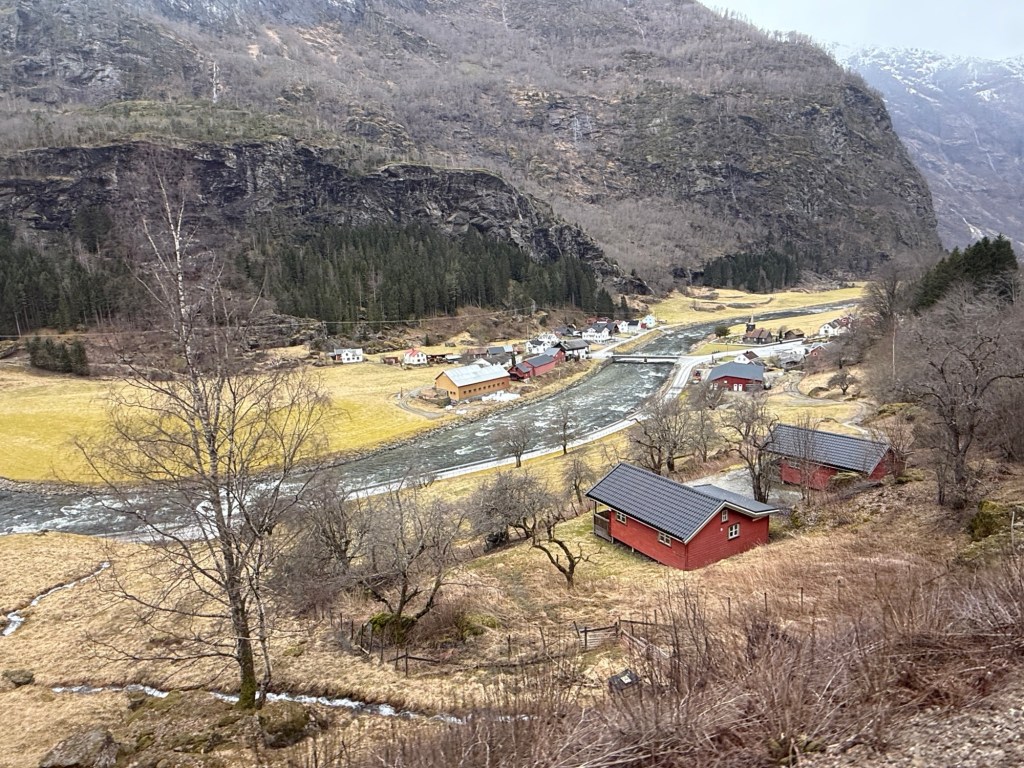
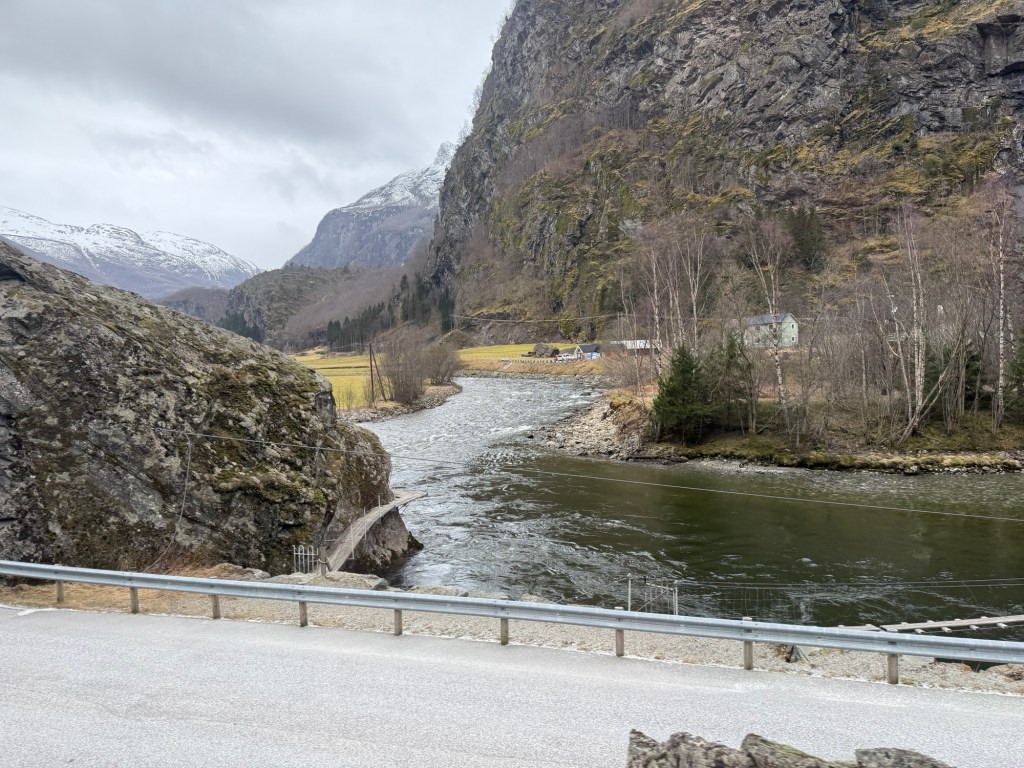
We passed through upwards of 20 tunnels, some corkscrew ones, that were built in the 1920s. A great scenic trip with waterfalls through the Flam Valley, beside the river.
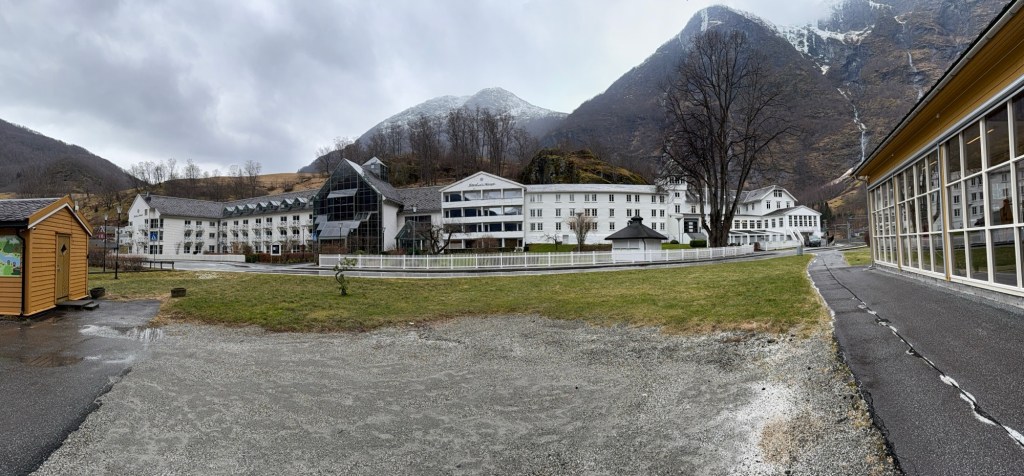
Arrived at the little township of Flam at 4pm and booked into the Fretheim Hotel for our 2 night stay and from where the story will pick up next time.
Oslo, going, going
Our last day in Oslo has reverted back to some sunshine and blue sky. Still a fair bit of cloud. We set off today for a group of three museums way out of town on the fjord shores. Have to catch a local bus to get there, it takes a while and a bit of walking to find the bus stop. Finally, we are on our way and it takes about thirty minutes through the suburbs.
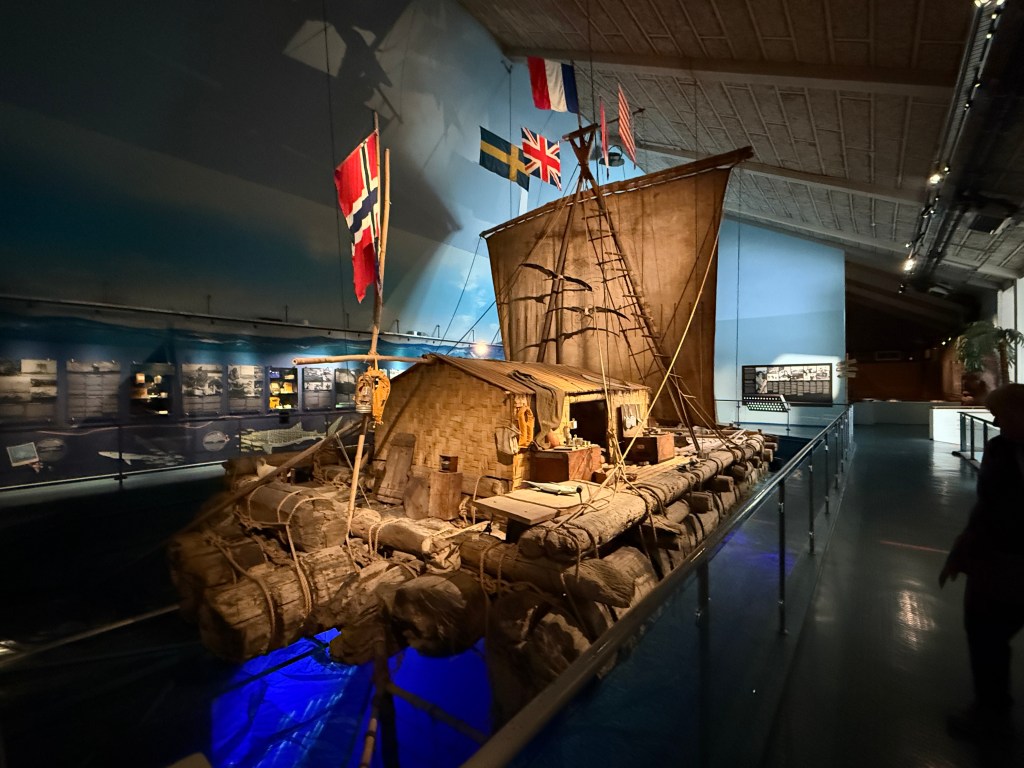
The first is the Kon Tiki museum that records the work of Thor Heyerdahl. He sought to prove that man could have sailed from South America to the Pacific Islands on rafts to establish civilisations of the same ilk as in South America. The success of the Kon Tiki journey certainly established that it could be done. Today, however, there seems to be evidence that the Polynesians came from the north east rather than South America, it is not proven though and doubts remain as to the source of the Pacific populations.
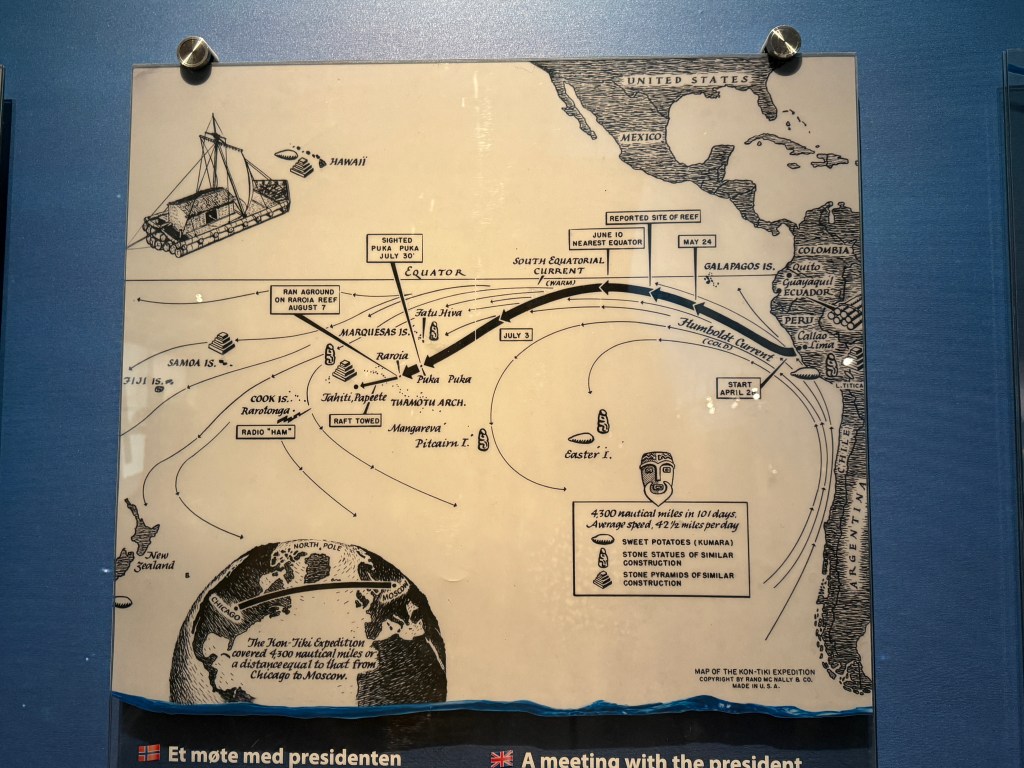
Later Heyerdahl did the same sort of trip on Ra across the Atlantic to prove that man could have sailed from southern Europe on rafts to introduce Egyptian ideas to the Mayan populations in South America. Again there is no conclusive proof. For all his work Thor Heyerdahl has his place in Norwegian history.
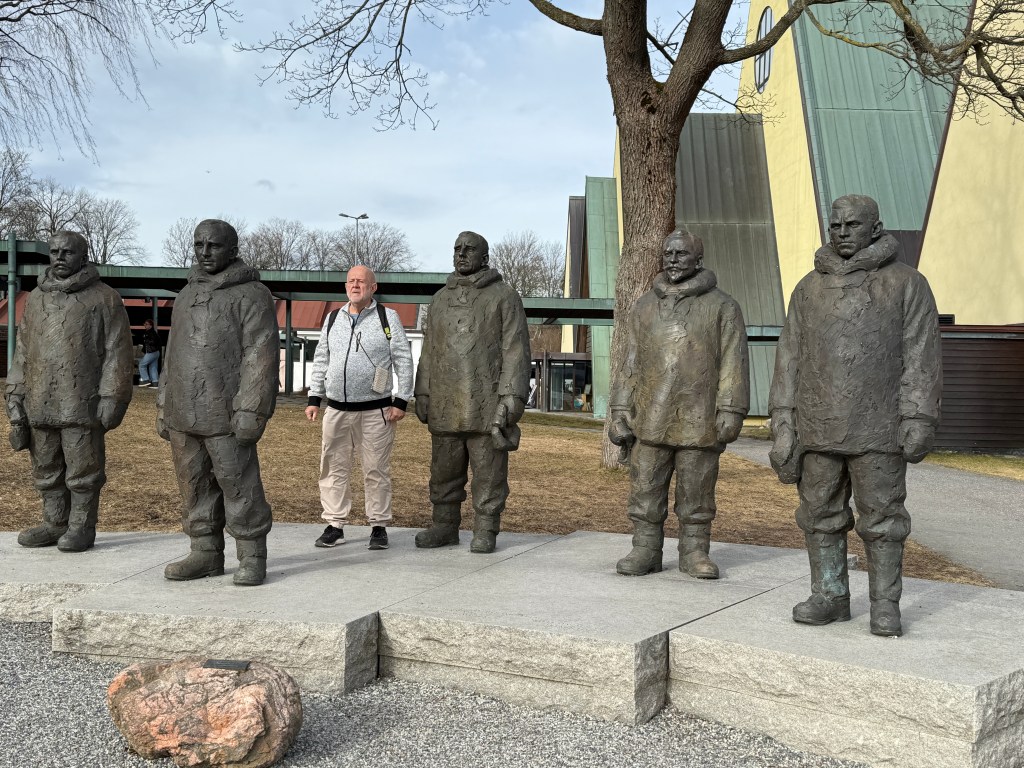
Across the road is the Fram Museum. It is here that the original Fram is securely preserved. The Fram was the ship used by Nansen and Amundsen on their polar explorations. Nansen in the north and Amundsen in the south.
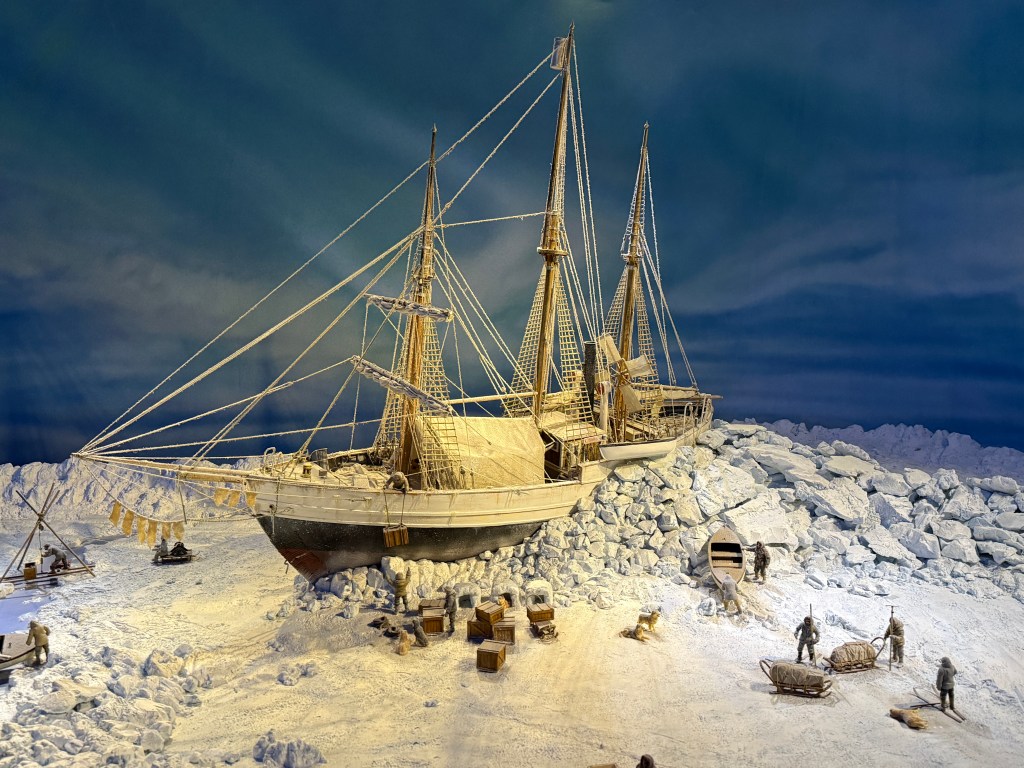
Considerable space is given over in the museum to the race between Amundsen and Scott (the English team) to be the first to reach the South Pole. But it is the Fram that dominates the museum space, an amazing vessel.
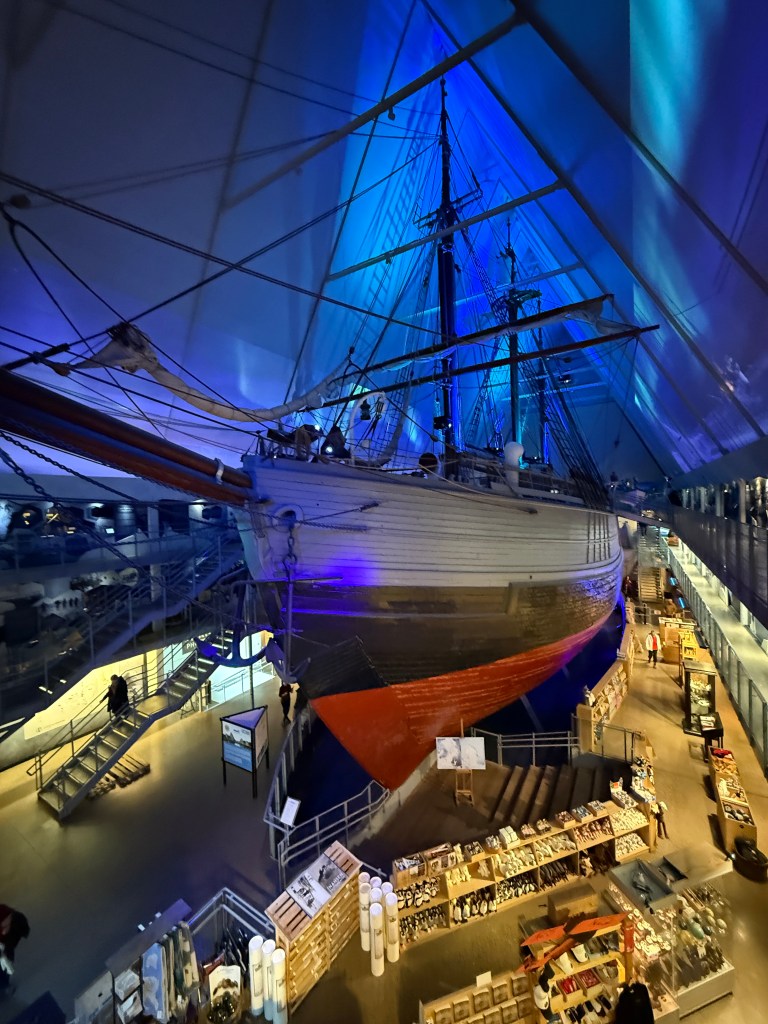
Lastly, we moved on to the Maritime Museum which records hundreds of years of Norwegian sea faring. Of interest to us though were some pieces of old Viking boats and the story of how these are being restored. A couple of pieces had been moved here from the Viking Museum which is undergoing a multi year restoration. Some amazing sights here in this museum.

This old canoe is the oldest boat ever found in Norway, some 2,200 years old. The tools are likely to be the sort of items used to make it.
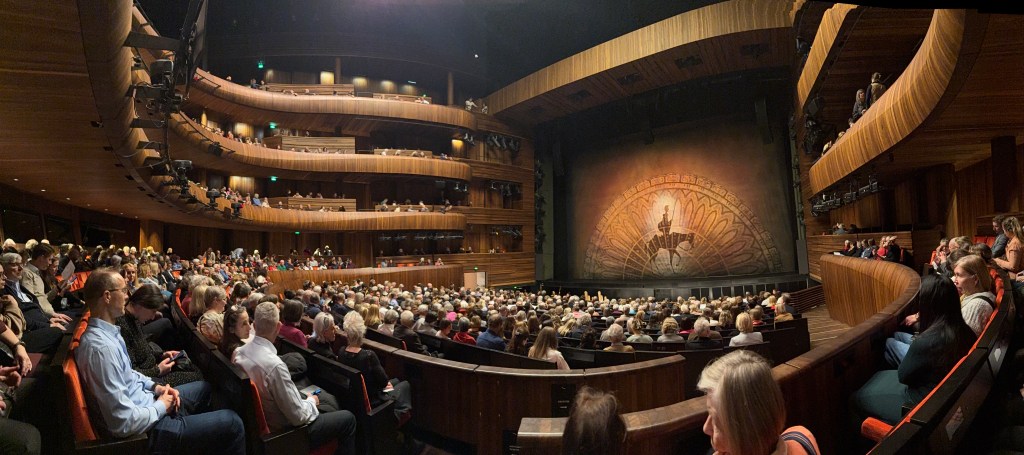
Late in the afternoon we headed back on the bus for the city, arriving without any drama. We had a treat lined up to attend the Oslo Opera House to see the ballet of Don Quixote. Quite an enjoyable show to round out our trip to Oslo.
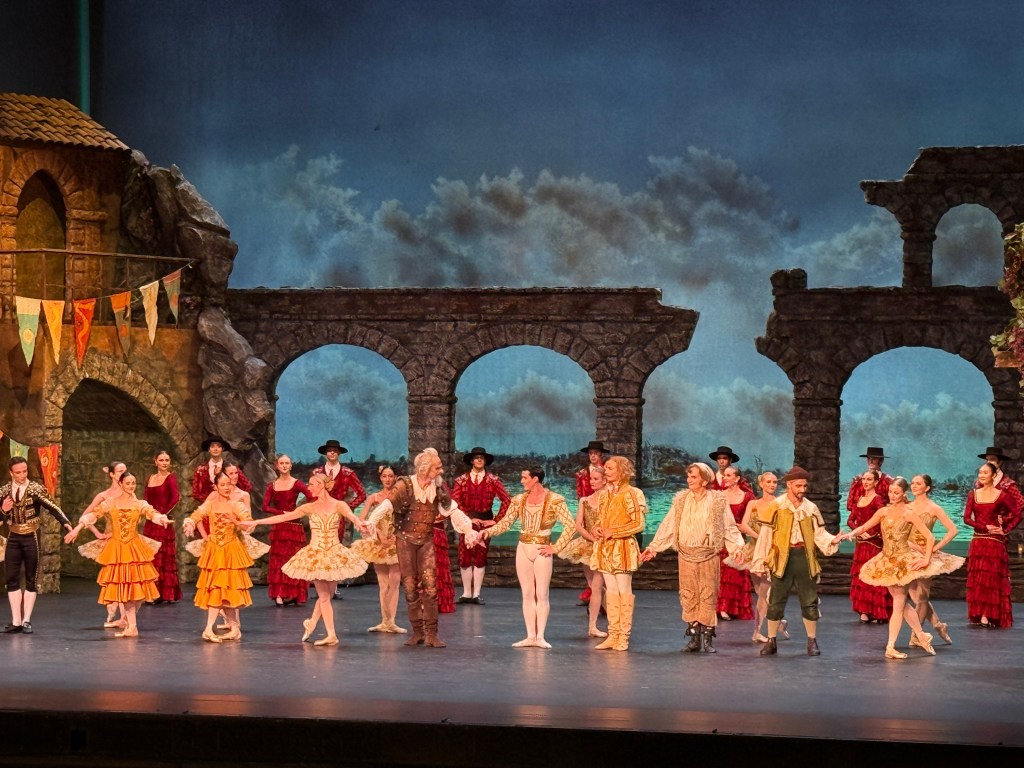
We head off early in the morning on the Bergen train, stopping at Myrdal to change trains for Flam. More of that next time.
Oslo on the go go
The new day has brought back the unsettled weather. A bit chilly and very overcast. After another healthy breakfast we set off on a walking expedition along the waterfront, which is only about five minutes from the hotel.
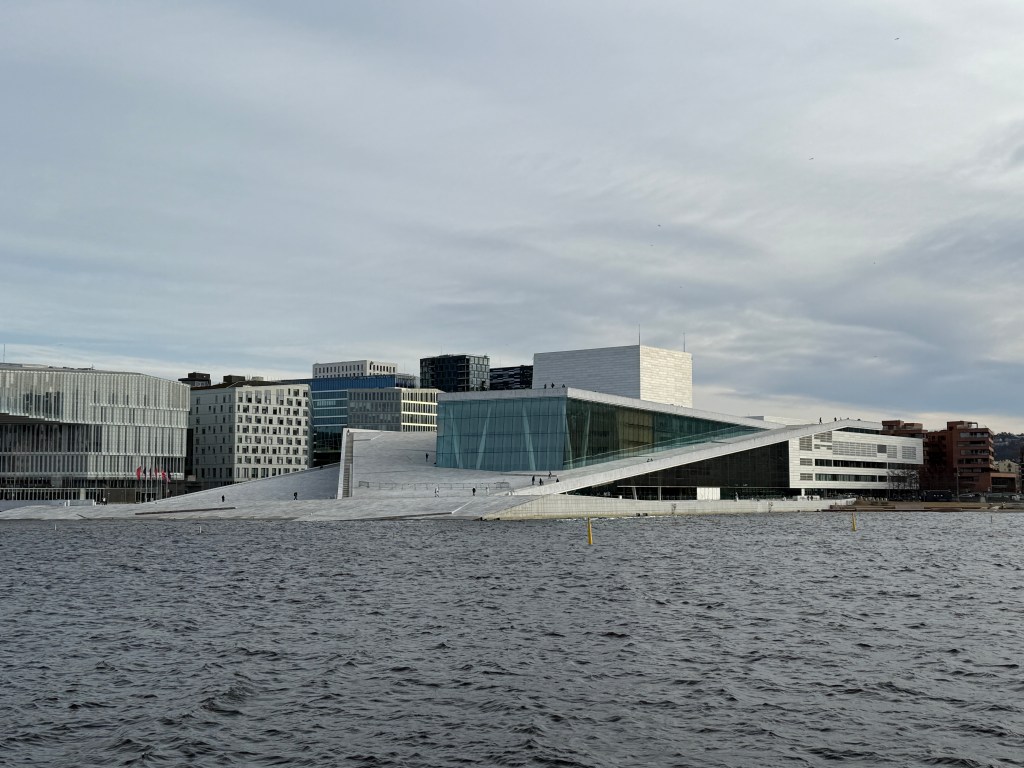
First stop is the Opera House. A big white marble building that sits on the waterfront and rises about three to four stories through various levels. Quite impressive, but one is not quite sure what goes on inside it! It is all a bit austere. Allthego walked up the sloping roofline to the top. Some great views of the harbour and surrounding buildings.
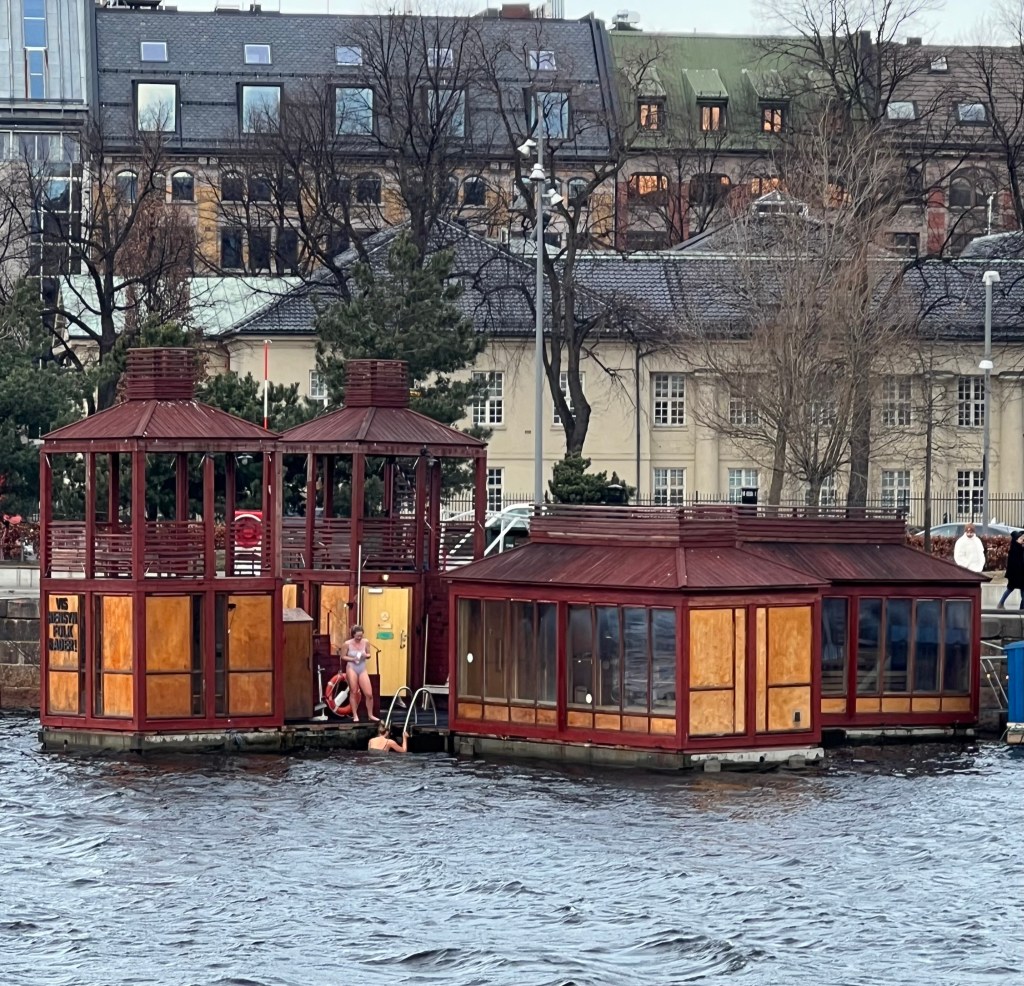
Across the bay there are a few saunas floating on the harbour. The idea is that after the sauna you go for a dunk in the harbour! Quite invigorating, some ladies of various shapes and sizes were having a go. Homealone, managed to get a close up of a couple of gals going in. The sauna would be ok, not sure about the cold plunge!
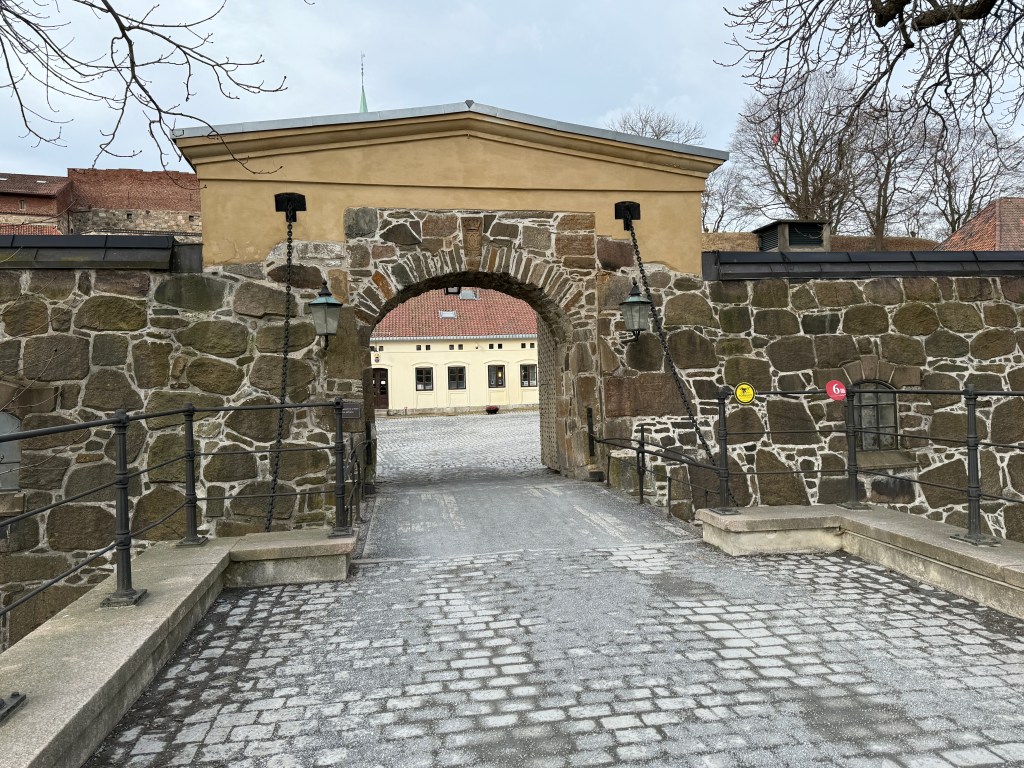
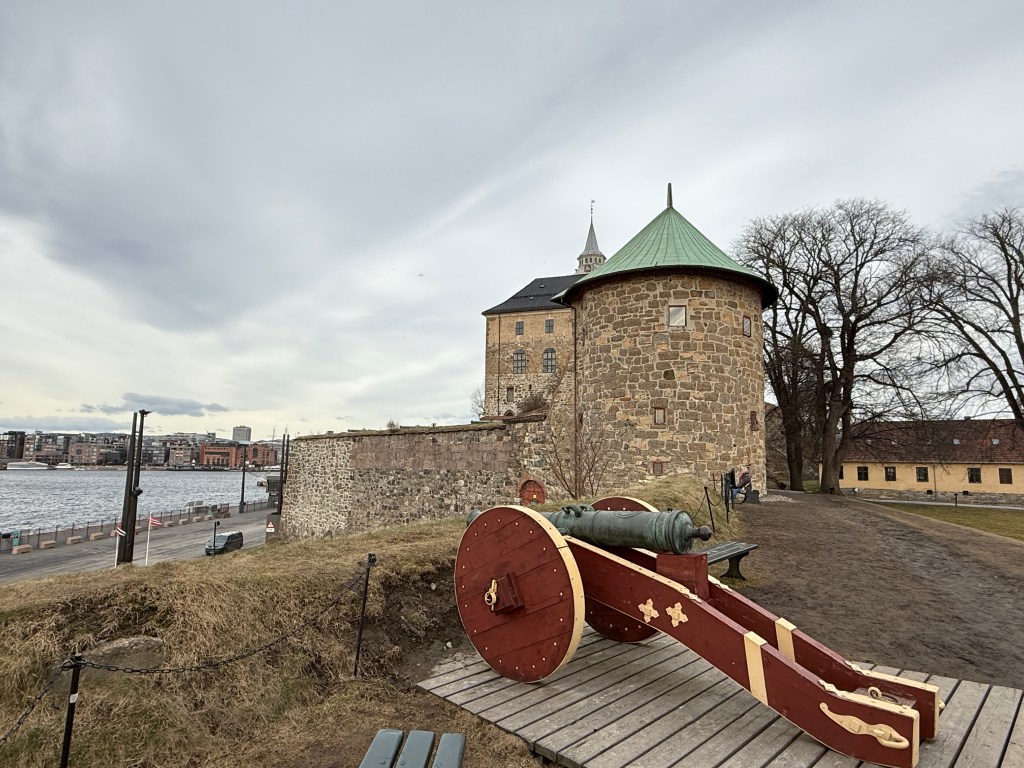
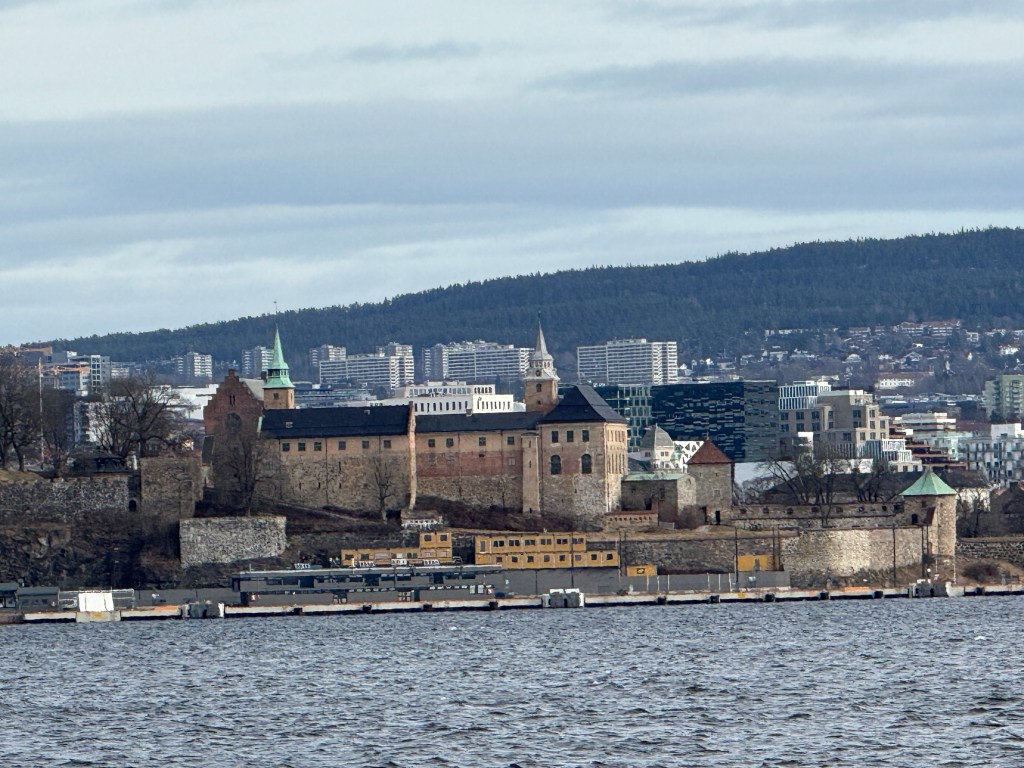
Further around the waterfront the old medieval Akershus Fortress juts out into the harbour. The oldest parts were built around 1300 by Hakon V, the great Norwegian castle builder. Over the centuries it has been added to and under Christian IV in the late 1500s was converted to a renaissance palace for his family. Since then it has served many purposes being added to and today serves as the administrative headquarters for part of the military.
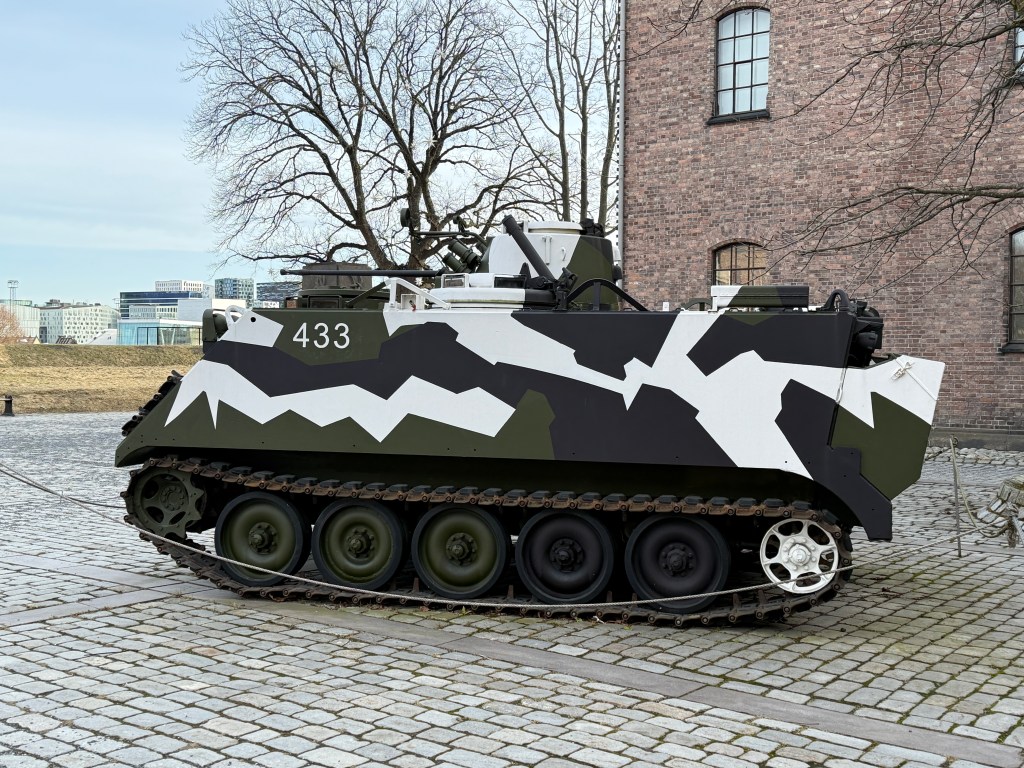
After some time at the Fortress we moved around the harbour line to the ferry terminal area. This is where the Town Hall overlooks the bay alongside the Nobel Peace Prize Centre.
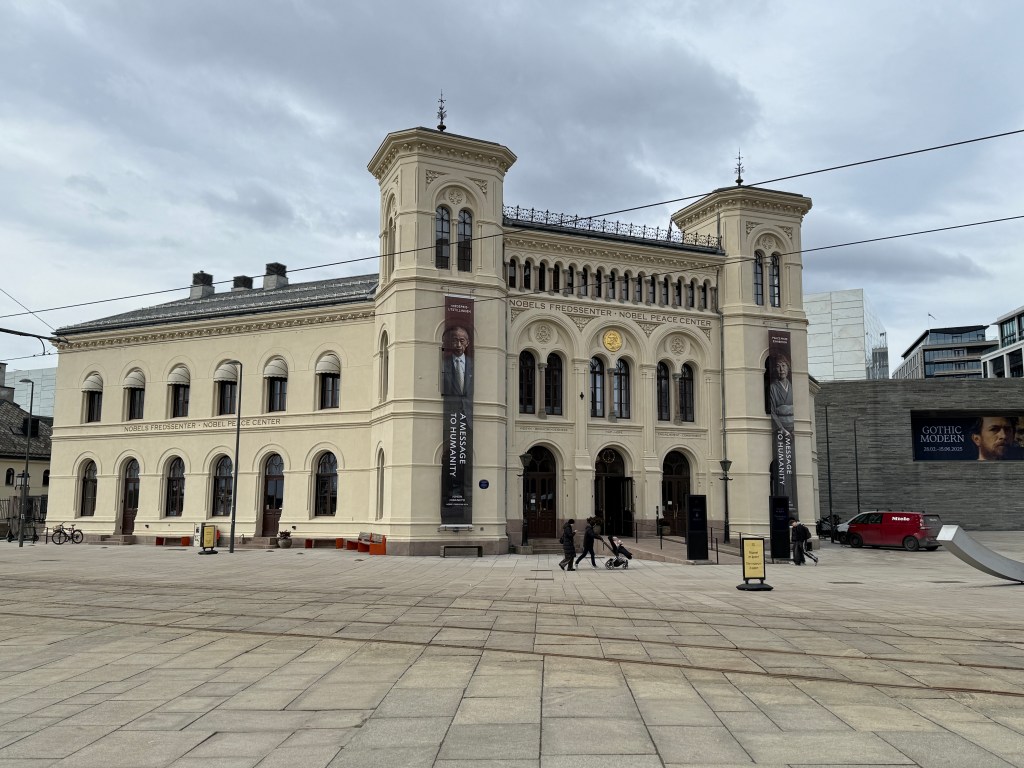
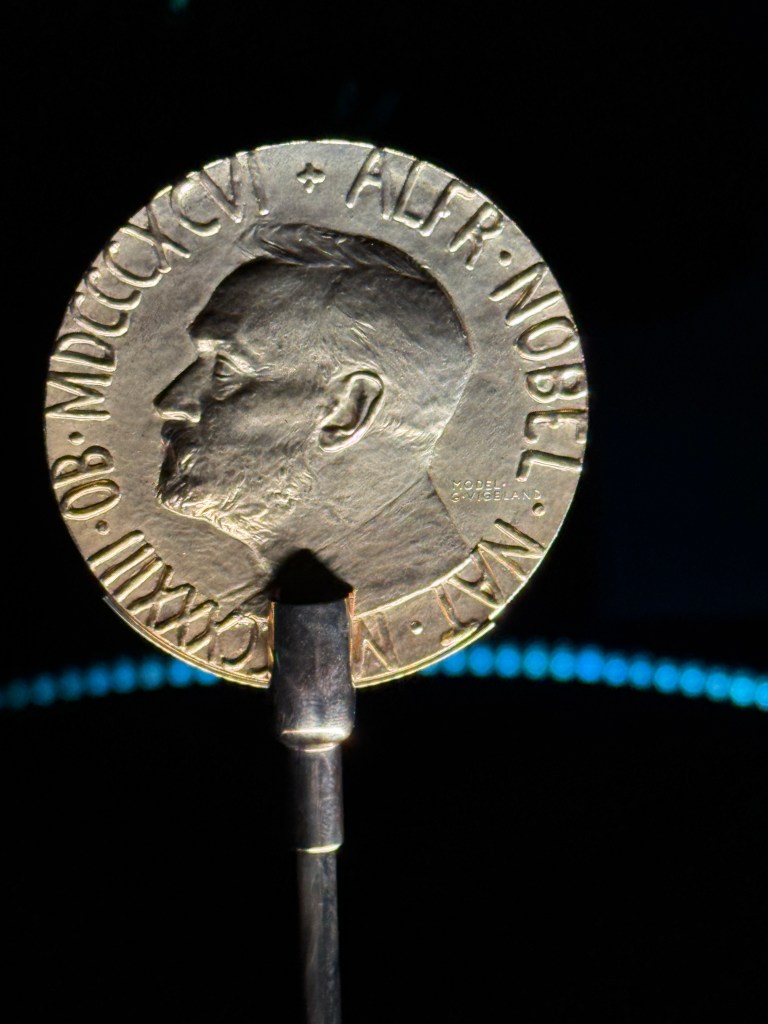
The Peace Prize Centre houses the history of the Nobel Peace Prize. The prize is administered by the Norwegians, apparently to the ‘annoyance’ of the Swedes who handle the other prizes. Nobel was a Swede. The displays are quite impressive and space is given over to the most recent nominee. It explains the background and reasons for the award. The 2024 one was for a Japanese group fighting to prevent nuclear war and using the countries WWII experiences in the presentation.
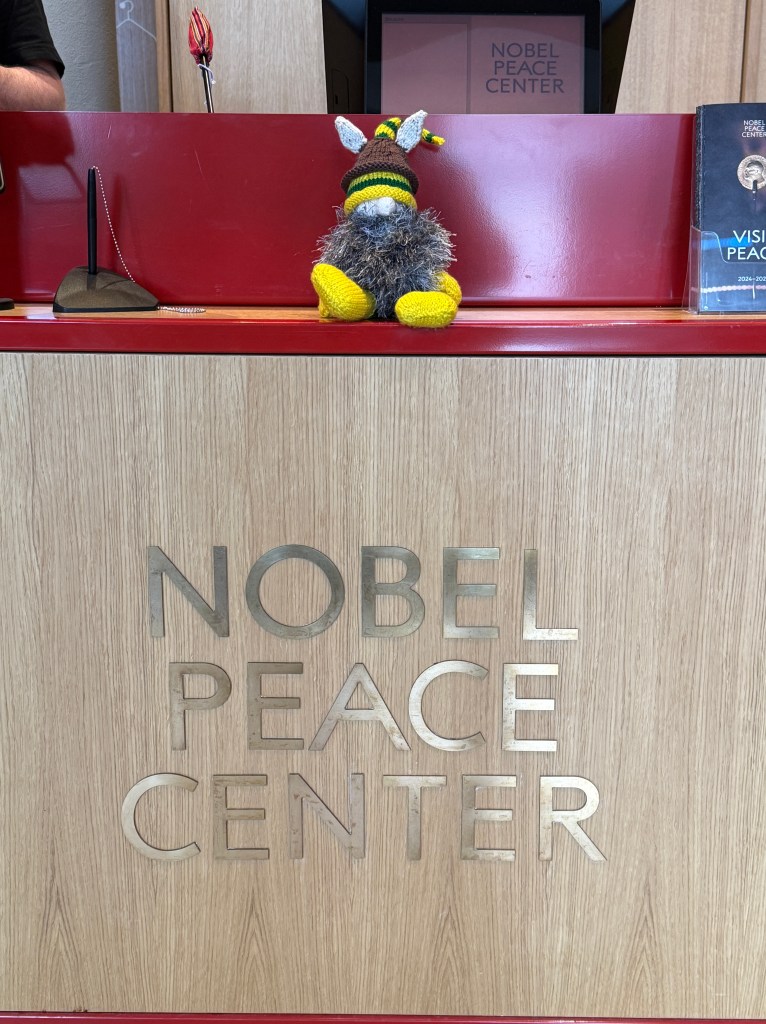
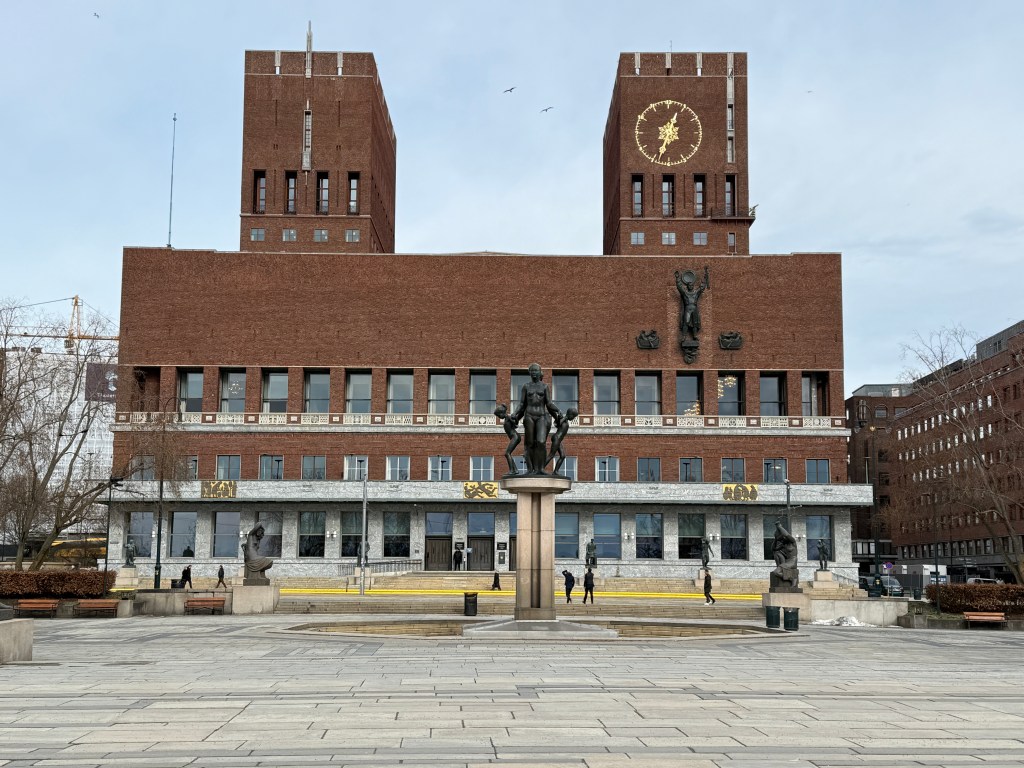
Next stop was the Town Hall. From the outside it looks a little bland, a couple of brick towers and adjoining building. Inside it is a different story. Some highly decorated high ceilinged rooms and spaces. Quite impressive even if all the murals and carpet hangings are not to your taste.


The afternoon was drawing to a close but we still had time to drop into The Viking Planet. This is the sort of place made for the tech savy. Lots of interactive stuff about the Vikings that help explain their lifestyle and beliefs. Not endless reading boards with old photos and drawings! Great place, Slobro was in his element here.
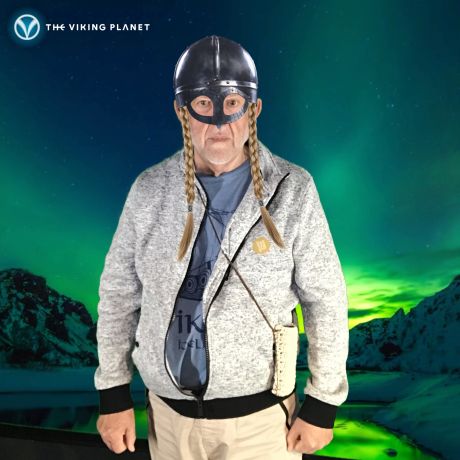
We headed back to the hotel and along the way called into the Sir Winston to see what it was like. True to form it felt like an English pub and it had Guinness on tap, so
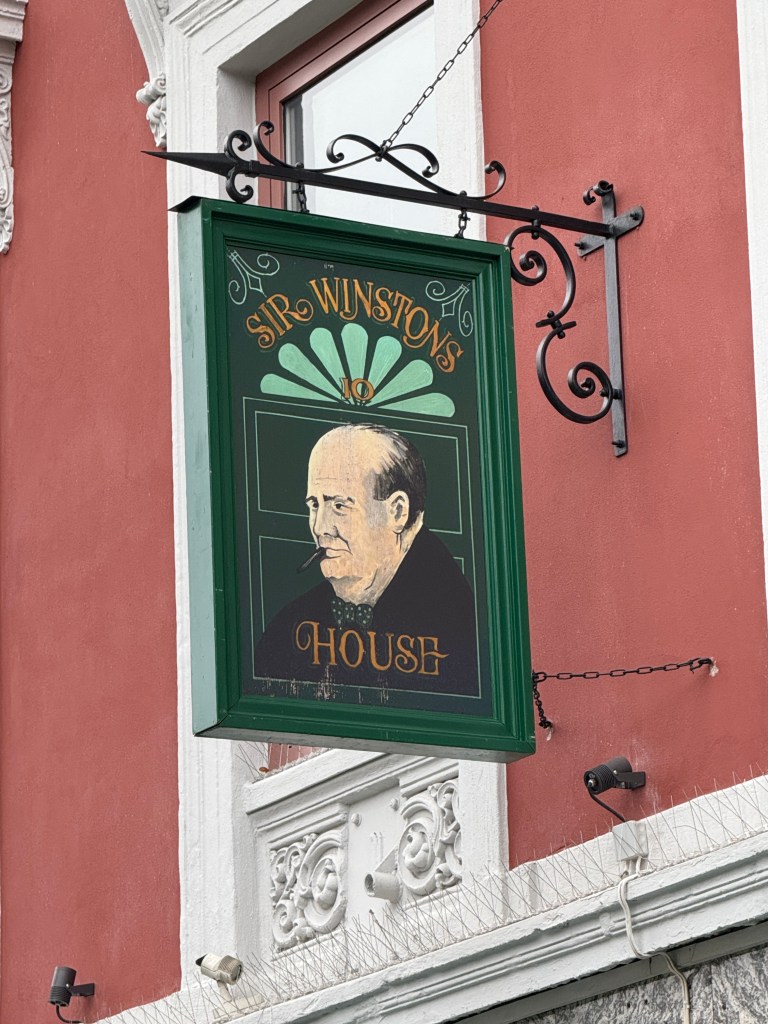
Allthego had a drop. No food!Further down the street the Cathedral Cafe called us in for dinner. Italian. Oslo seems to be going made about Italian food, it is all over the place from pizza chains through to high end establishments. Homeslone settled for a pesto chicken pasta.
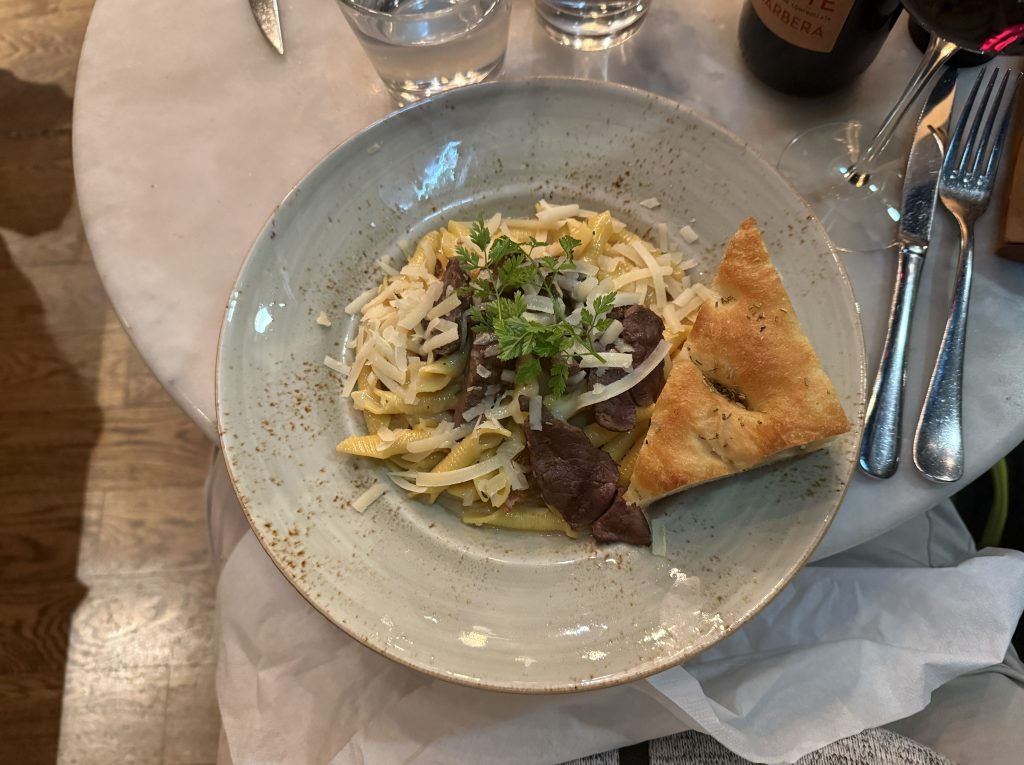
Allthego tried something a little different, reindeer, bacon and mushroom creamy pasta. Rather good, the reindeer very tender and moist!
Back to the hotel for bed, our last day in Oslo to come. Brisbane is battening down for the night in the face of Cyclone Alfred. Will it end up being as bad as predicted? We hope not!
Oslo on the go
We had three days in Oslo ahead of moving over to Bergen to catch the cruise up the Norwegian coast. The weather forecast for Oslo was not great, rainy, cloudy periods with not much sun. Typical early Spring weather, despite a less than average snowfall through Winter there was still icy snow laying around the streets and parks.
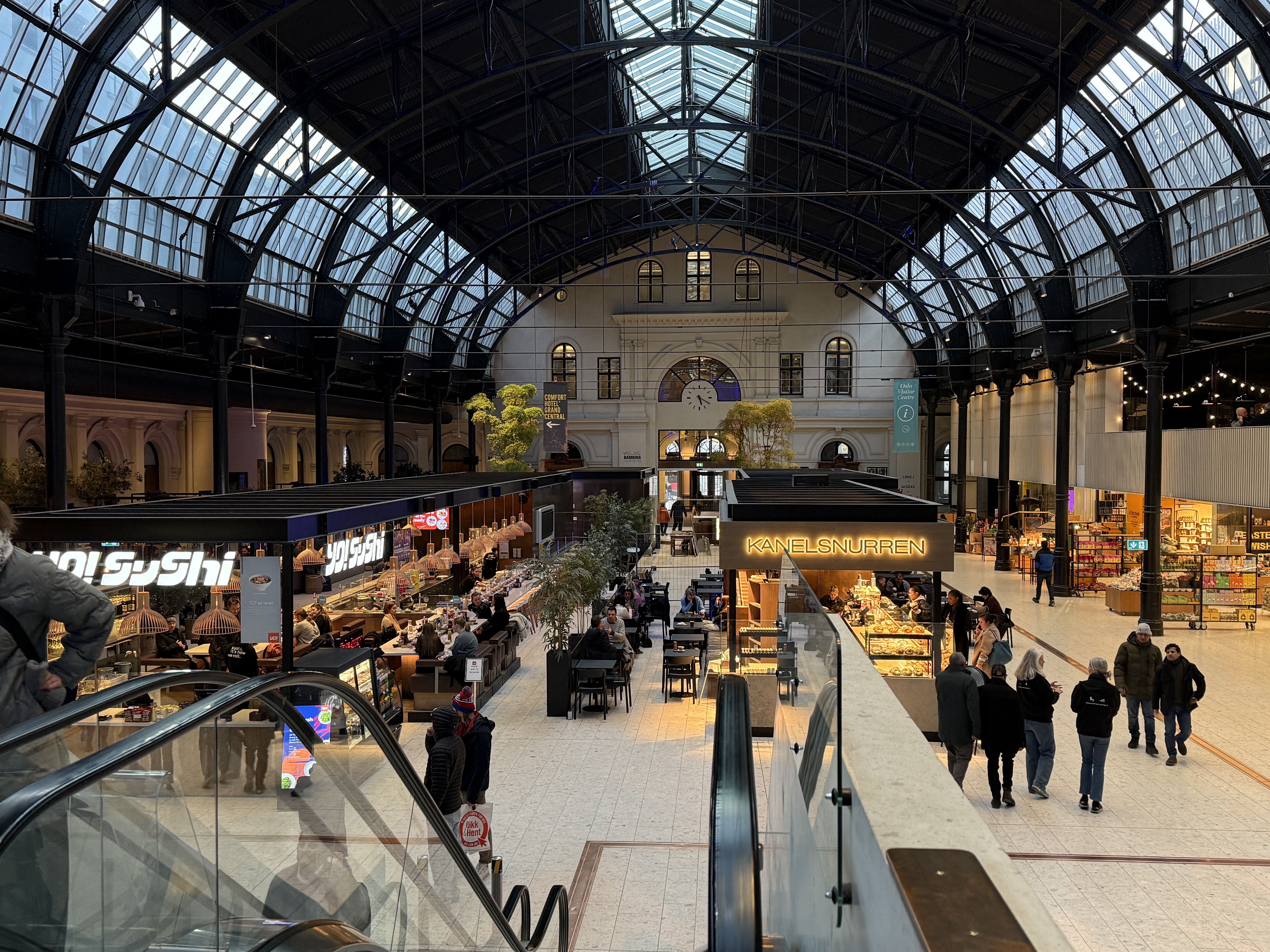
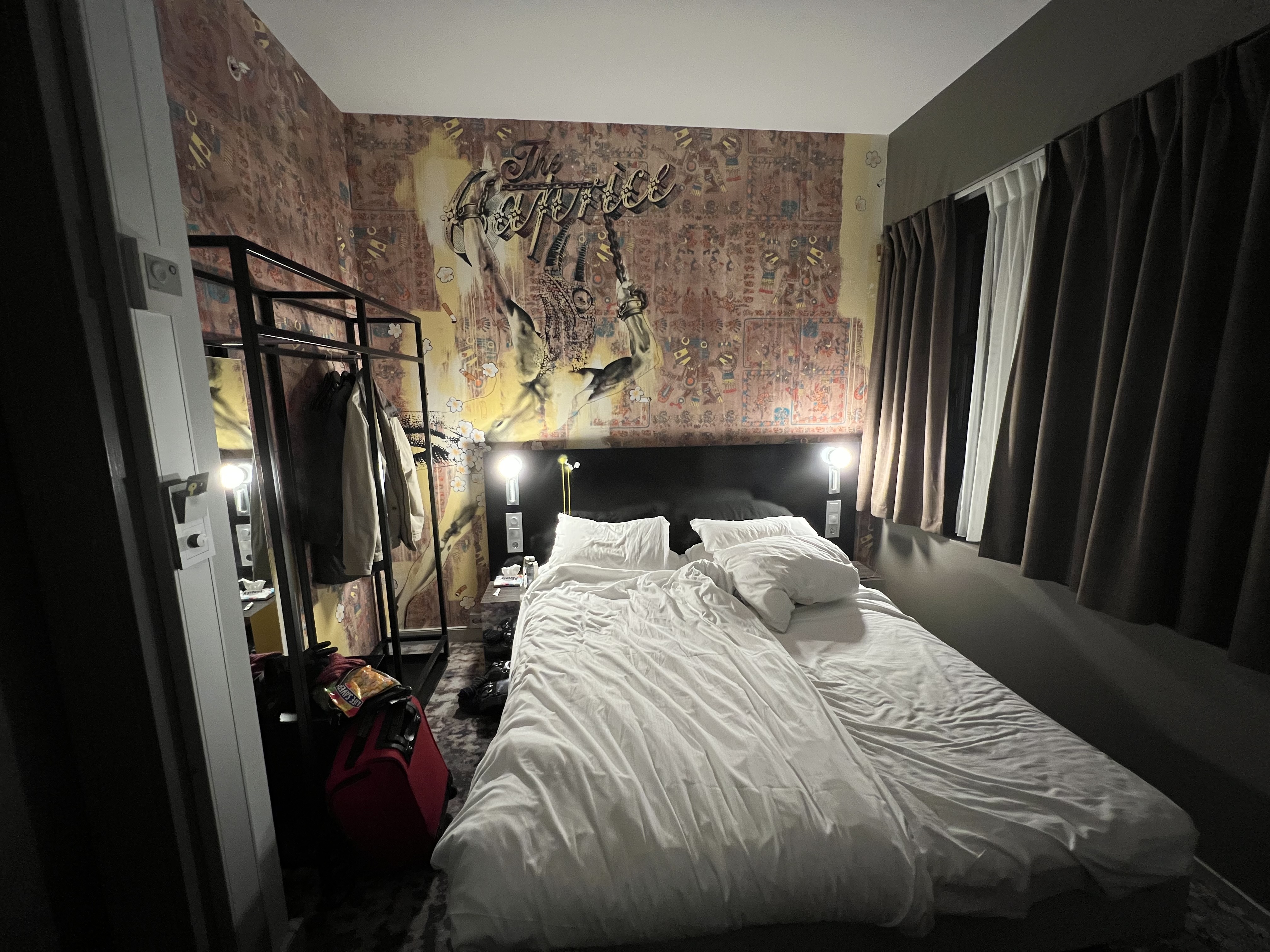
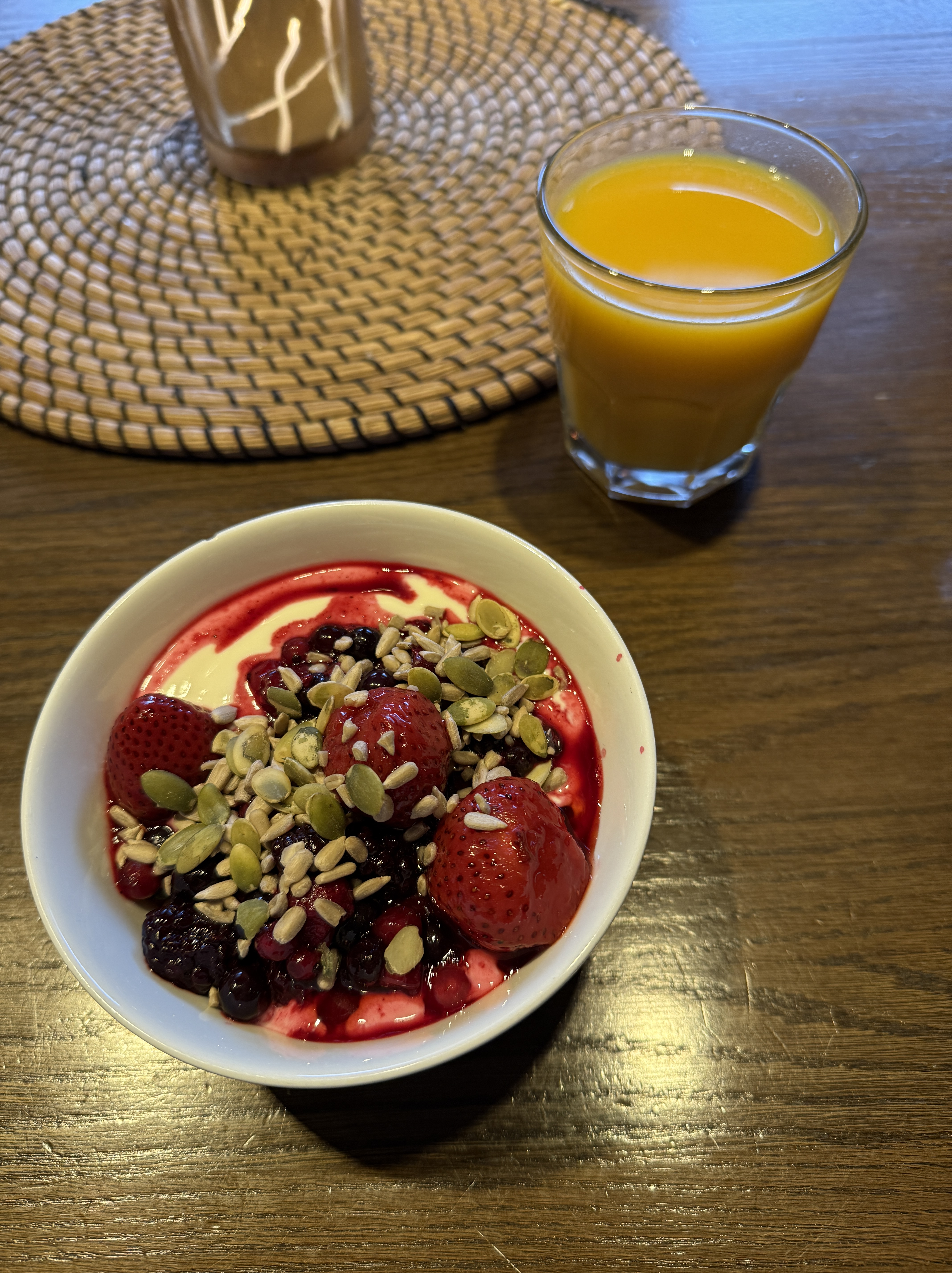
Our room in the hotel was quite small, but comfortable. Not much space for luggage! Breakfast was included so we started the day with a healthy alternative. Allthego occasionally lapsed and finished off with bacon and eggs.
We were surprised when we woke to sunny, blue skies with some high cloud. The chap at the Visitors Centre advised us to take advantage of it and head up the mountain to the Holmenkollen Ski Fields. Take the train to the end of the line and walk back down the hill to the Centre. So we did. Some great views of ski runs in the back woods.
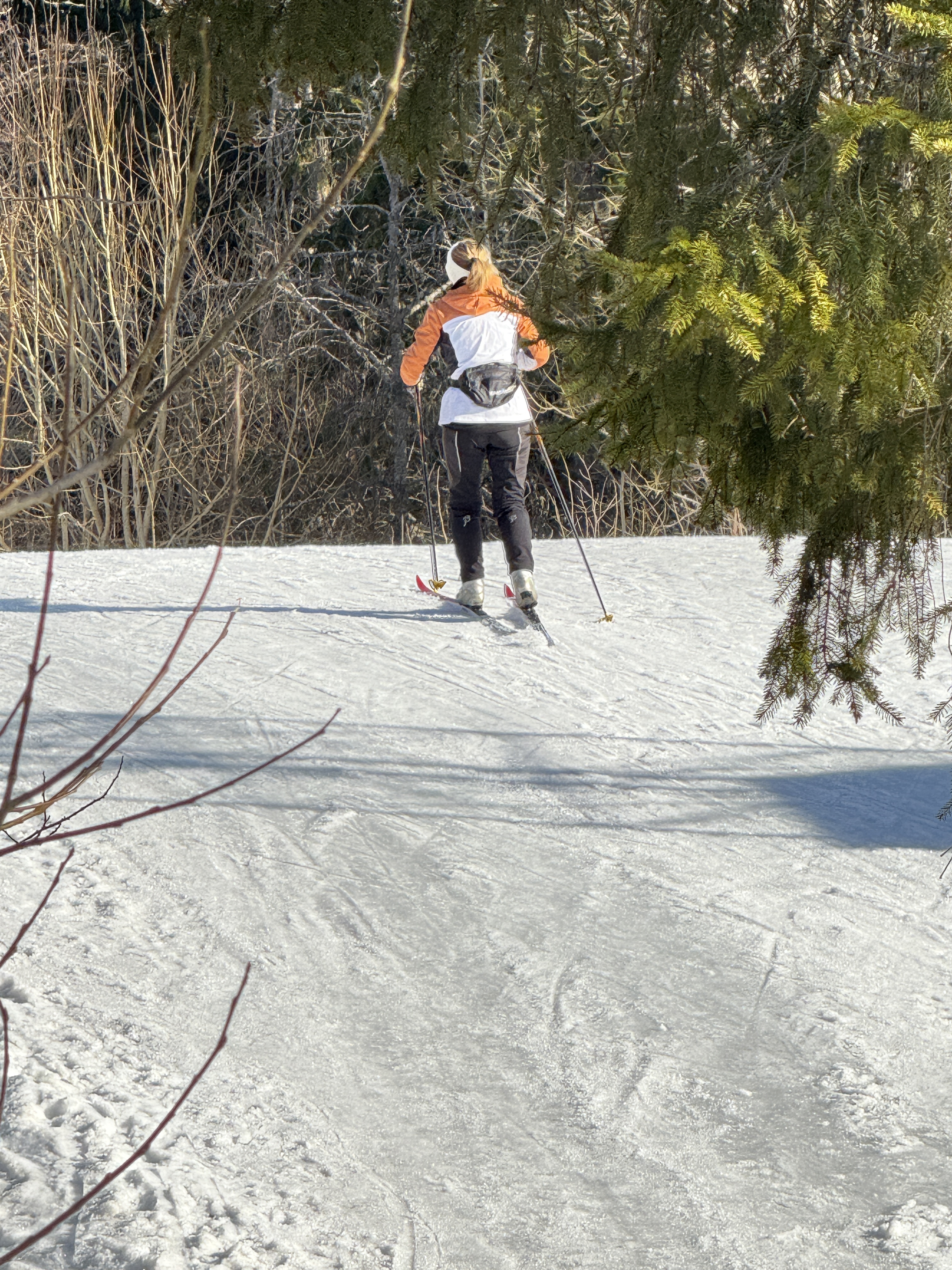
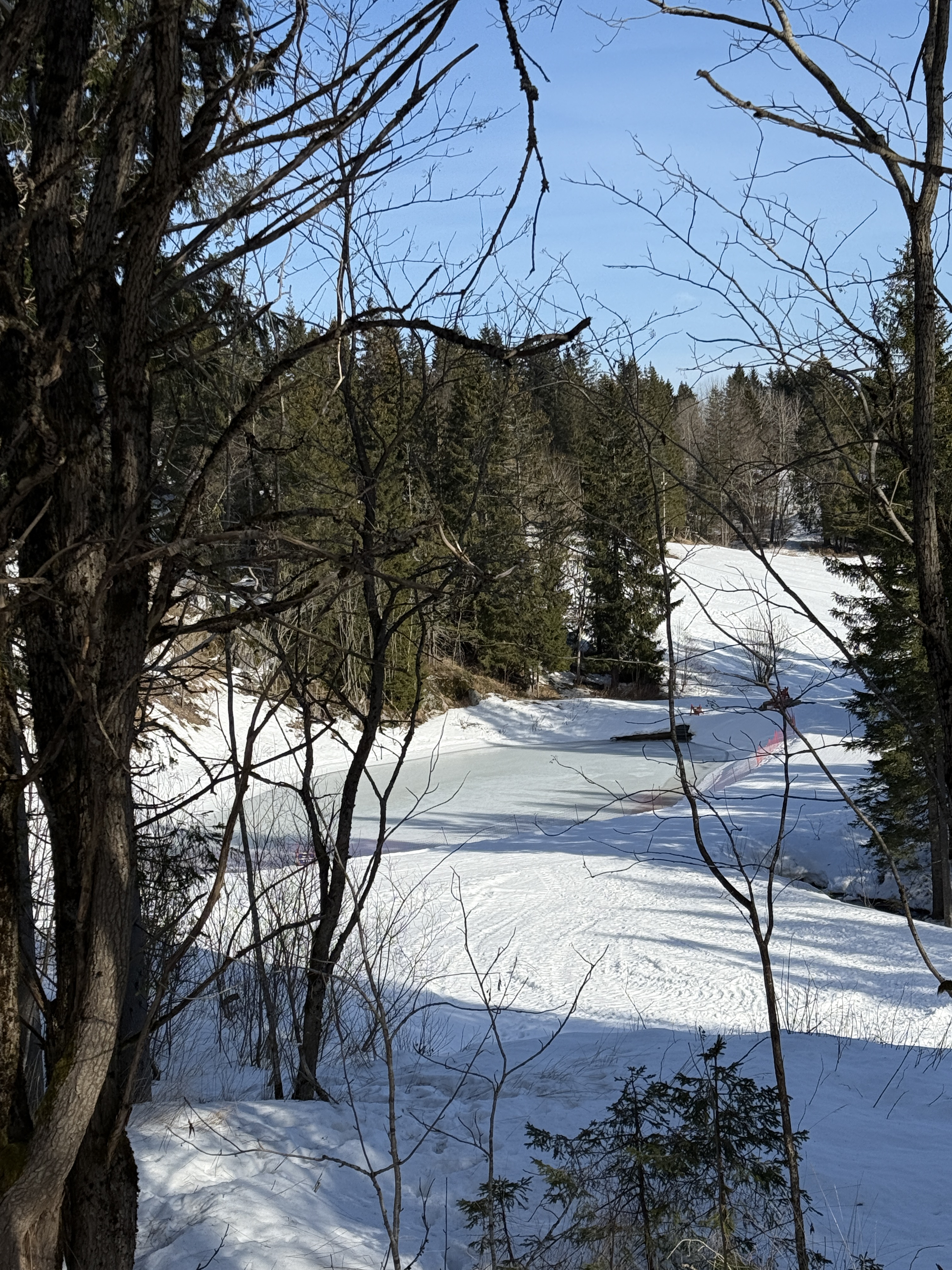
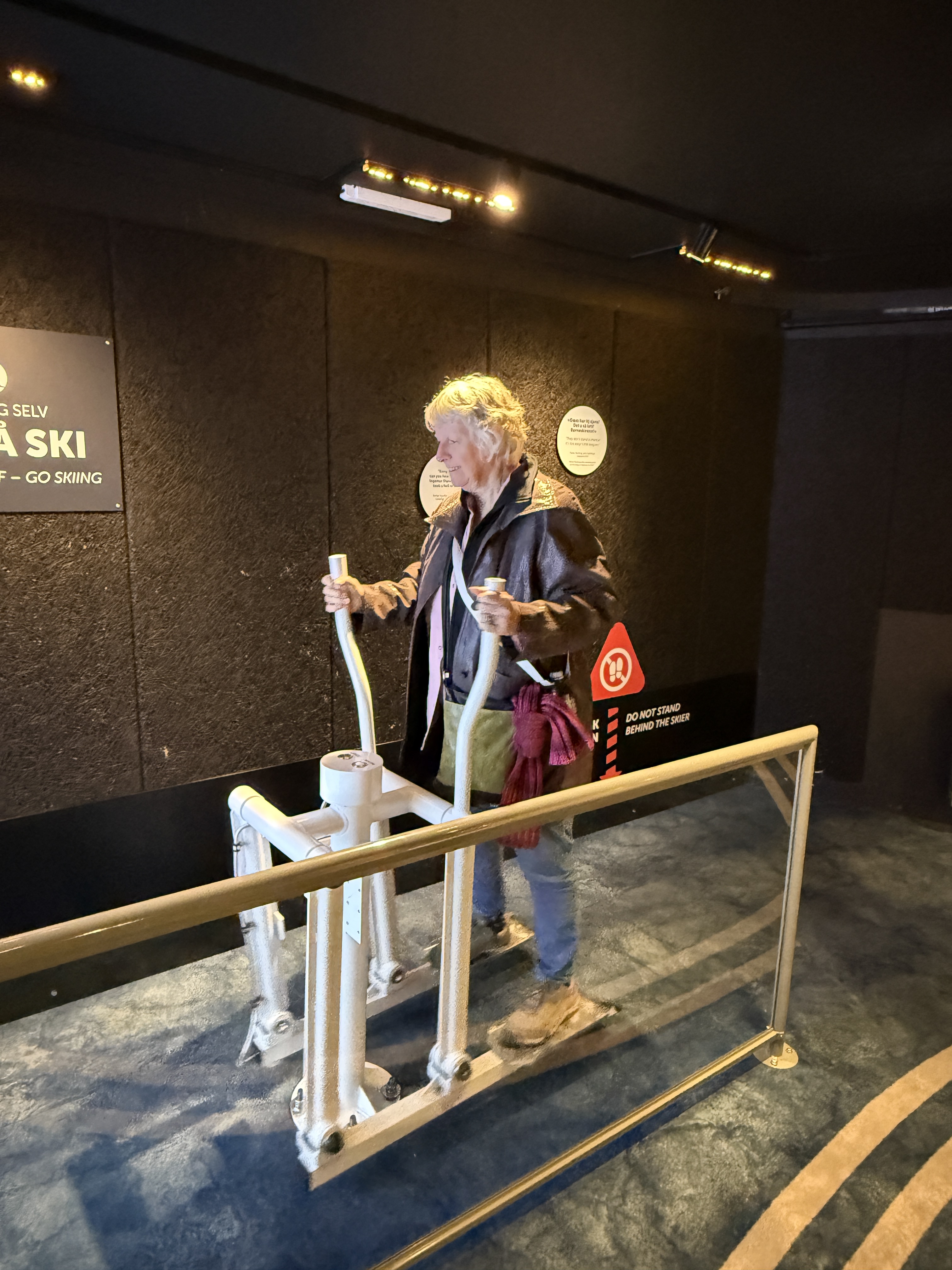
The main objective here was to look at the Ski Museum. Holmenkollen was the location of the 1952 Olympics and also held a number of World Championships. An interesting centre with plenty of old gear. Also some historical bits from the Norwegian polar explorers Nantzen and Amundson. Allthego, thought he saw an old pair of his 1970s Blizzard brand skis on display. Blizzards are not hard to forget, but maybe they weren’t! We both had a go on a cross country race simulator, the two other AI contestants beat us easily.
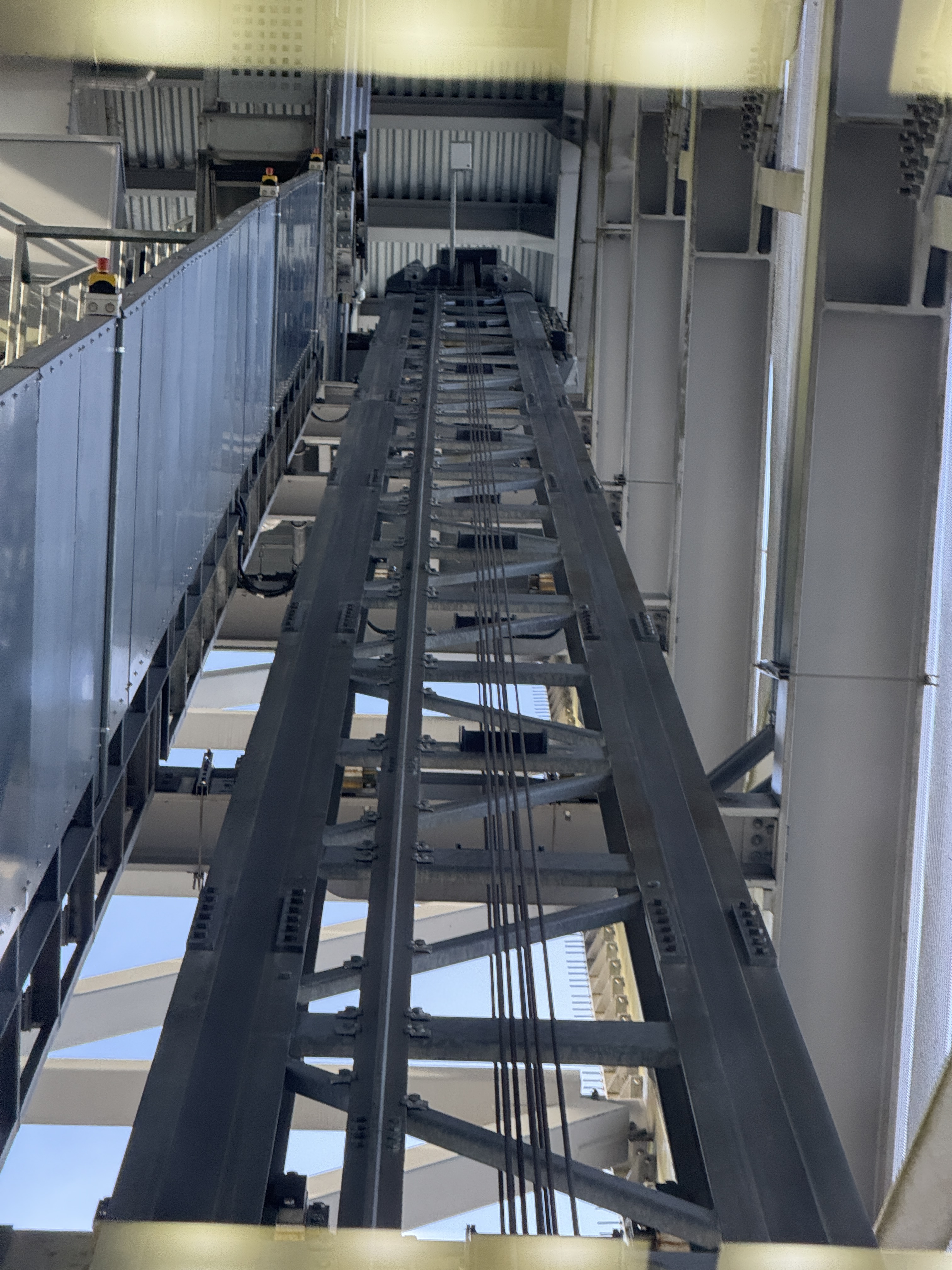
We then caught the lift to the top of the Ski Jump. Quite a height, Slobro hid in the back pack and Homealone wished she was! There were some great views from the top and looking down the ski jump was a little nerve wrecking. Must be quite an experience descending the run and jumping into thin air about half way down before landing on the run at the bottom!
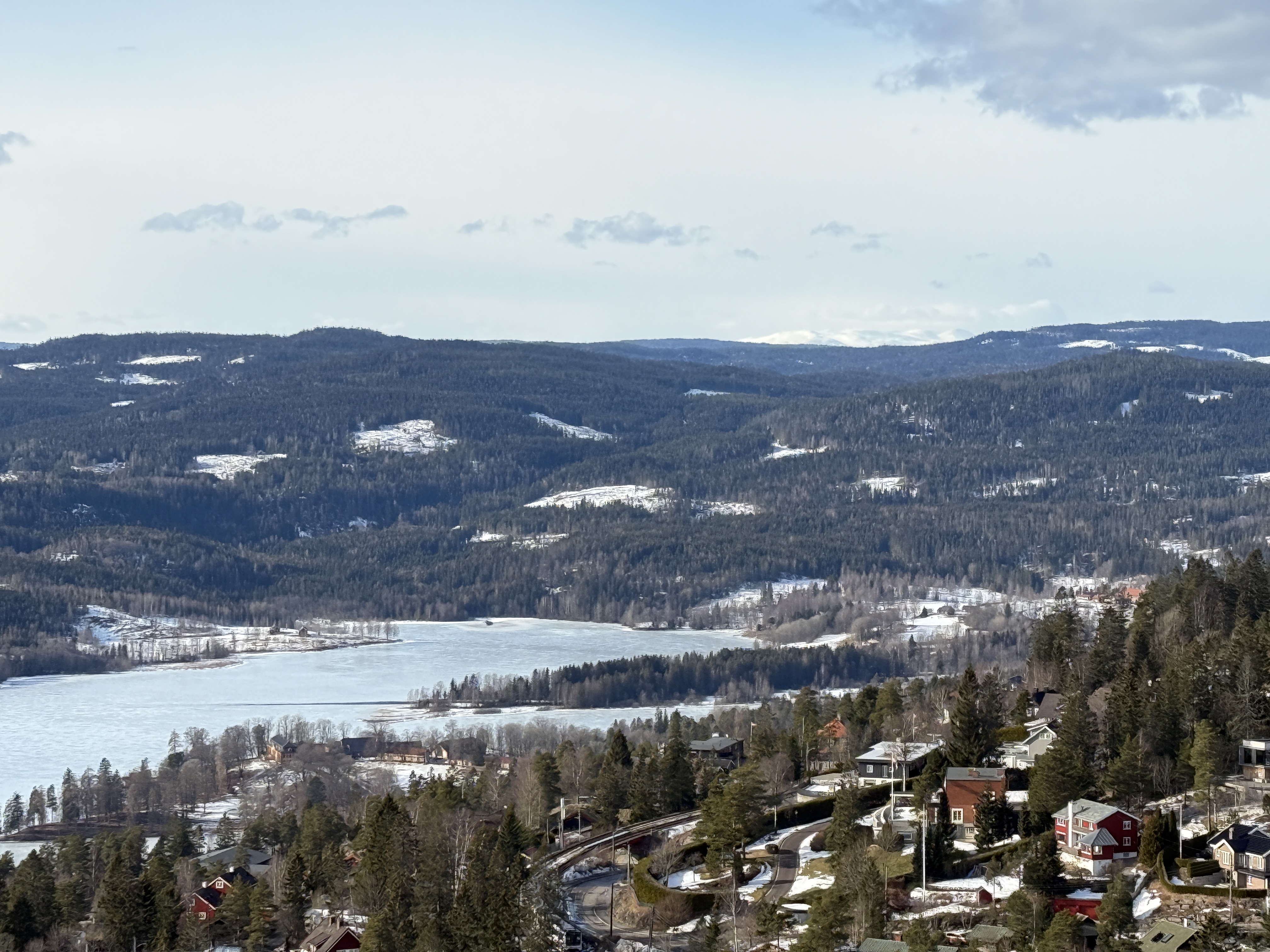
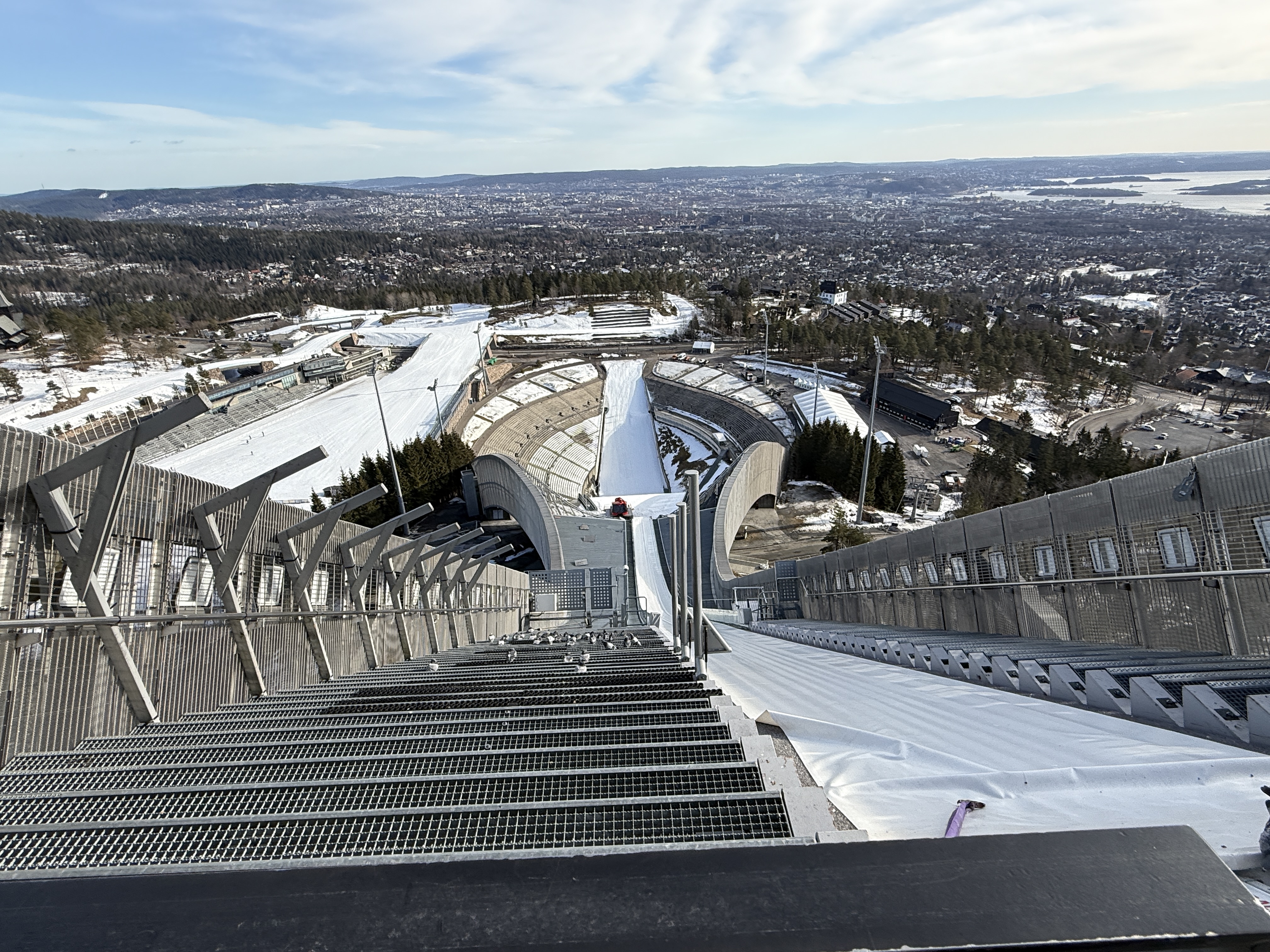
We made our way further down from Holmenkollen to the railway station to catch the train back to the city. Along the way we stopped off at the Vigeland Sculpture Park. Vigeland was a famous sculptor from the early to mid 20 century. The City Council have put a lot of his sculptures up in this park. He seemed to have a strong focus on the human body and its various appendages. Enough said. All quite interesting but we needed to head off to get back to the hotel before dark.
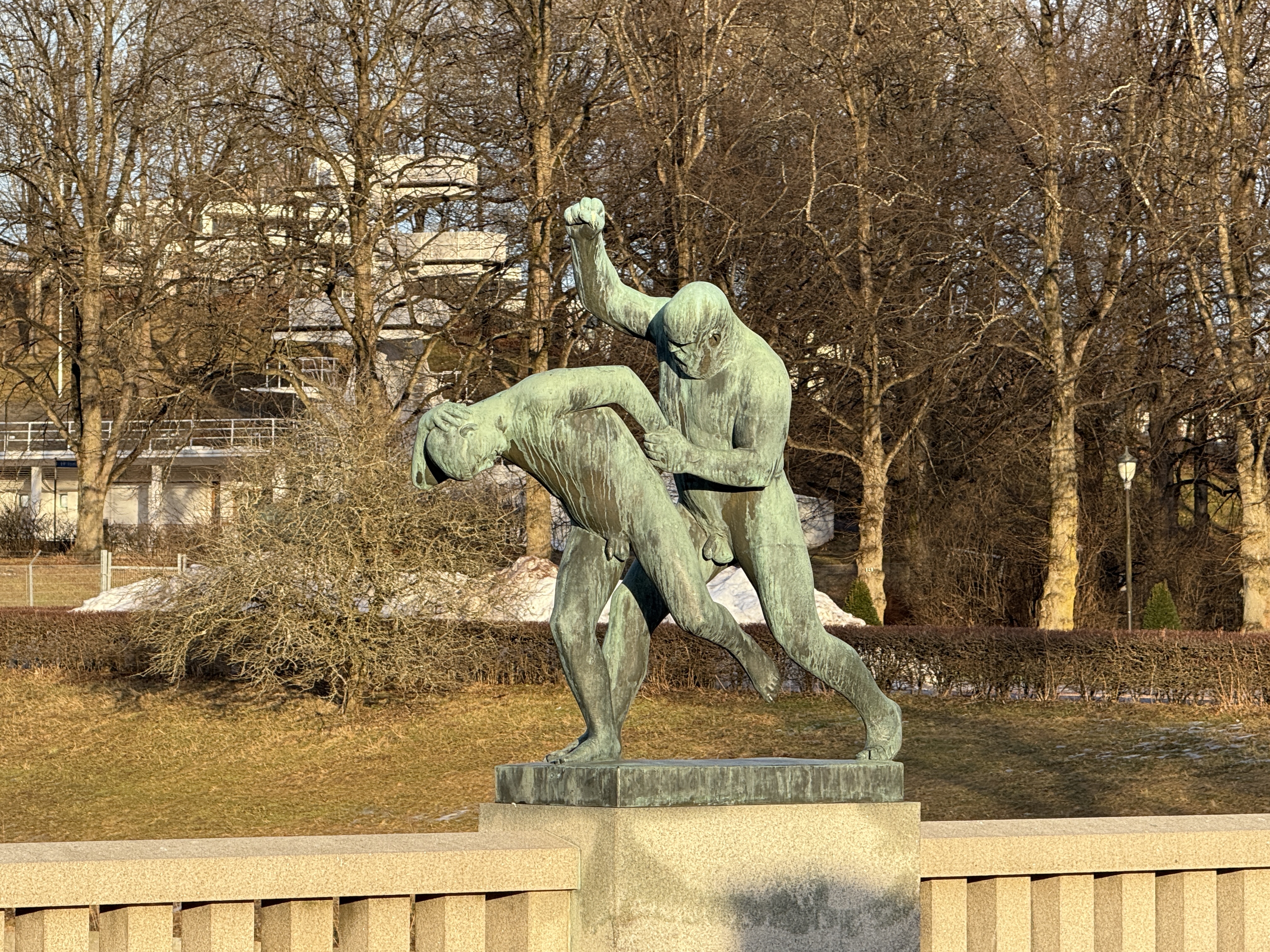
The next couple of days we aimed to stay in the city for the local sights.
Oslo
We have arrived in Oslo, got in at the planned time of 12 noon on March 2, the temperature 8C. So it is a good bit cooler than Brisbane. We were an hour late leaving Brisbane for Dubai aboard an Emirates plane. Had to be towed back to the gate after a fault had been identified as the plane idled on the tarmac. Took an hour to fix. Very smooth flight to Dubai. The connection from Dubai to Oslo went off without a hitch.
We had an interesting flight path though, avoiding Ukraine but in so doing we went further north, crossing the Caspian Sea and flying just south of Moscow. Then across the Baltic Sea and over Stockholm to Oslo.

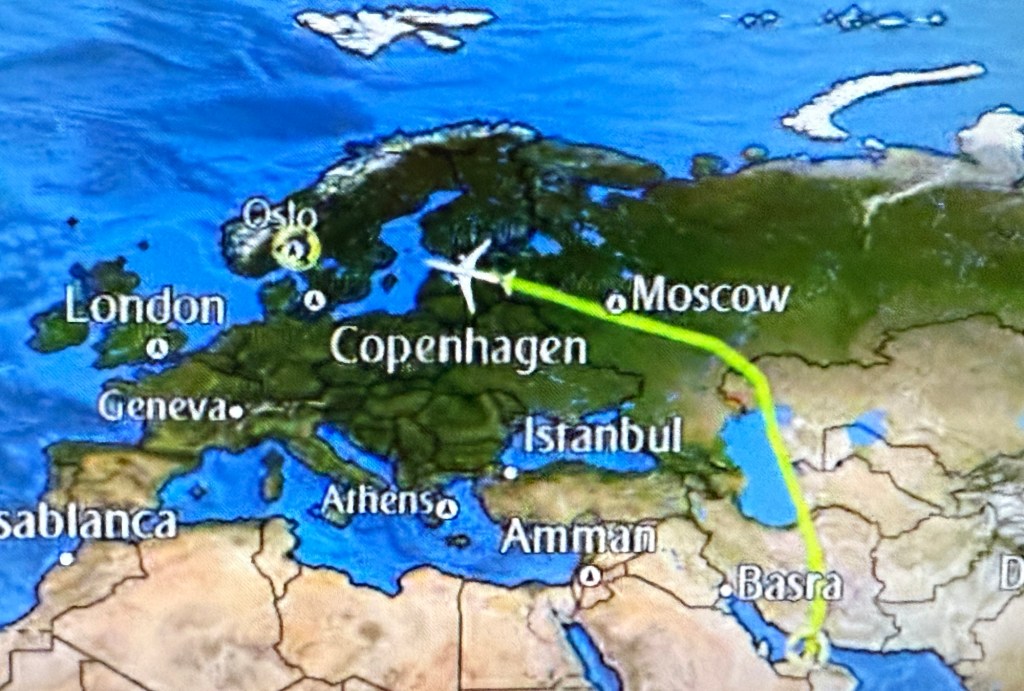
Snow still present on the Norwegian landscape and lakes iced up a bit. Some nice views from the plane windows.
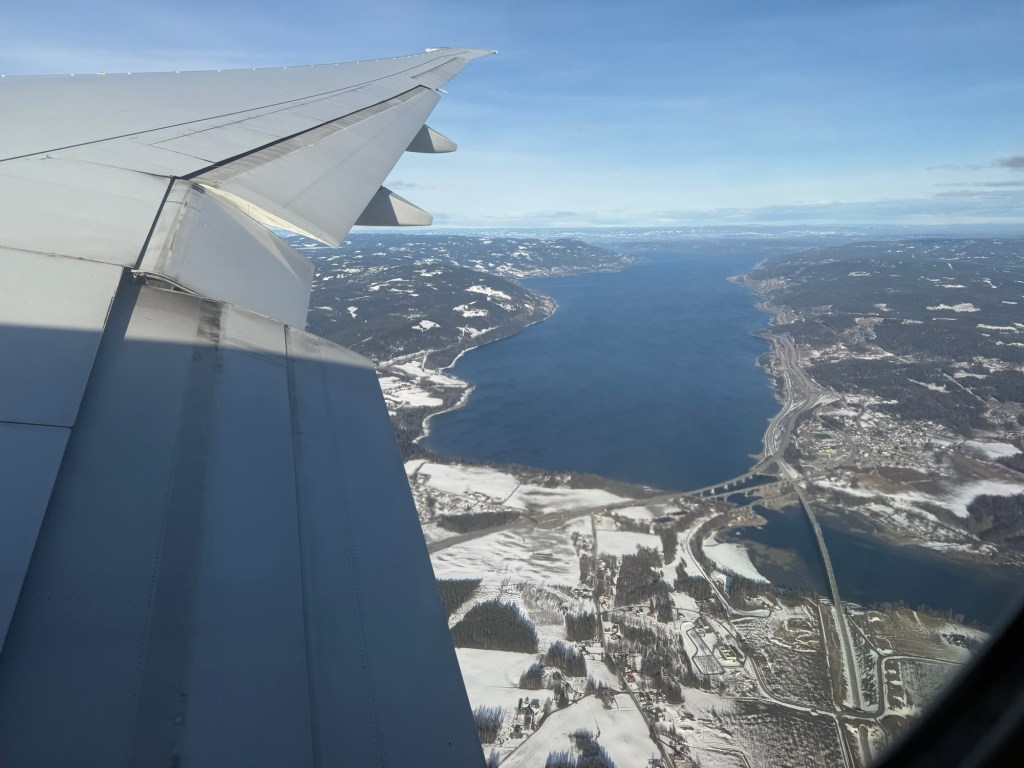
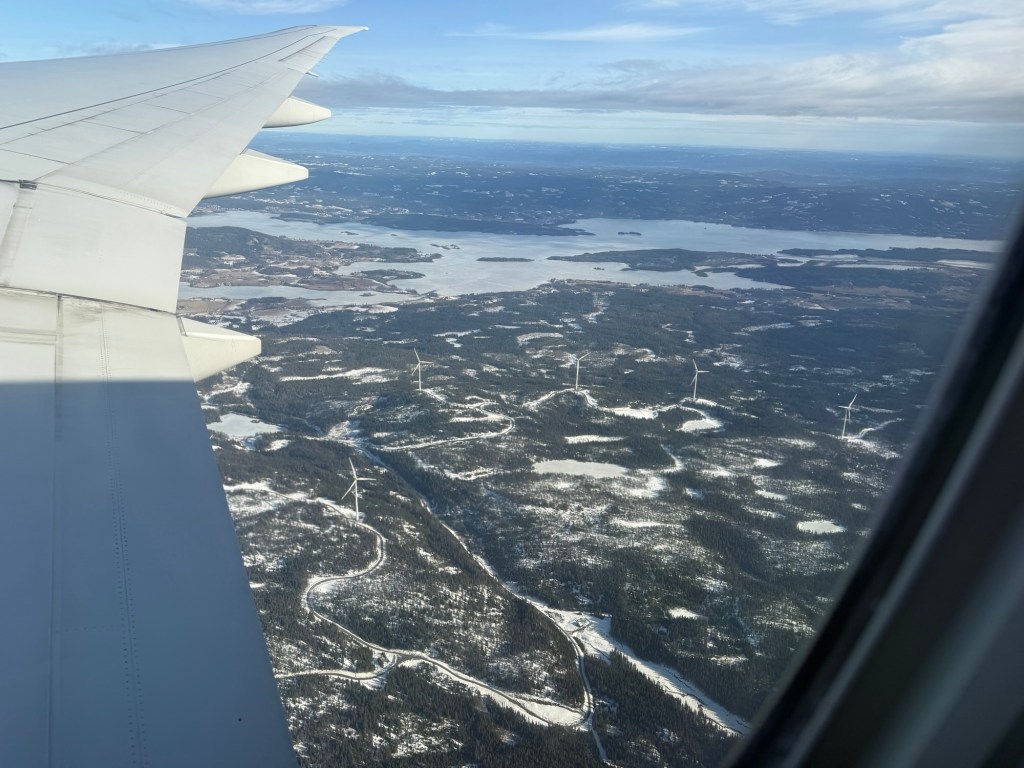
From the airport we caught a train into central Oslo, our hotel is part of the station complex and is a little rustic.
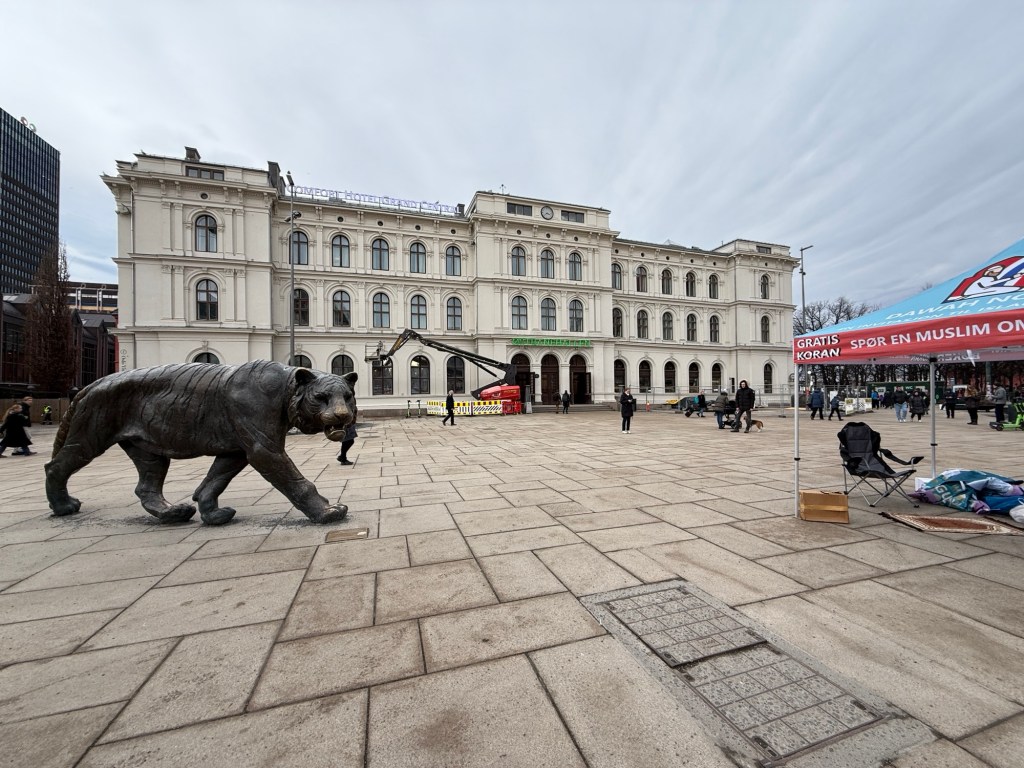
It is fairly central though to some of the city’s attractions, including the Viking history stuff that Slobro is keen to see as soon as he escapes from the luggage bag. It has been a long couple of days and bed has called. Weather looking not too bad tomorrow.
On the way to Norway
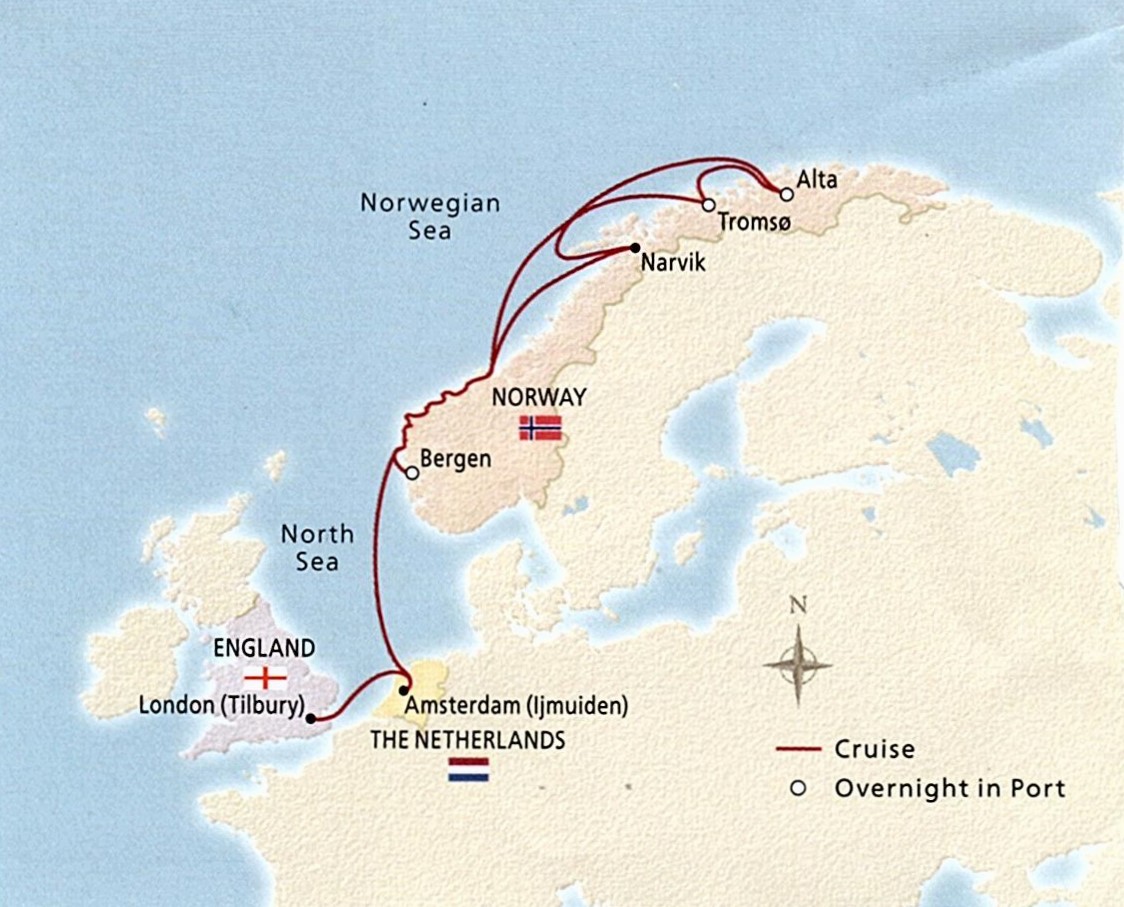
We are off to Norway for about three weeks. A few days in Oslo before transferring to Bergen via Flam, on the railway. From there we join a Viking cruise heading north to the Arctic Circle in search of the Northern Lights.
Flying home from London after the cruise.
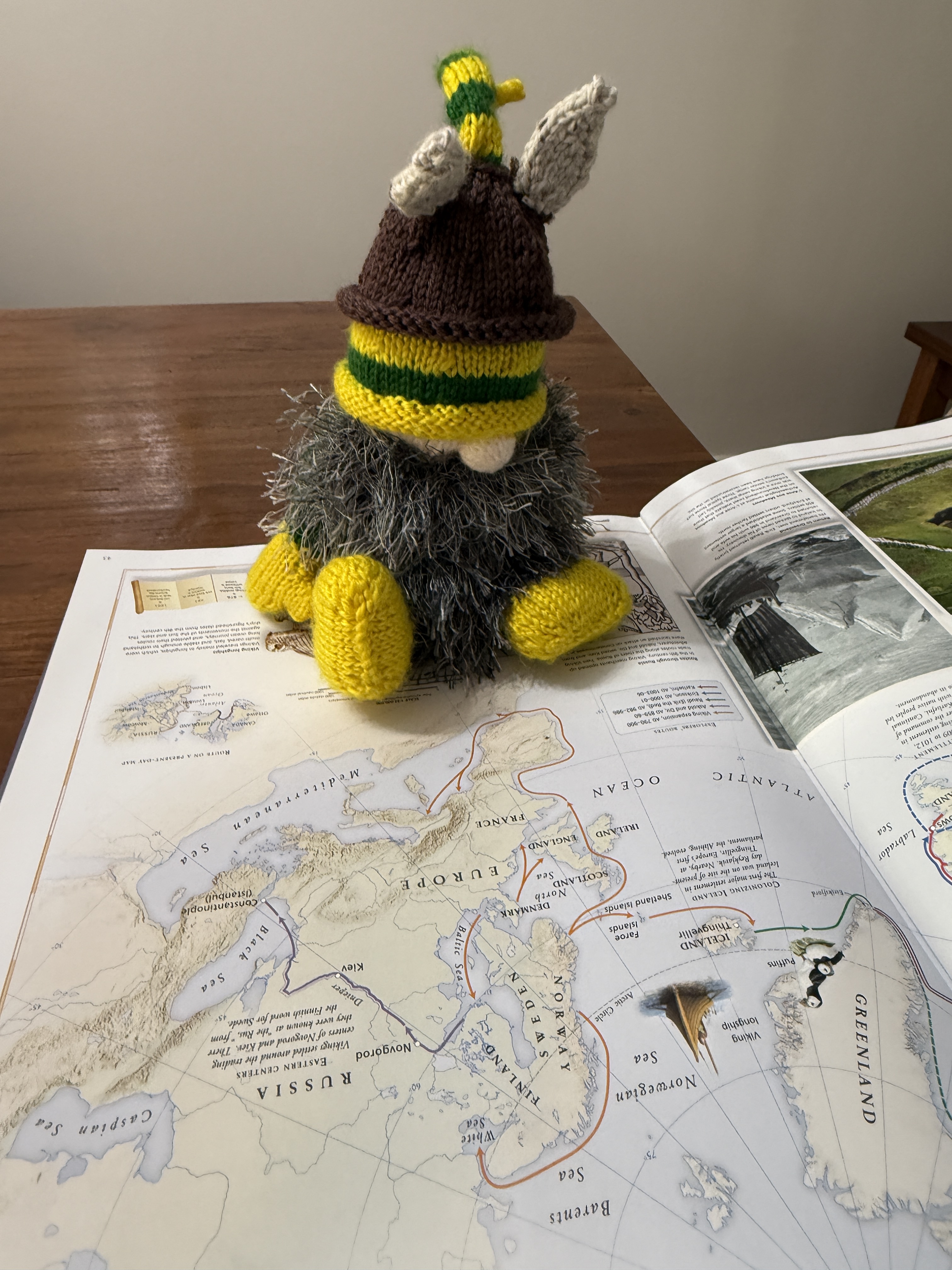
Slobro is accompanying us this time. Wearing his Viking helmet. He claims a long line of ancestors dating back to Viking days. Not sure about this but who argues with a Viking!
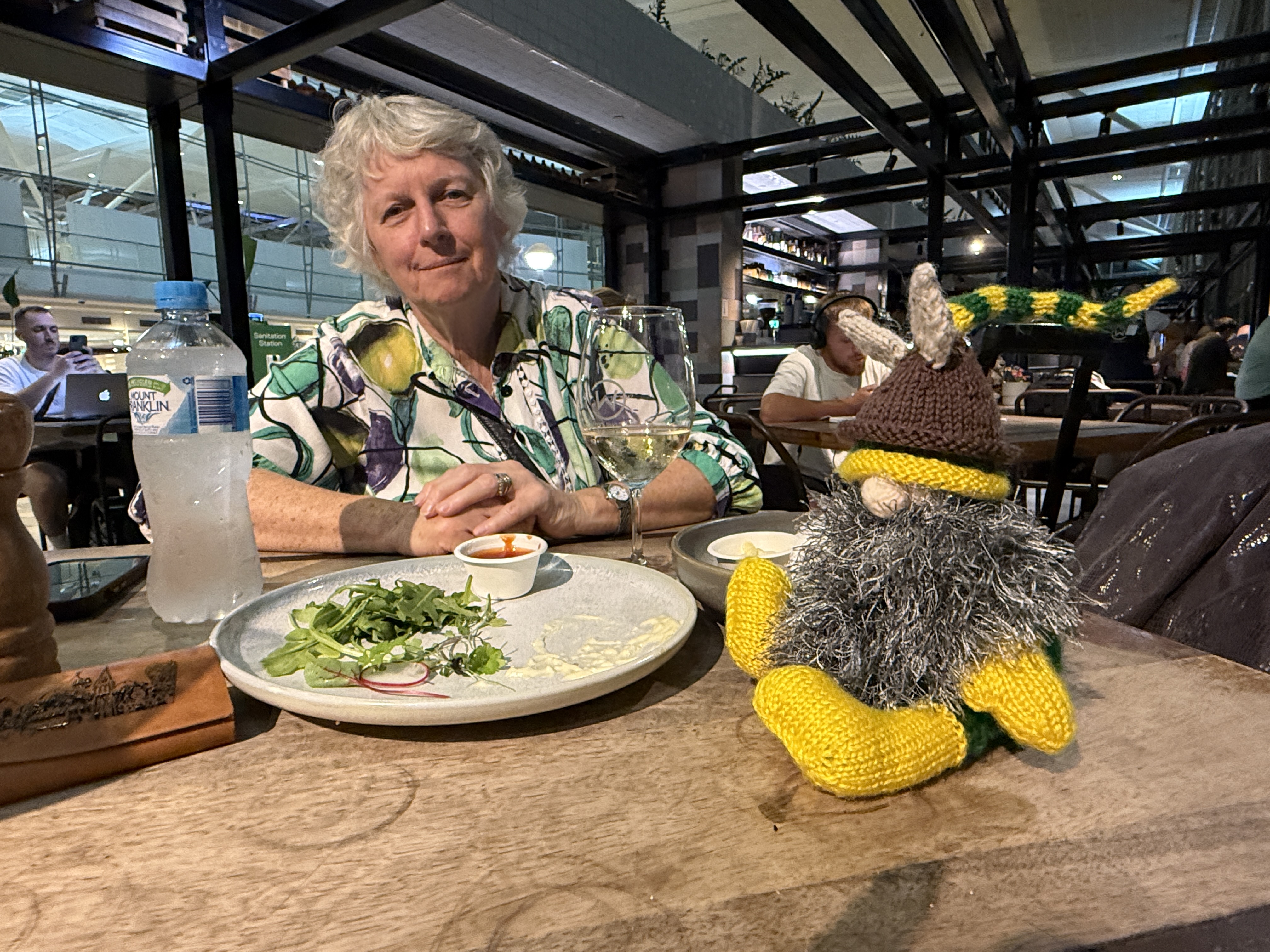
He even insists on eating some chips while we wait in the airport lounge for the flight.
It is the start of Spring in Oslo and the temperature will be around 5c at mid day. A little chillier than Brisbane town. We have a stopover in Dubai for a few hours before heading for Oslo.
Until Oslo!
Out of Africa
We are now in Cairo having flown up from Aswan and spent a night here in Le Meridian, adjacent to the airport. After a lazy day in Aswan after the Abu Simbel excursion we are a little more relaxed for the flight home after a busy five weeks.
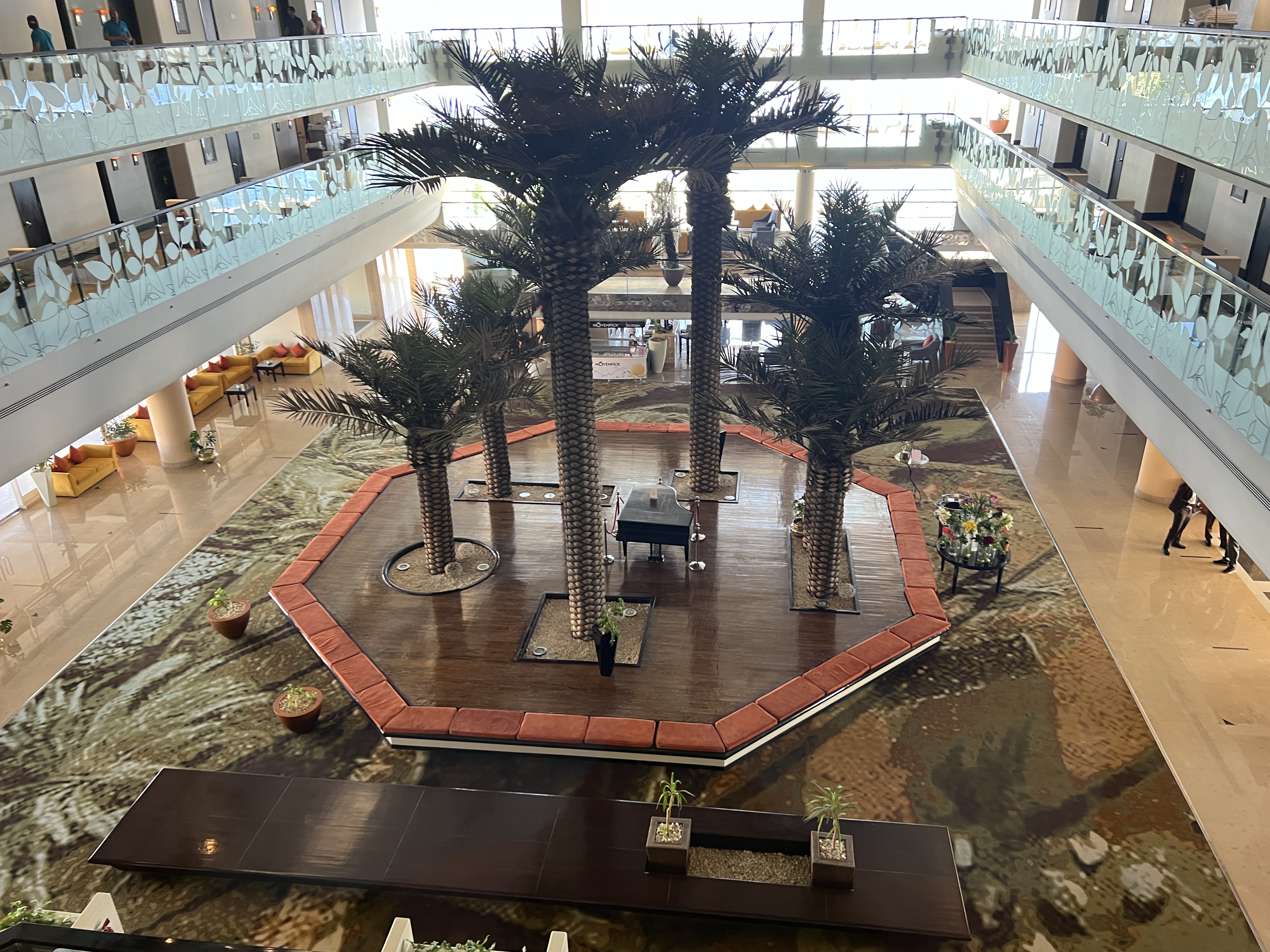
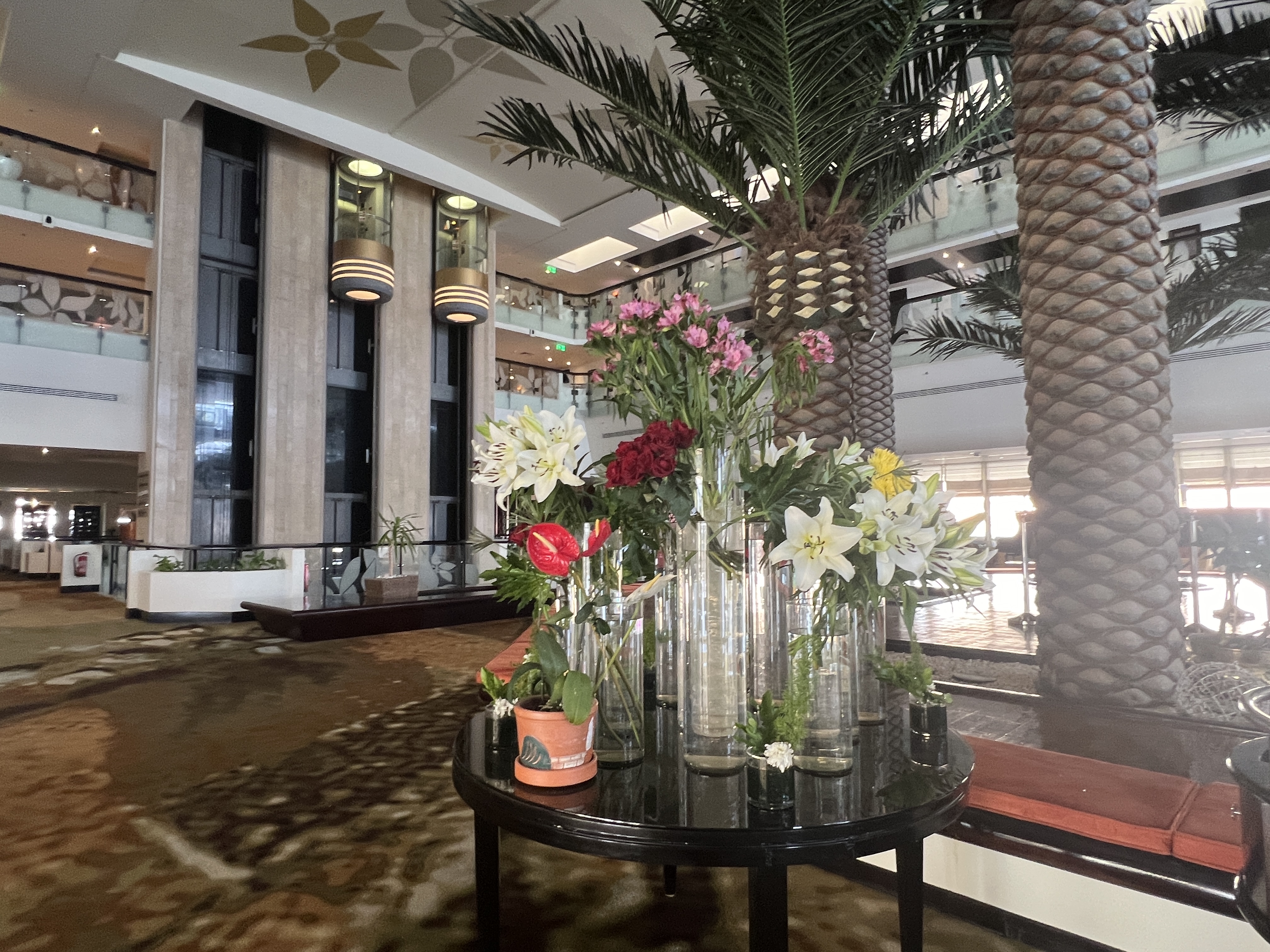
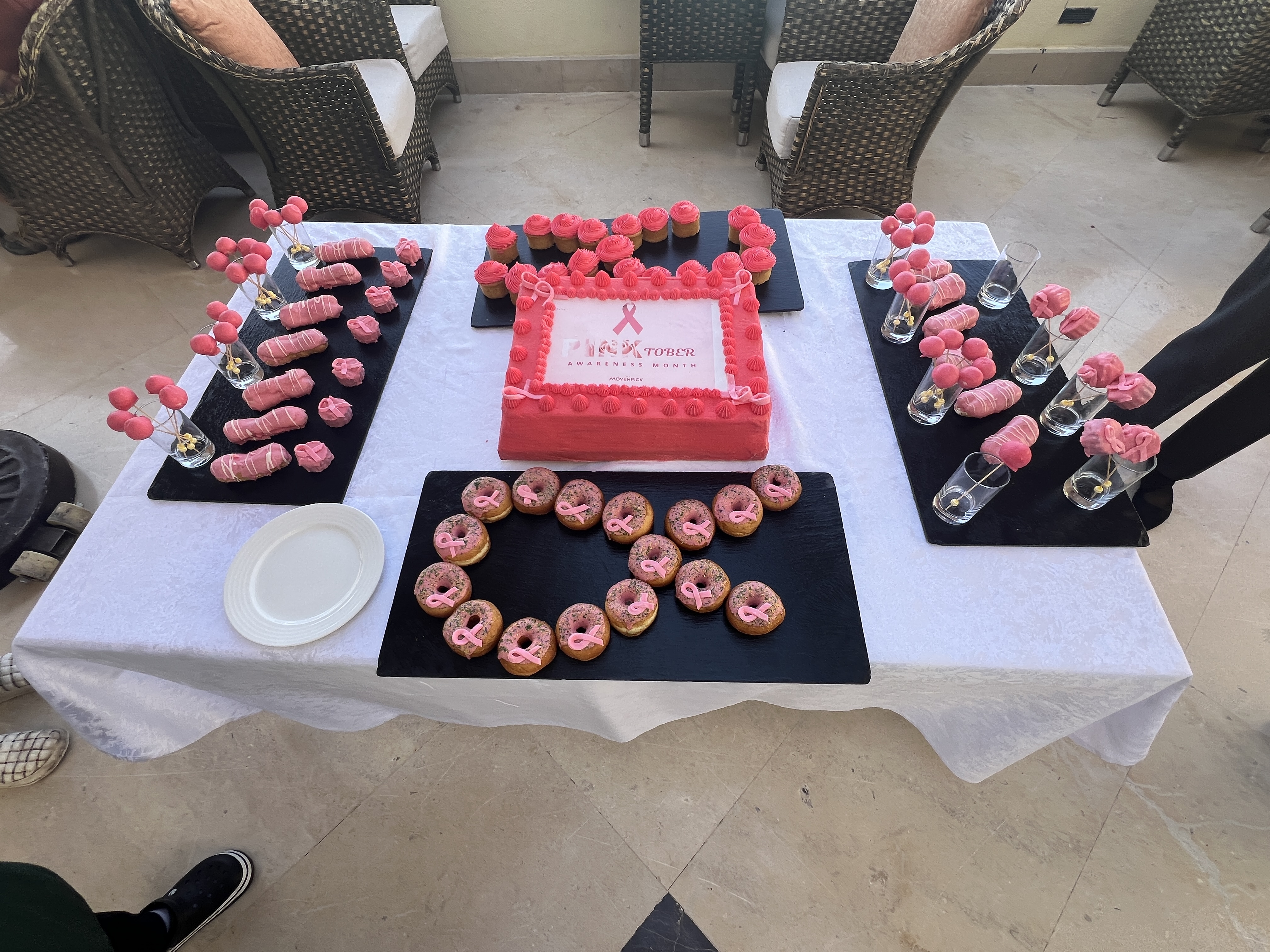
The Movenpick’s atrium and below a flower display. Breast cancer awareness also on the agenda here with a big cake and fundraiser.
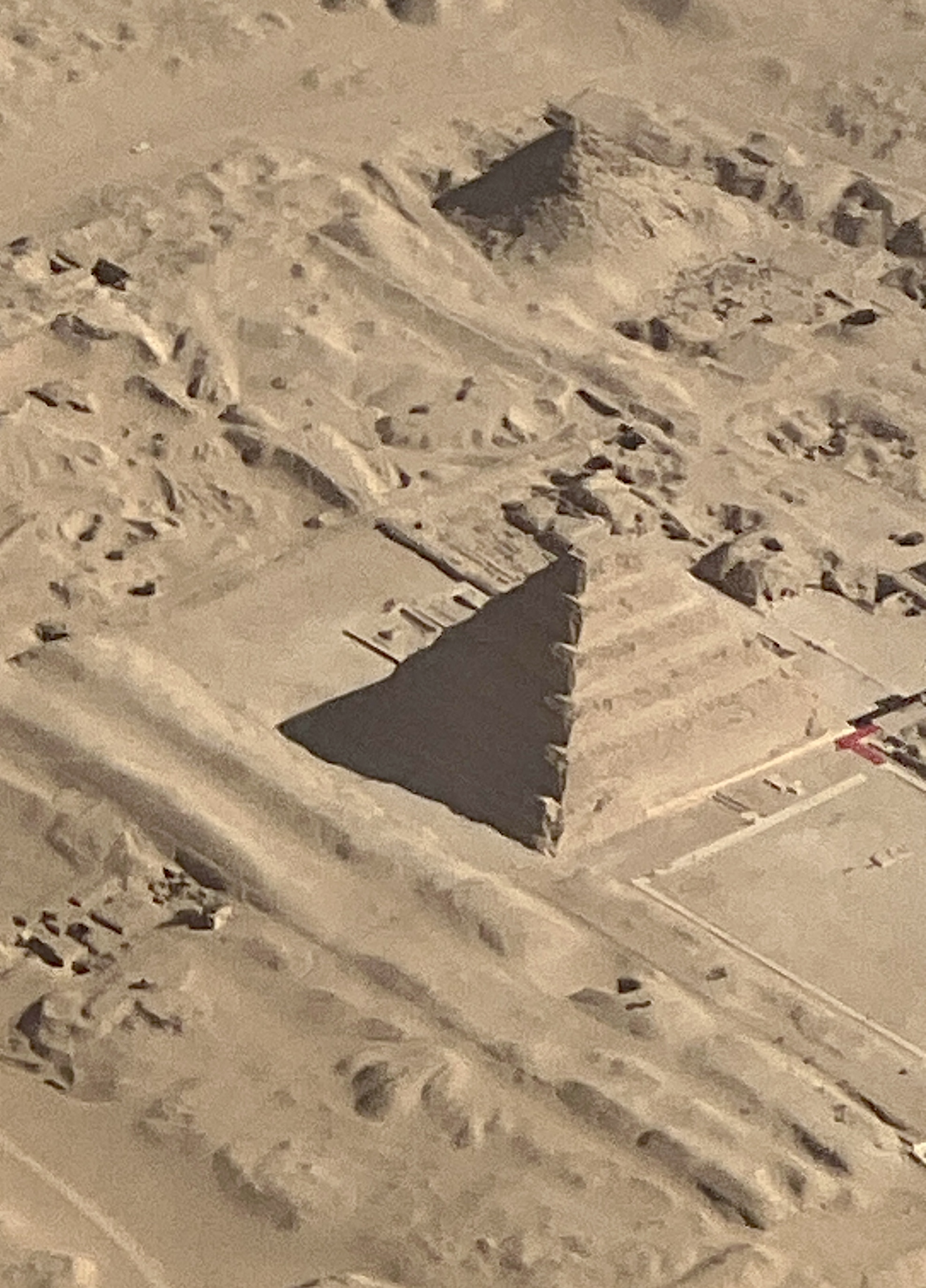
On the way into land at Cairo we had a great view of one of the oldest pyramids, the Step Pyramid.
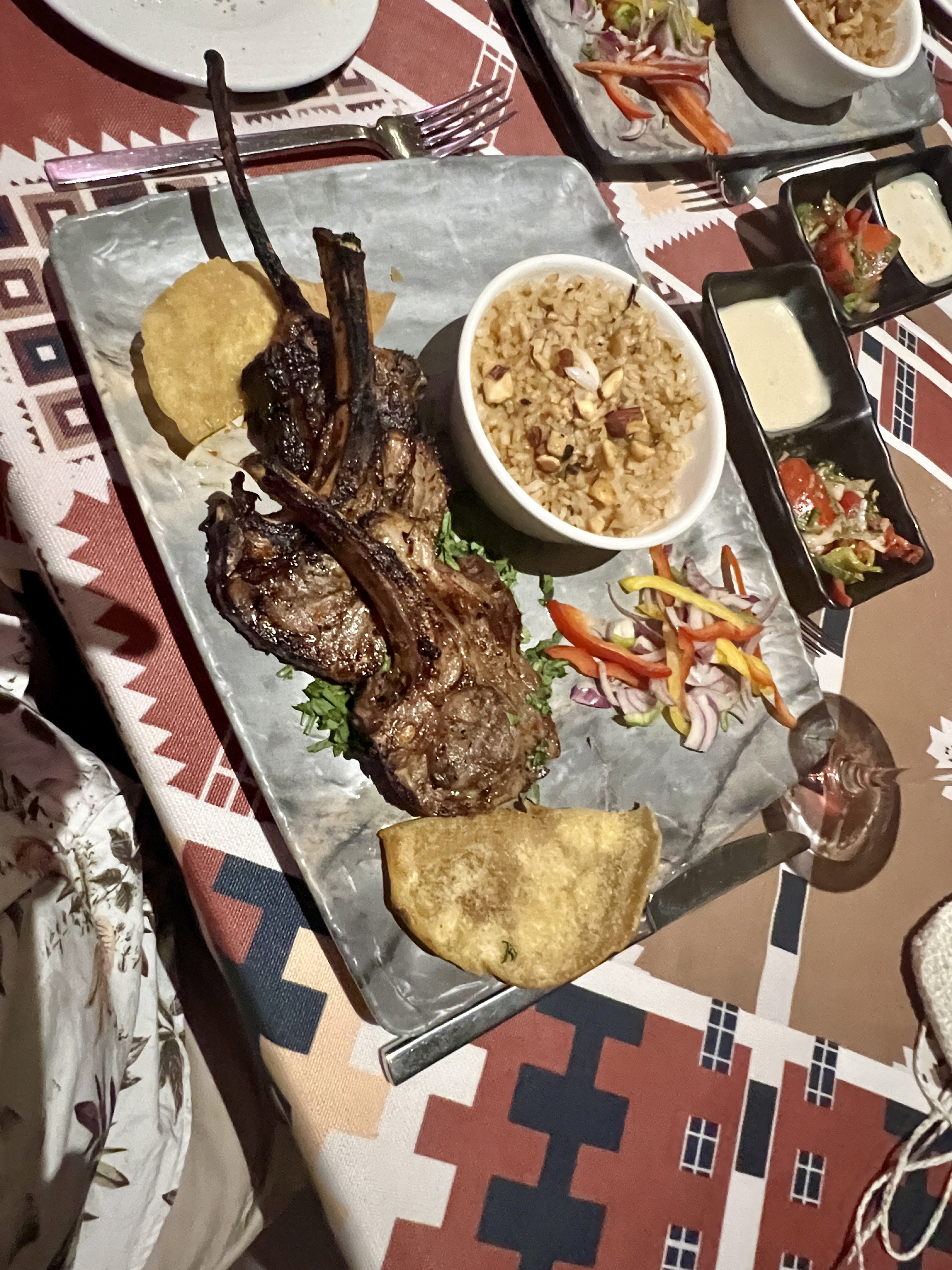
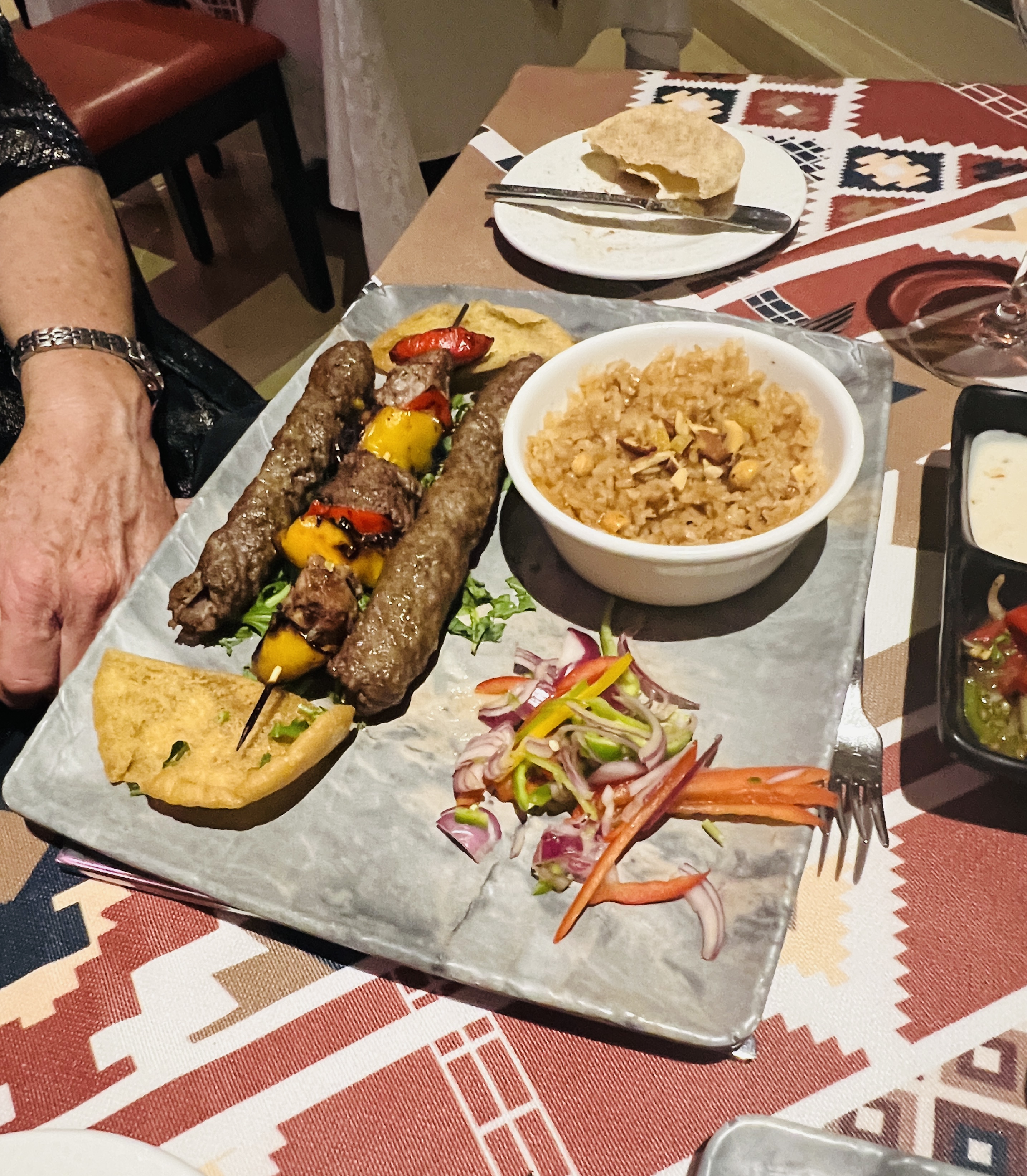
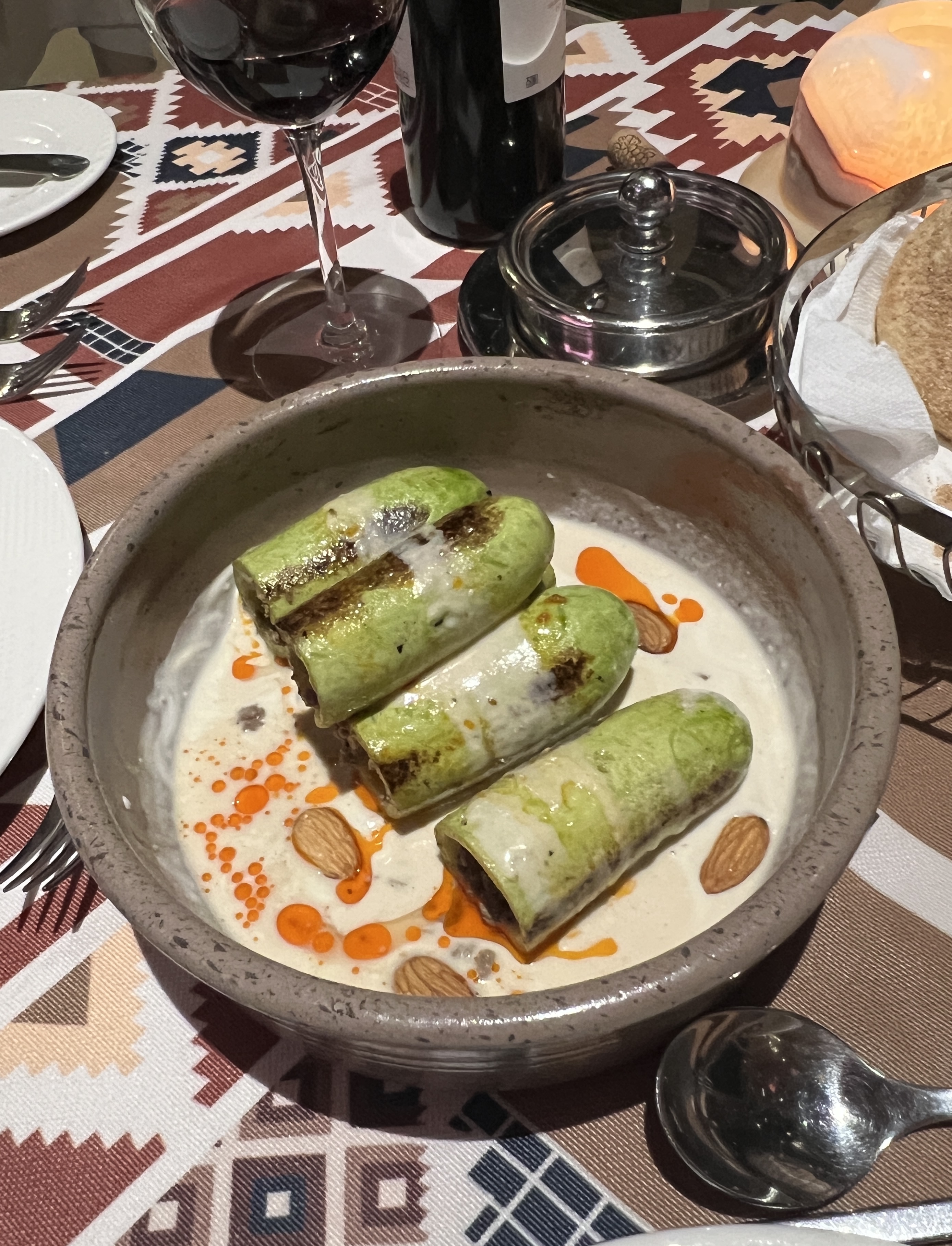
We had a ‘farewell’ dinner in Aswan enjoying some local flavours on kebabs and lamb chops. An interesting stuffed zucchini in garlic yogurt might make an interesting Christmas side dish (????)
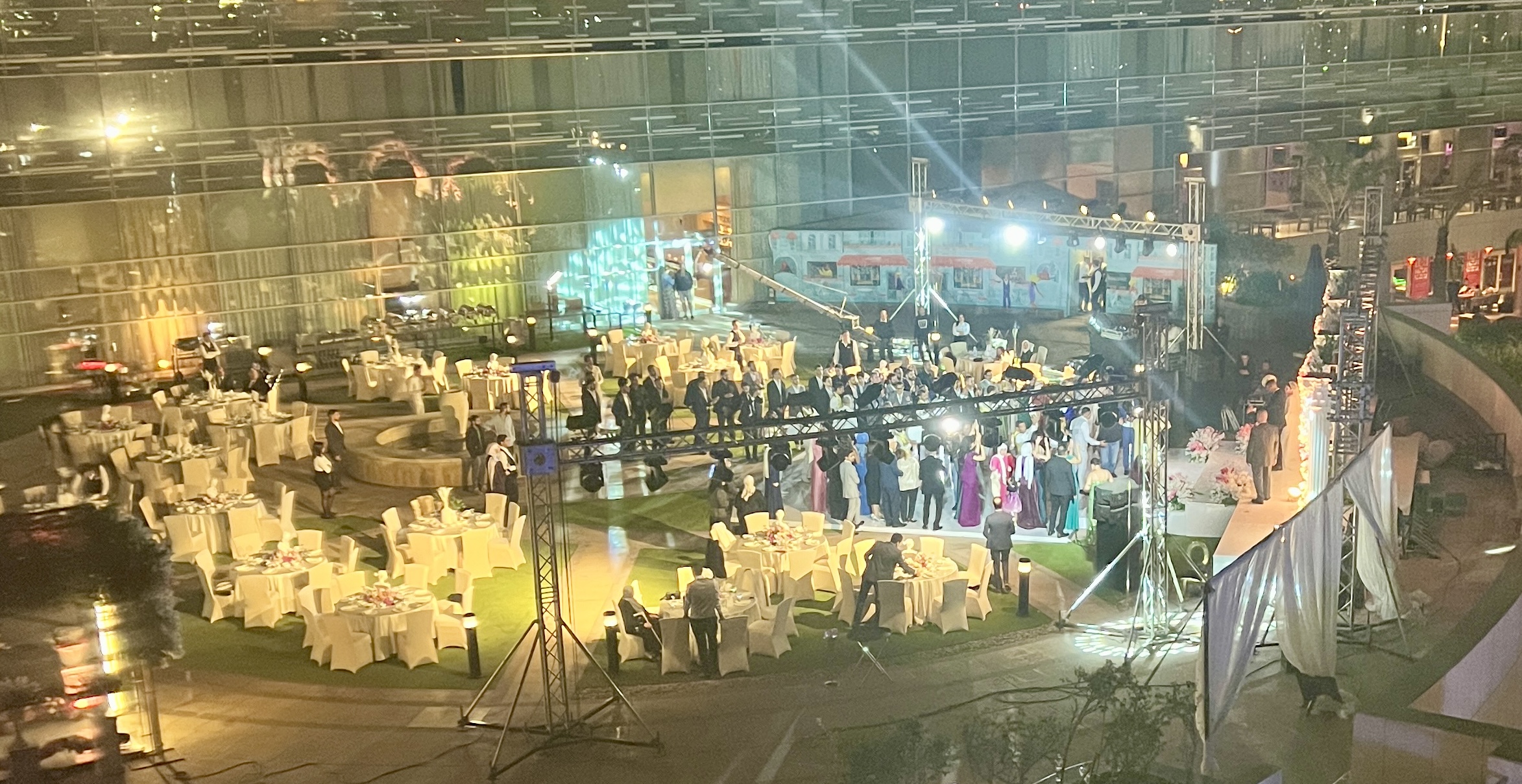
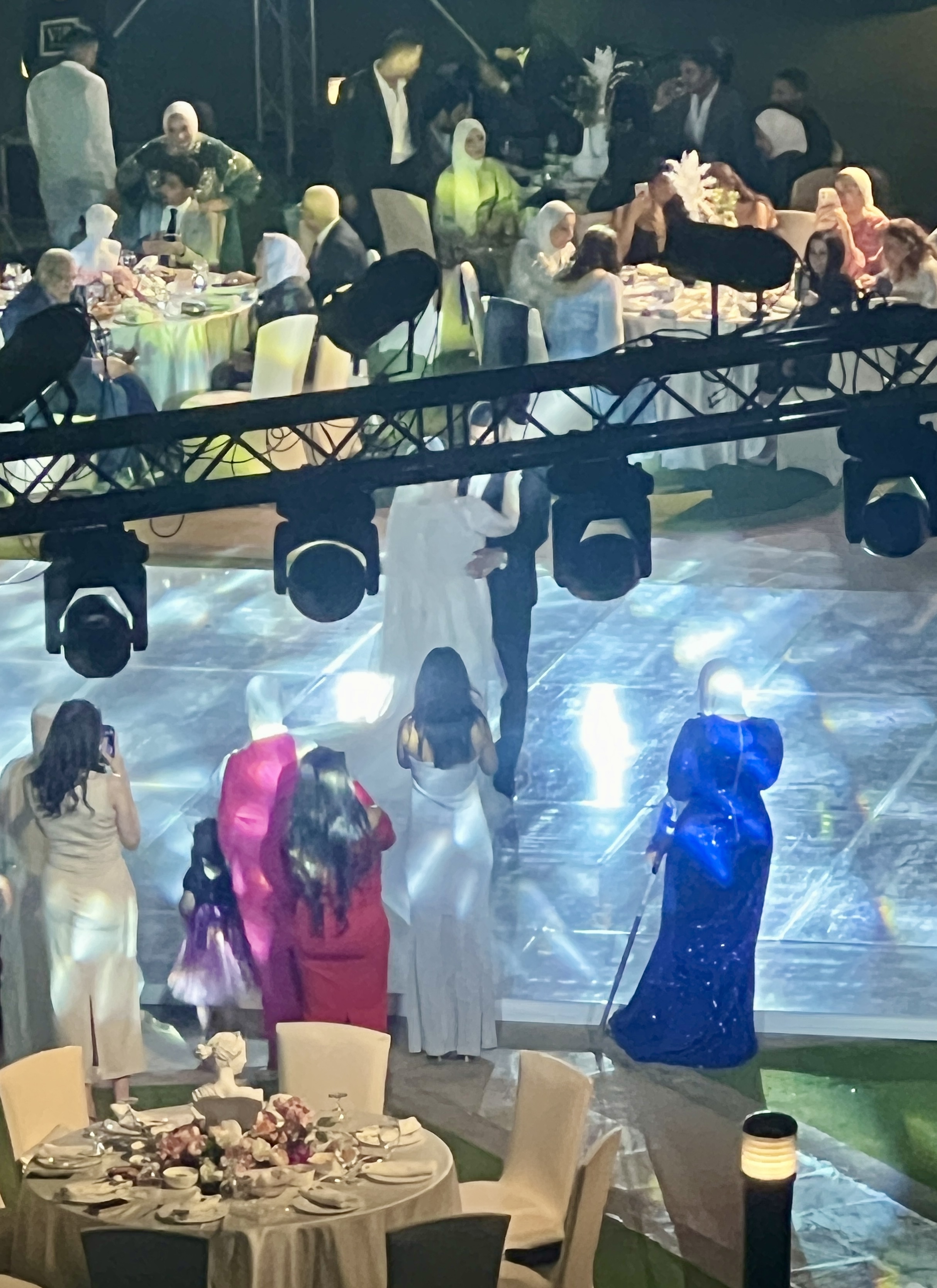
In Cairo we were ‘entertained’ by an Egyptian wedding reception in the hotel, a bird’s eye view from our hotel room. Fuzzy pictures of the frivolity.
Our flight on Emirates leaves at 8 pm and I am sitting contemplating trying to finish the 1930s ‘Out of Africa’ by Karen Blixen on the way home. Have got through about a quarter of it so far. A very lyrical memoir of her time in Africa in the 1910/20s. Got to concentrate.
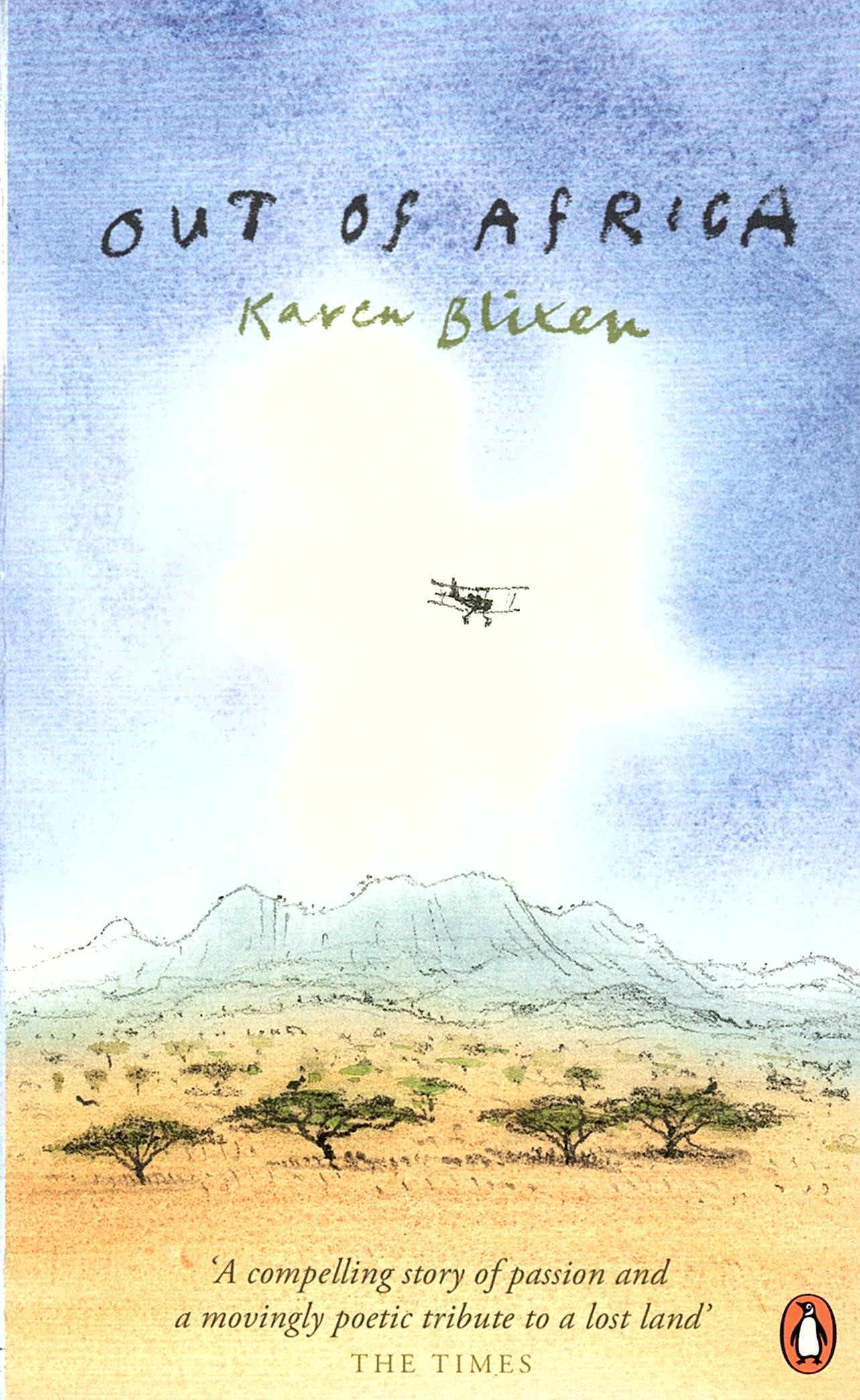
Also wondering where one might go in Africa next. Maybe to Uganda to see the Gorillas in the mist? But Homealone thinks the movie is a better option………! Probably agree …….
Temples, Tombs and Tales V
Our last site visit before leaving the SS Sudan in Aswan was to see the Philae temple complex. It is a comparatively young complex built from around 350 BC. Originally, it was located on the Island of Philae and lies in the waters between the Low and High dams.
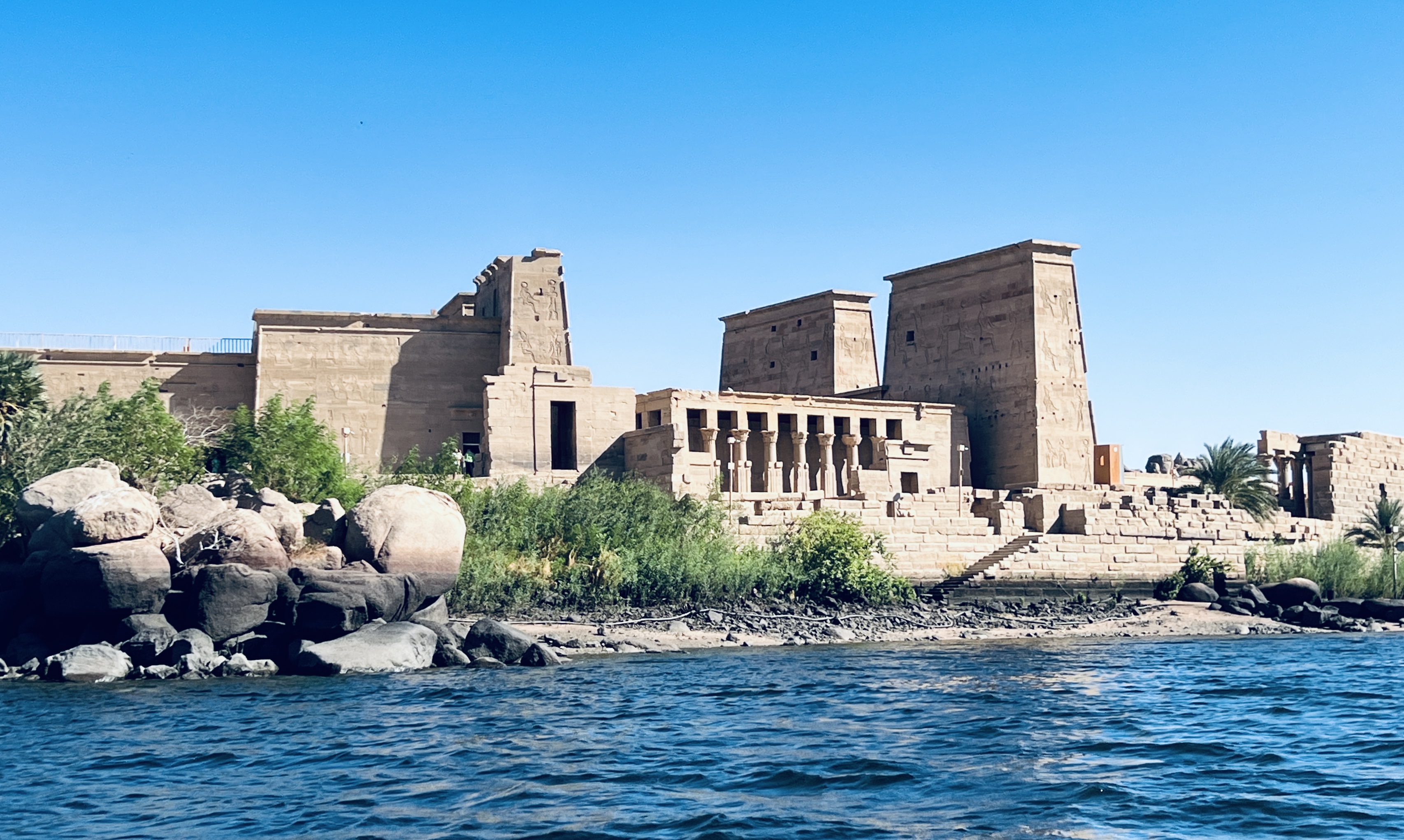
This island and the temples though were to be the victims of the rising waters of Lake Nasser behind the Aswan High Dam, built from around 1960, further up the river from the Aswan Low Dam. So, the temple complex was moved block by block to the nearby island of Agilkia, where it is today. A few rocks and remnant tree trunks are all that remain above water of Philae Island.
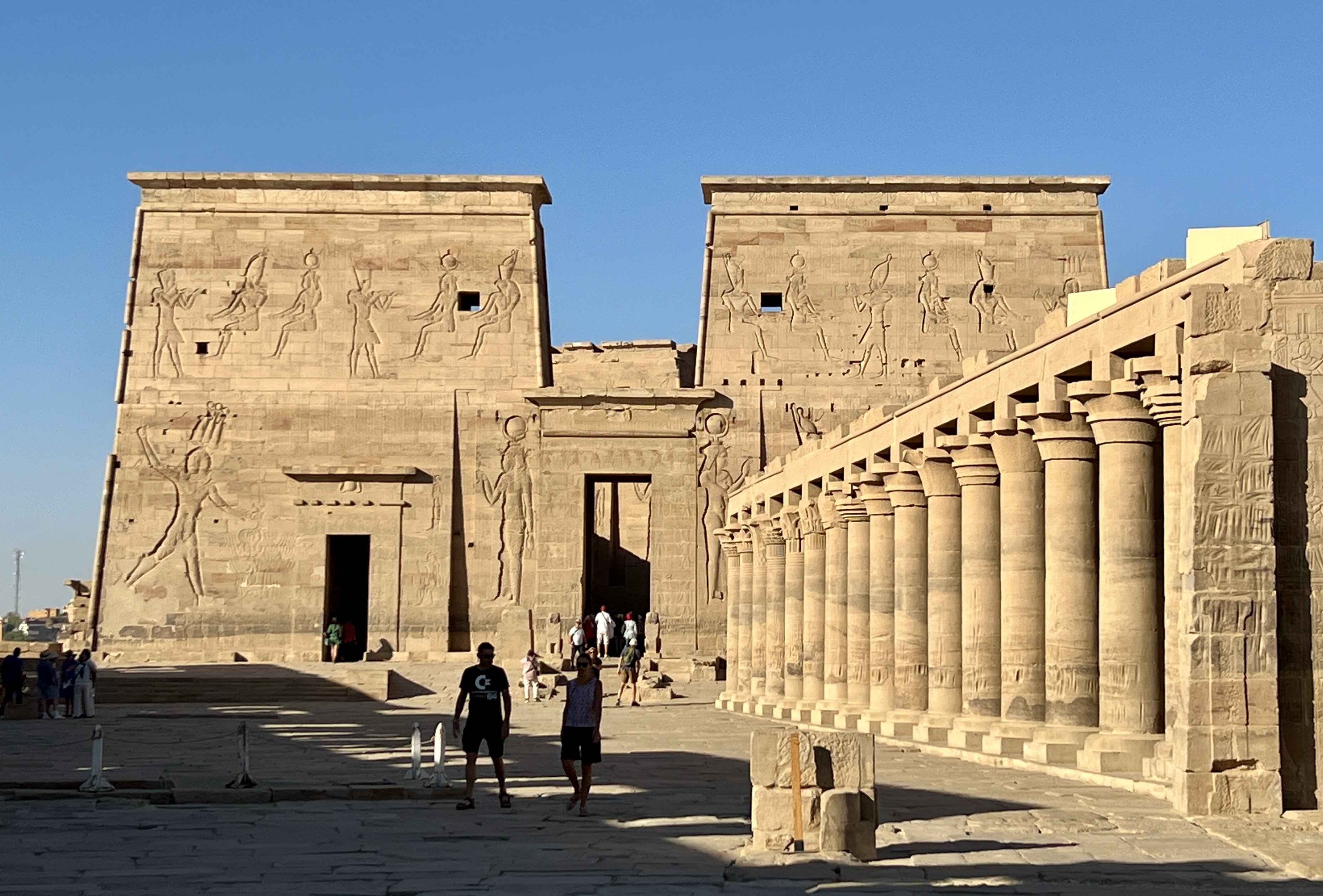
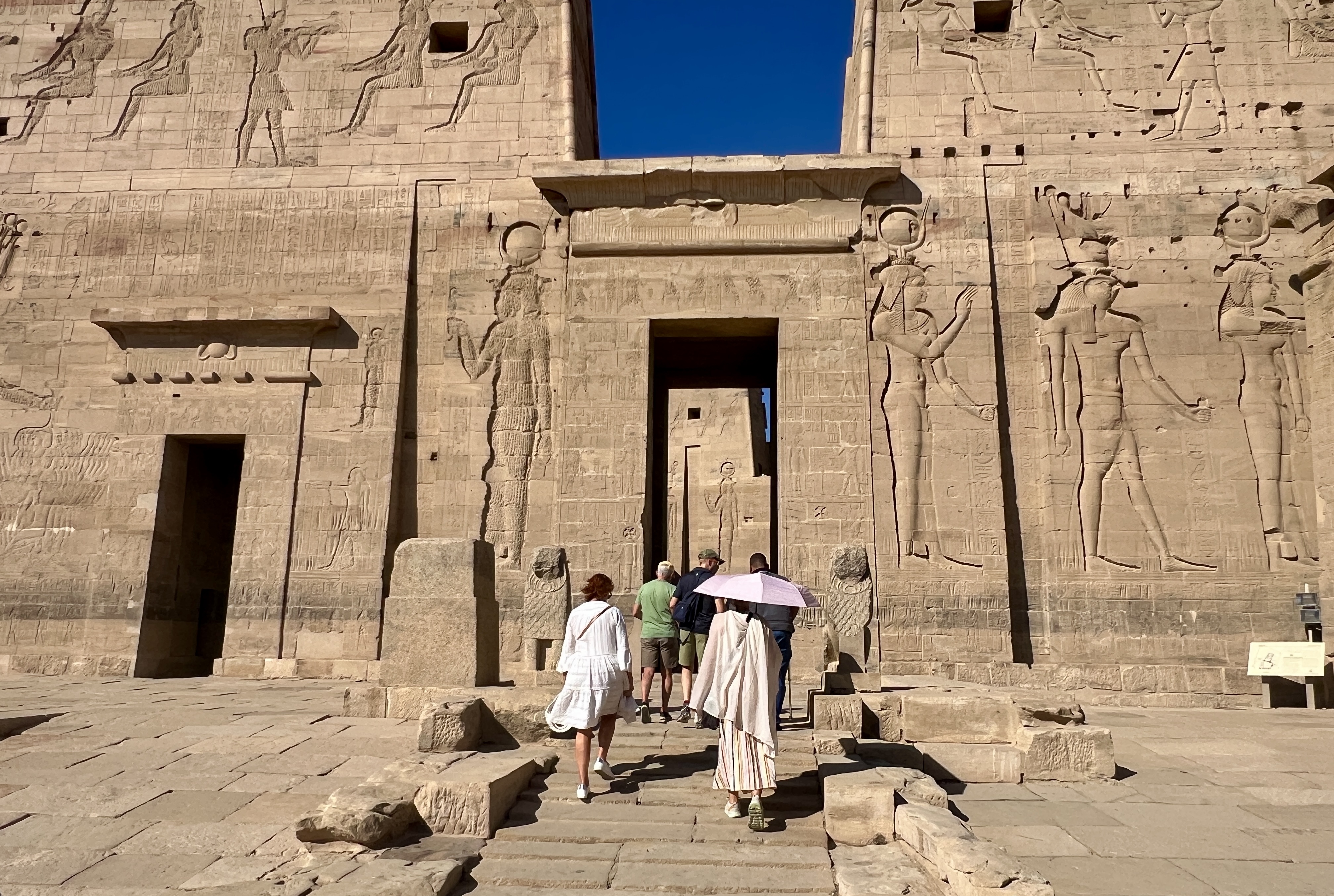
The main temple is dedicated to the god Isis.
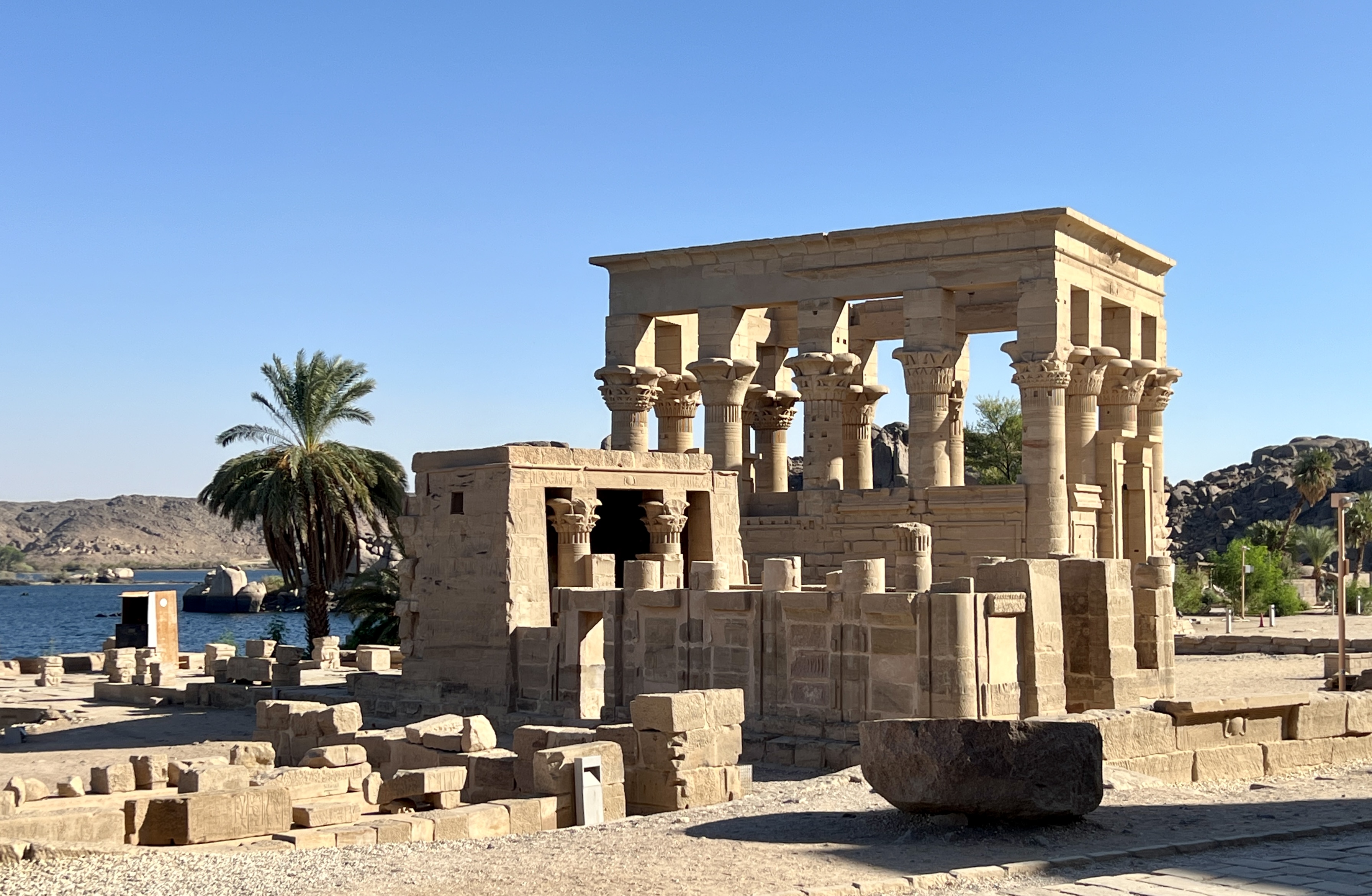
There is a small stand alone temple for Hathor at the rear of the main complex.
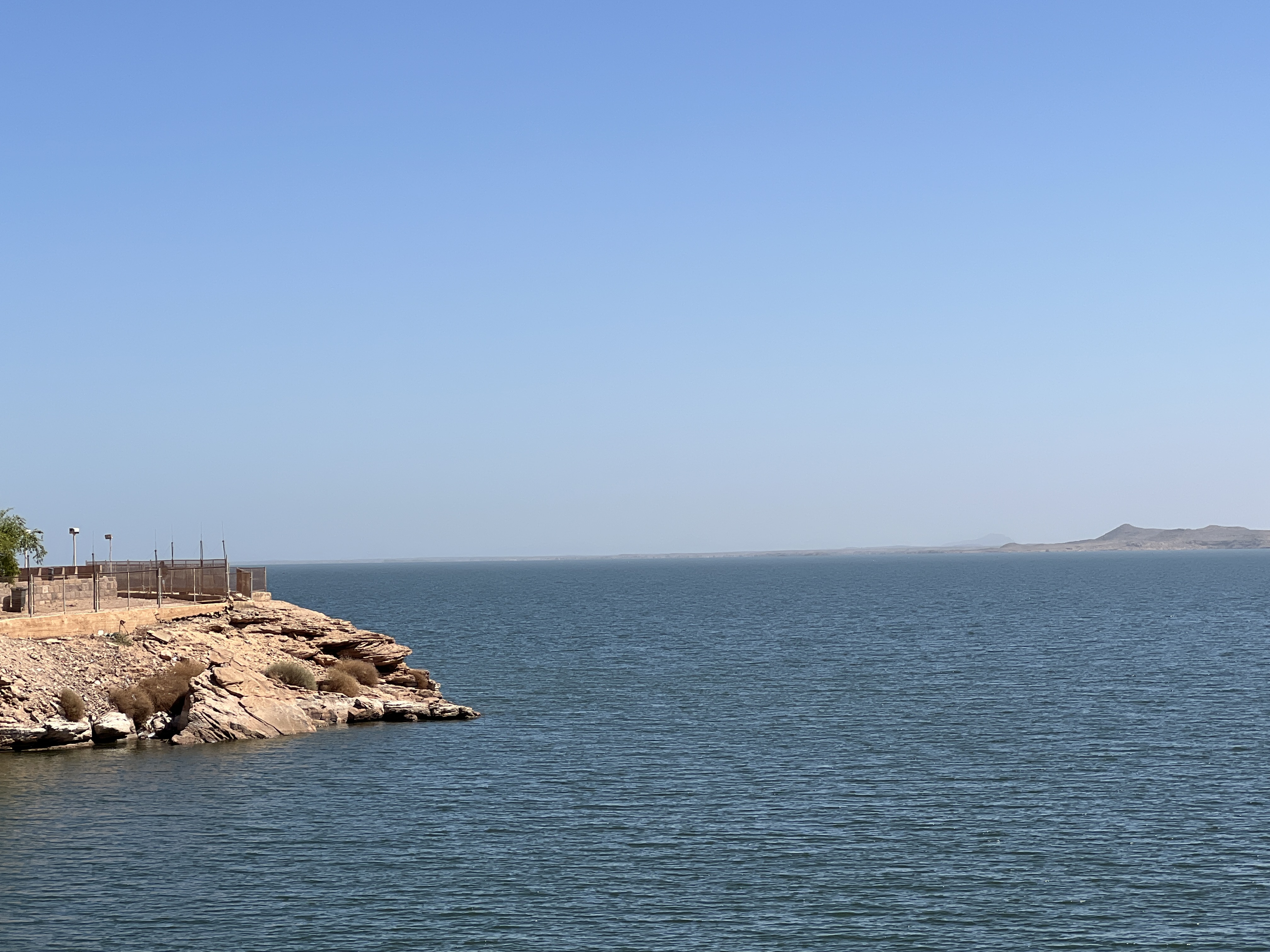
Staying on in Aswan for a few nights allowed us to make the day trip down to Abu Simbel, on the shores of Lake Nasser.
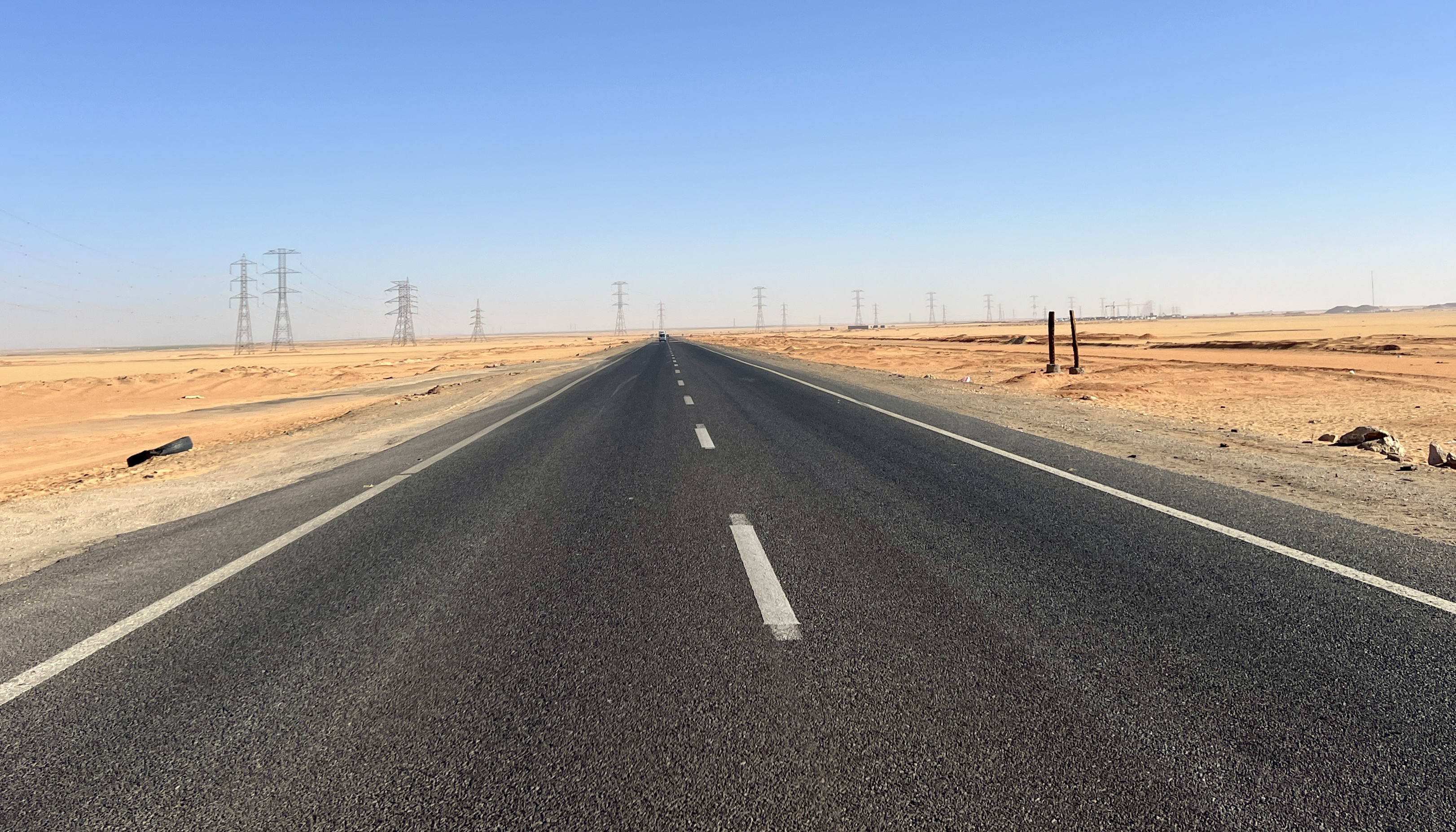
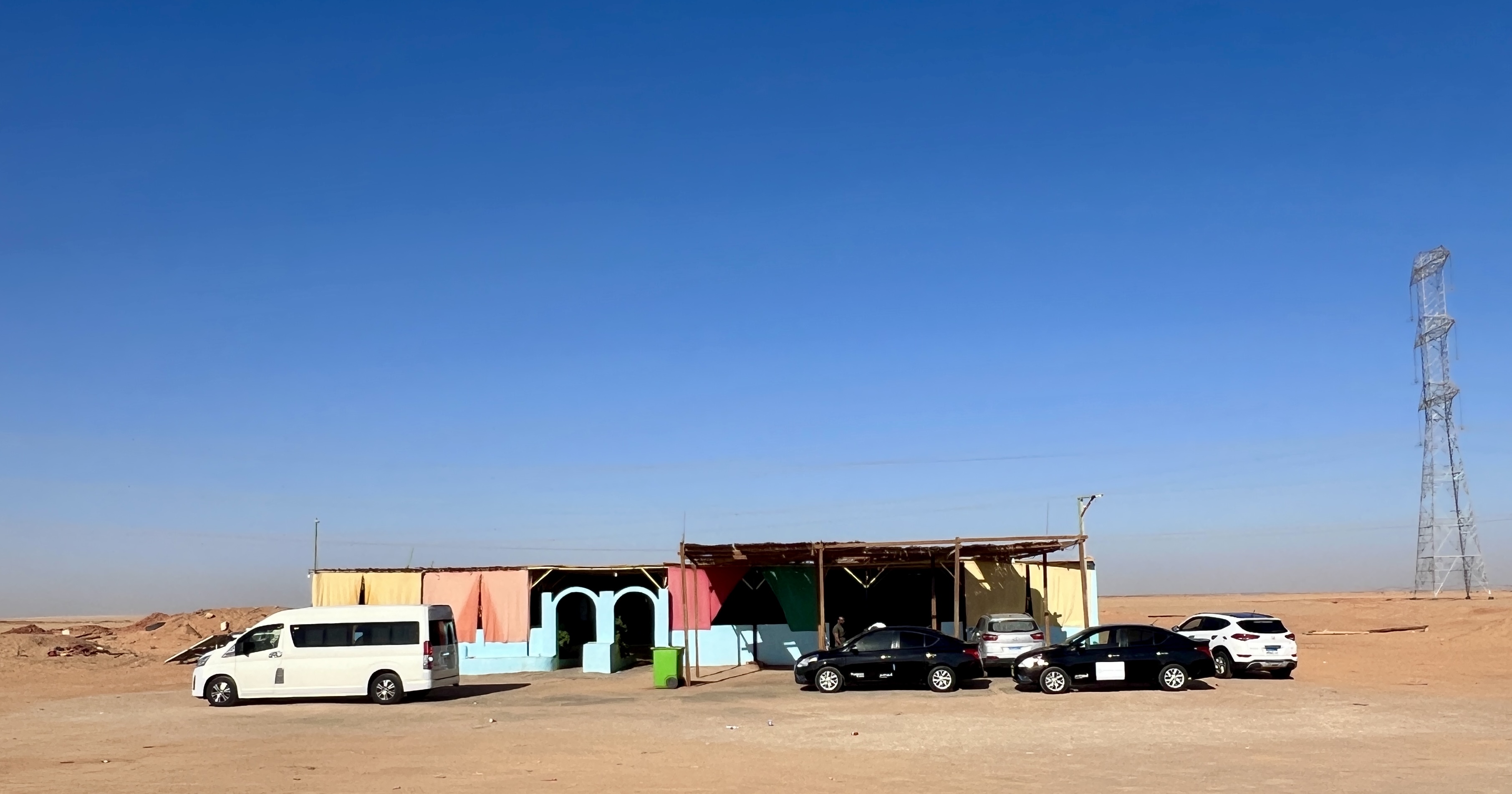
Just the two of us with the driver and guide. Had a bit of a snooze along the way. It is a three hour trip to about 40 km north of the border with Sudan. Big military presence for most of the way. It is a fairly sensitive region and Egypt is making an enormous effort to populate the area which is a vast desert landscape stretching away to Libya in the west and the Red Sea in the east.
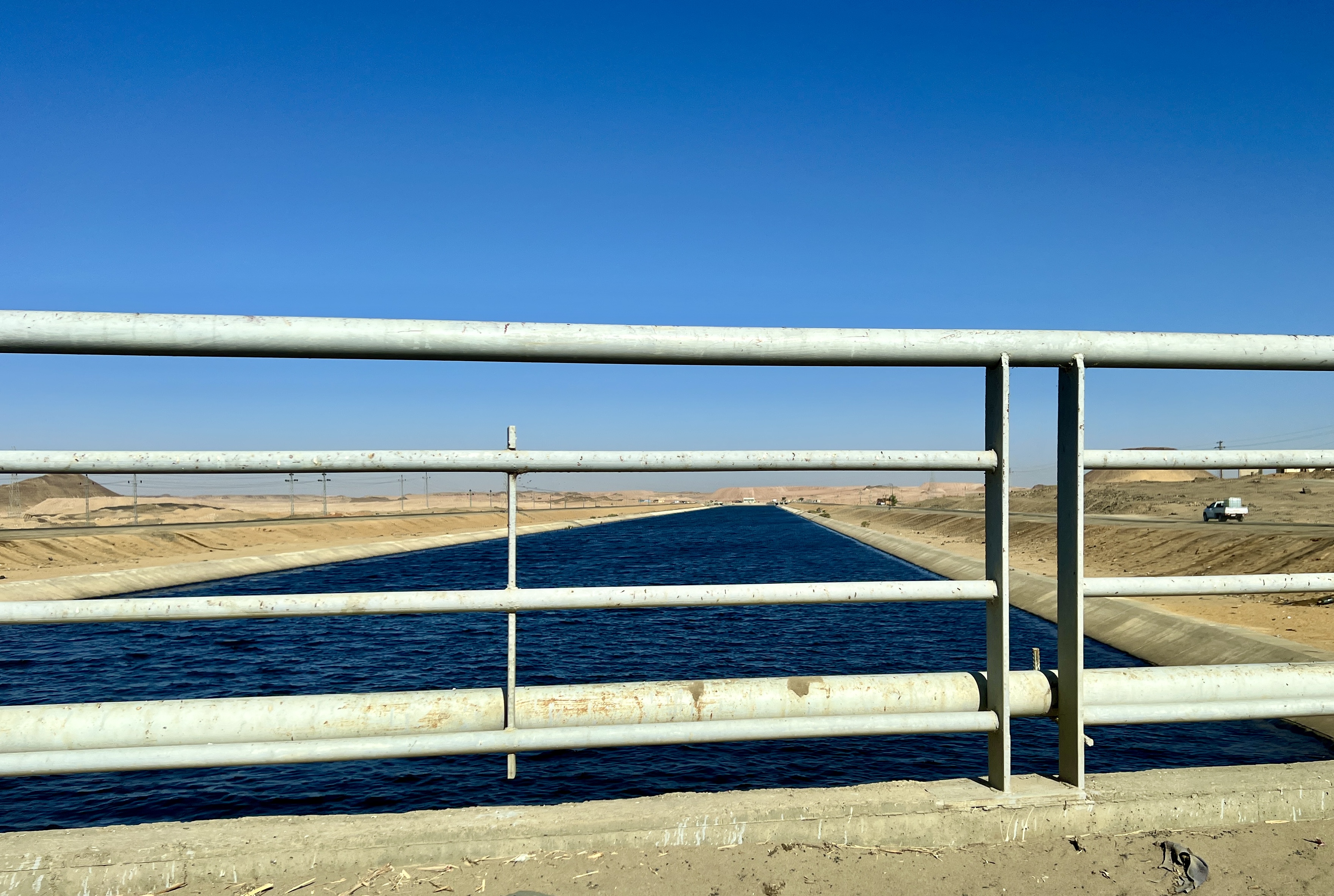
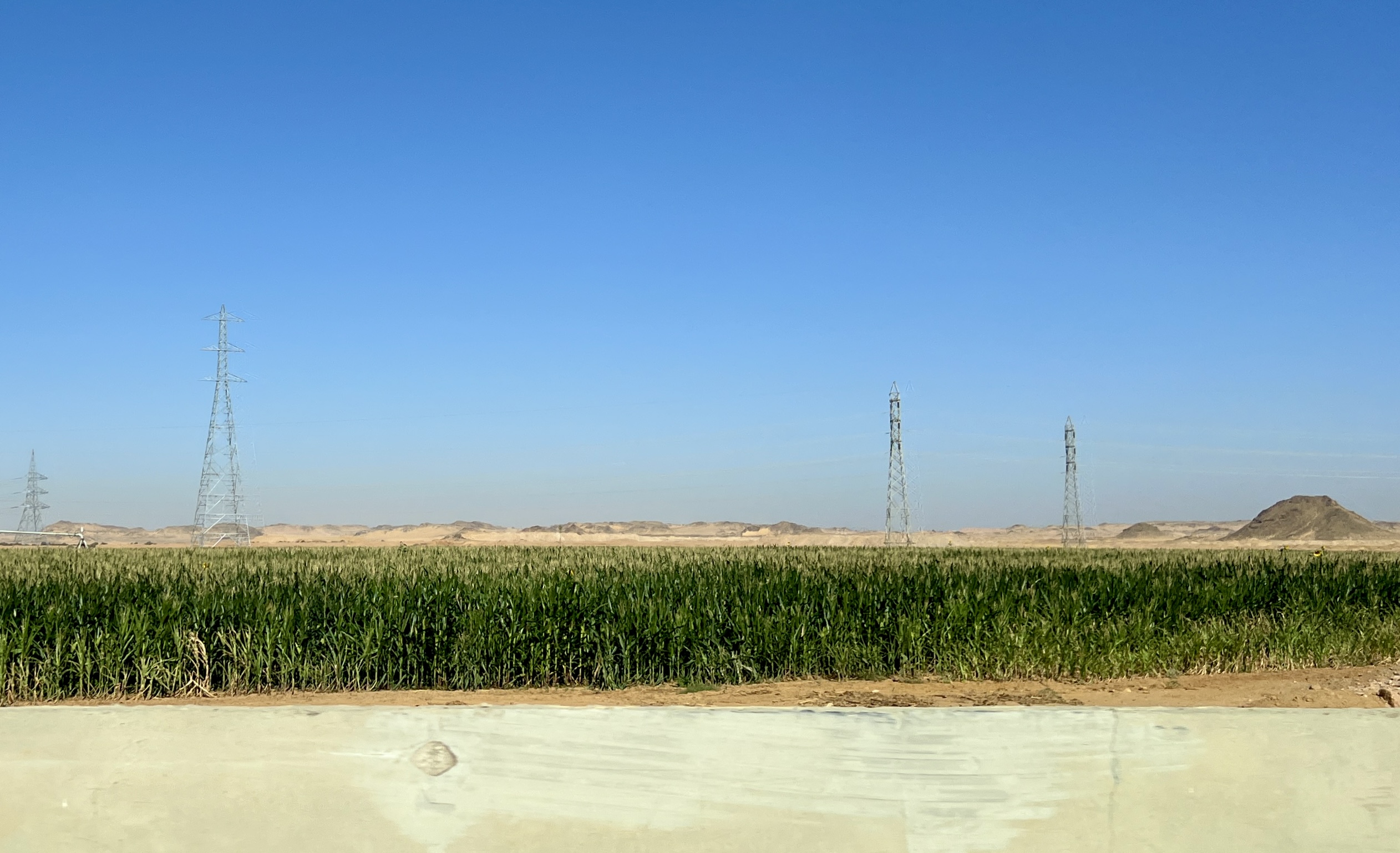
Huge canals have been built moving water from the Nile to irrigate the desert soils for crop production on a grand scale. Our guide notes there is a big drive for grain supply security, particularly given that Egypt imports grains from Ukraine. He said they aim to be self sufficient ASAP.
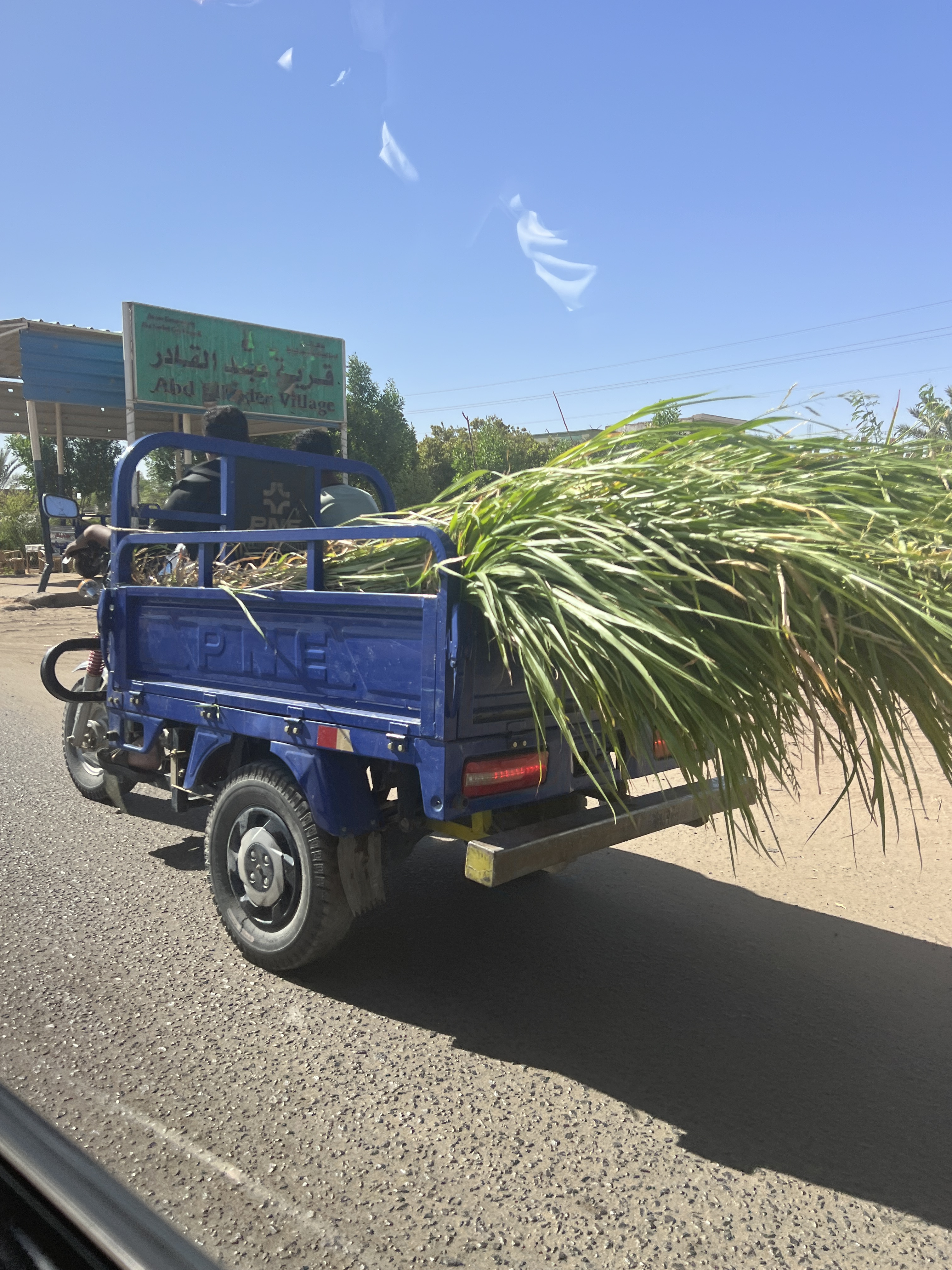
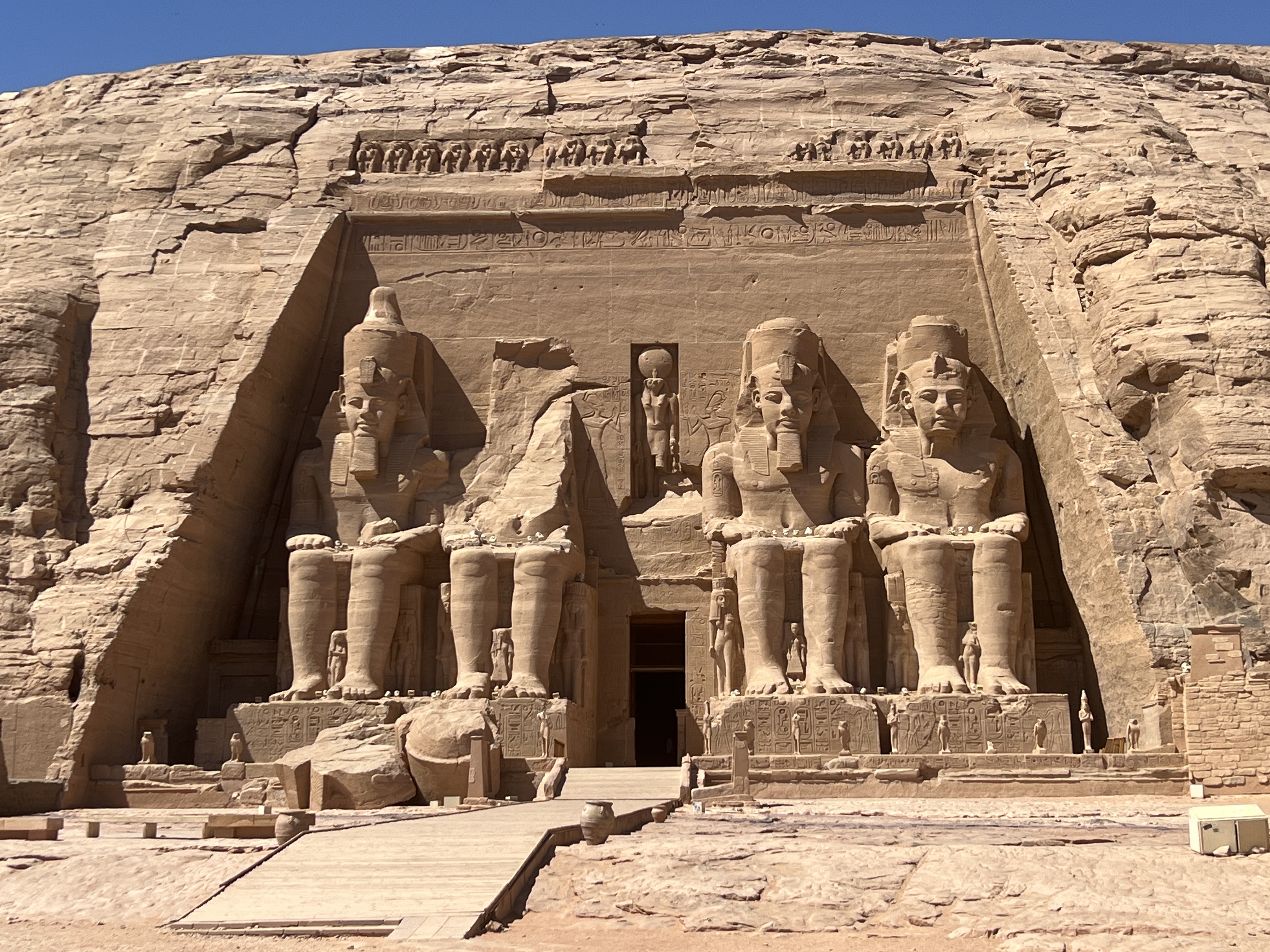
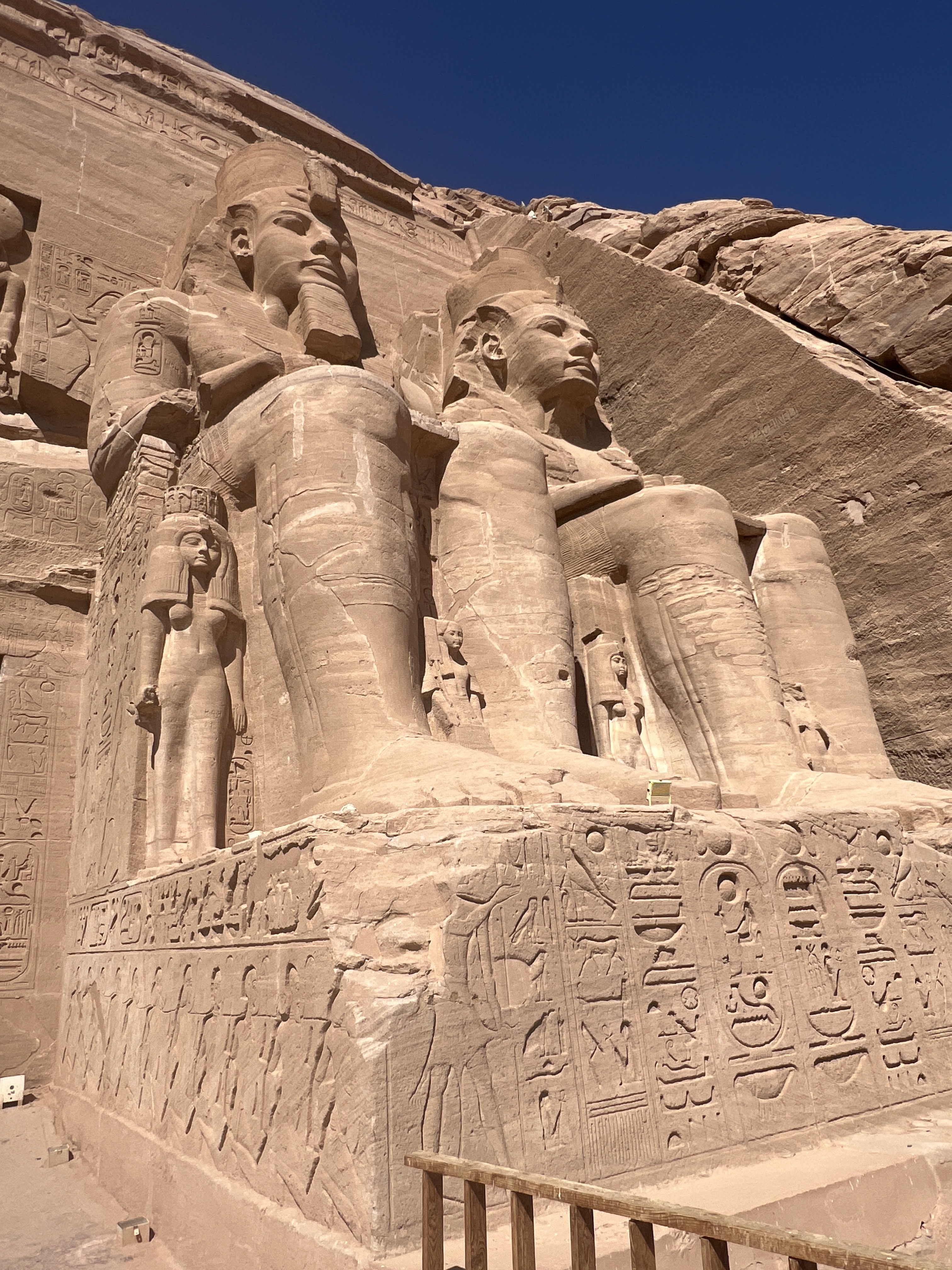
Abu Simbel is an amazing first up sight. The task of relocating the temples as enormous and complex as their original creation.
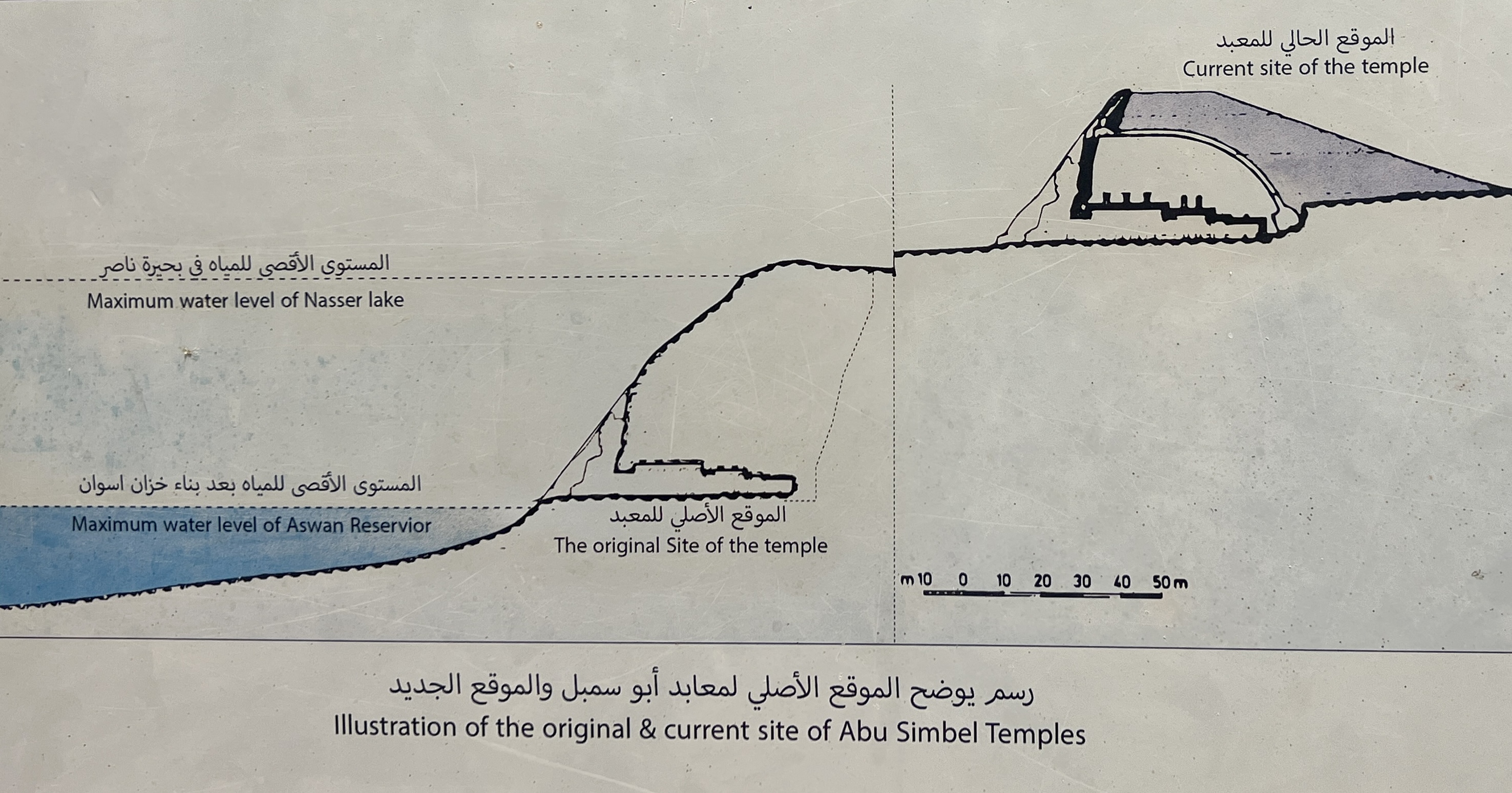
The temples were made by sculpting the mountain face in the mid 1200BCs. Then in the face of Lake Nasser flooding them after 1960 the mountain was cut into blocks and glued back together again on a higher site with the same positioning and aspect as the originals. A giant three dimensional jig saw puzzle. Amazing work.
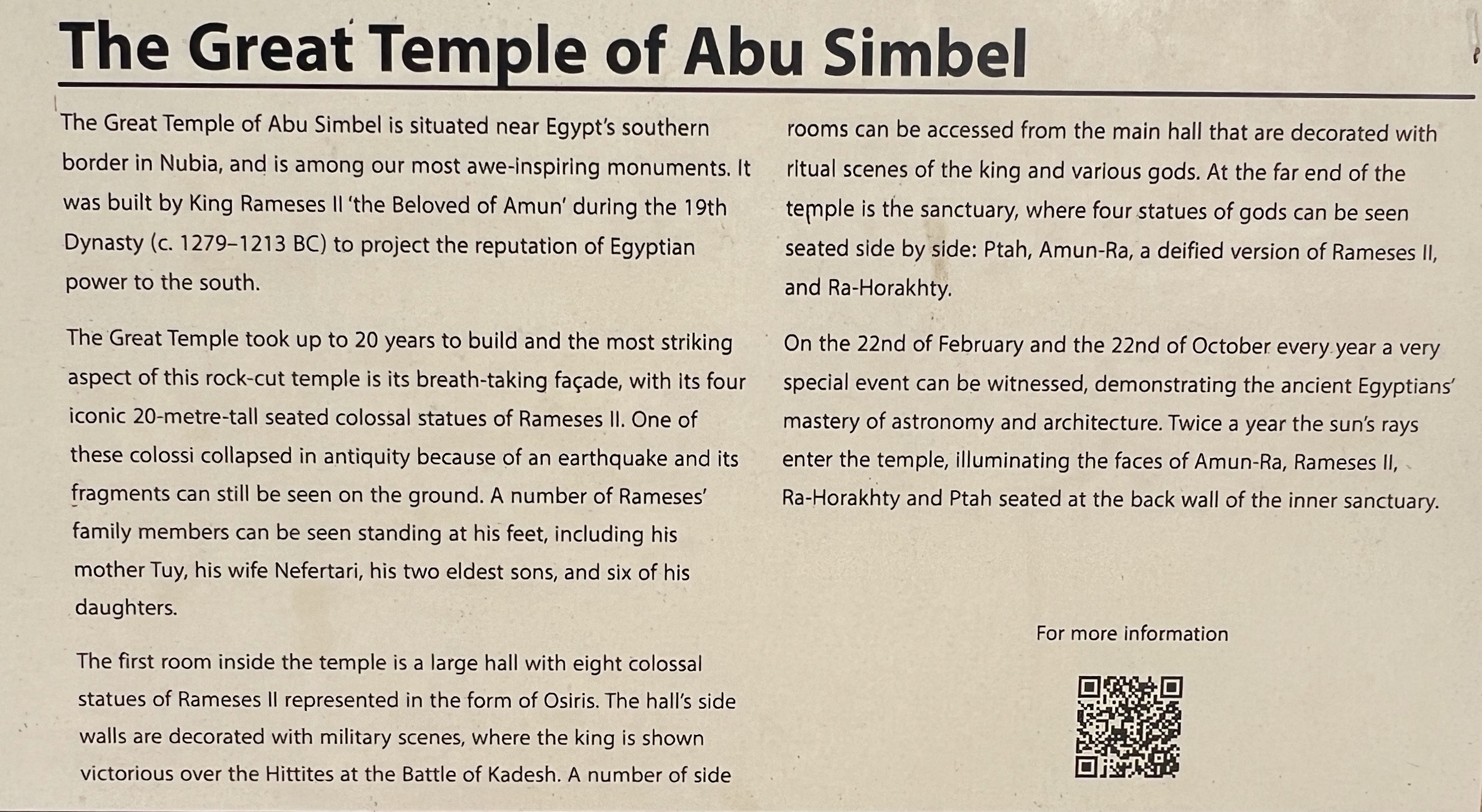
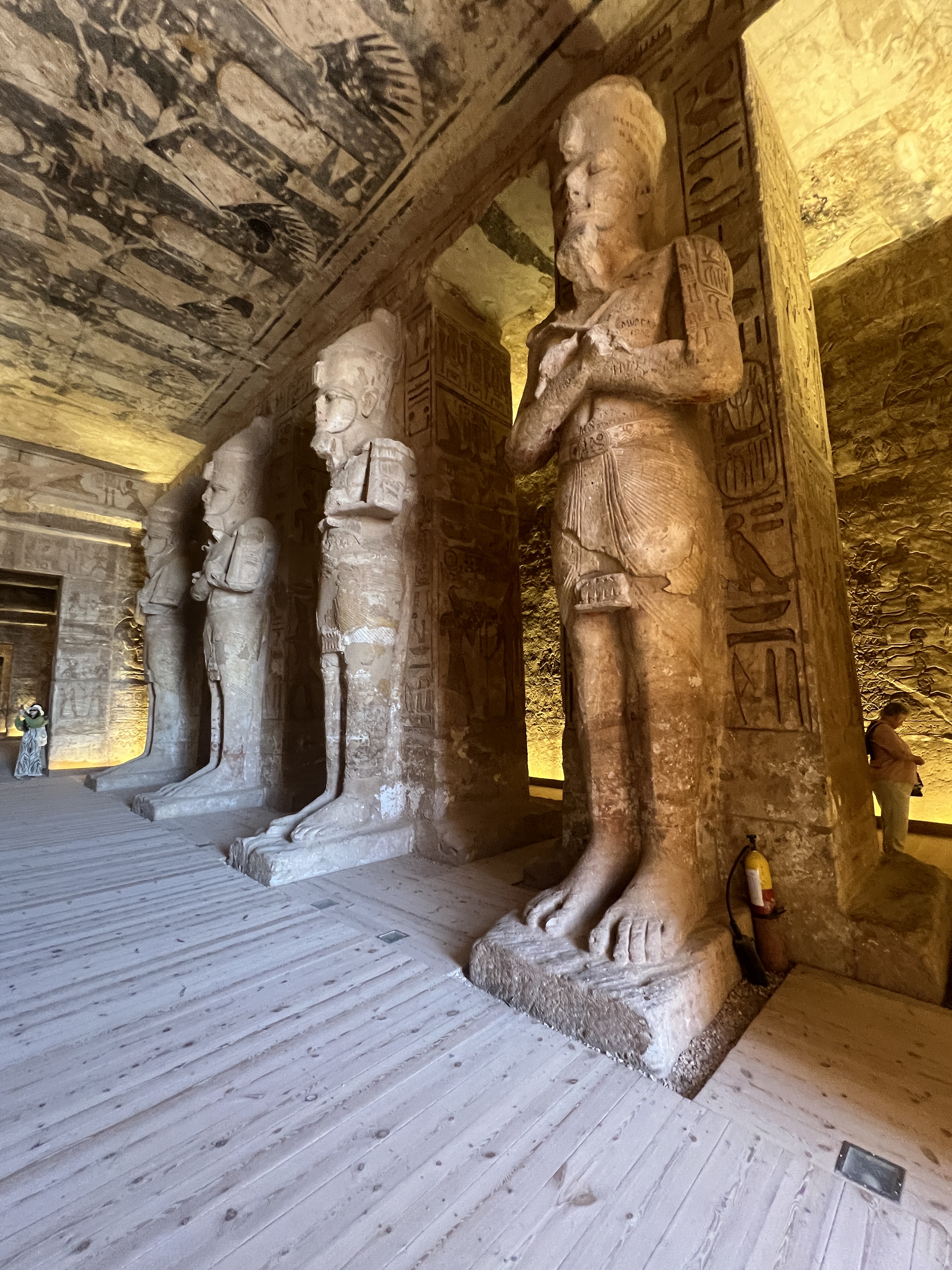
Inside the temple the walls are covered with the usual sort of carvings, paintings and hieroglyphs. In one spot there is a large panel that documents Ramesses II victory over the Hittites at the battle of Kadesh. We had previously ‘heard’ about this while in Jordan a few years back. Amazing now to see the actual text!
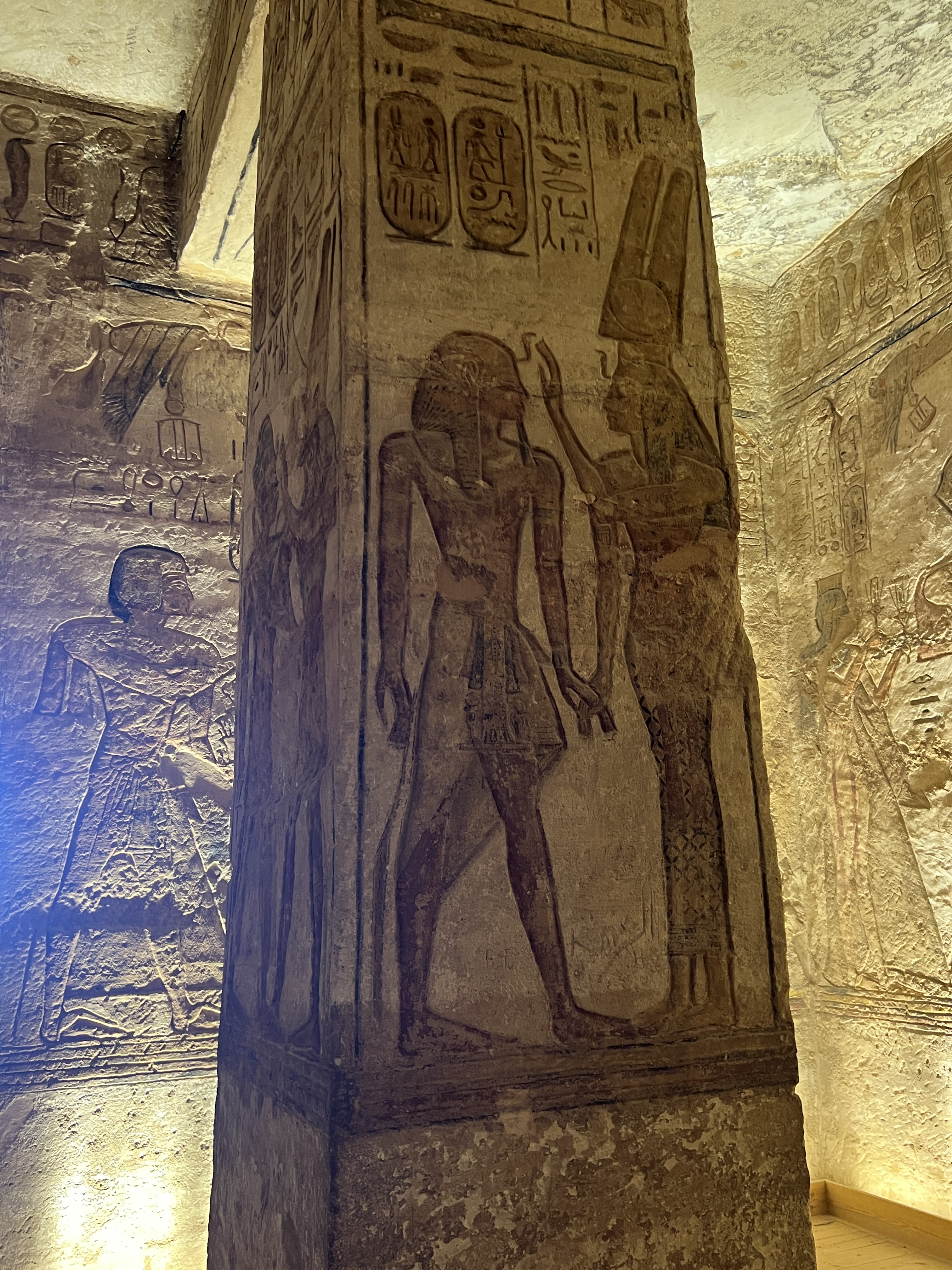
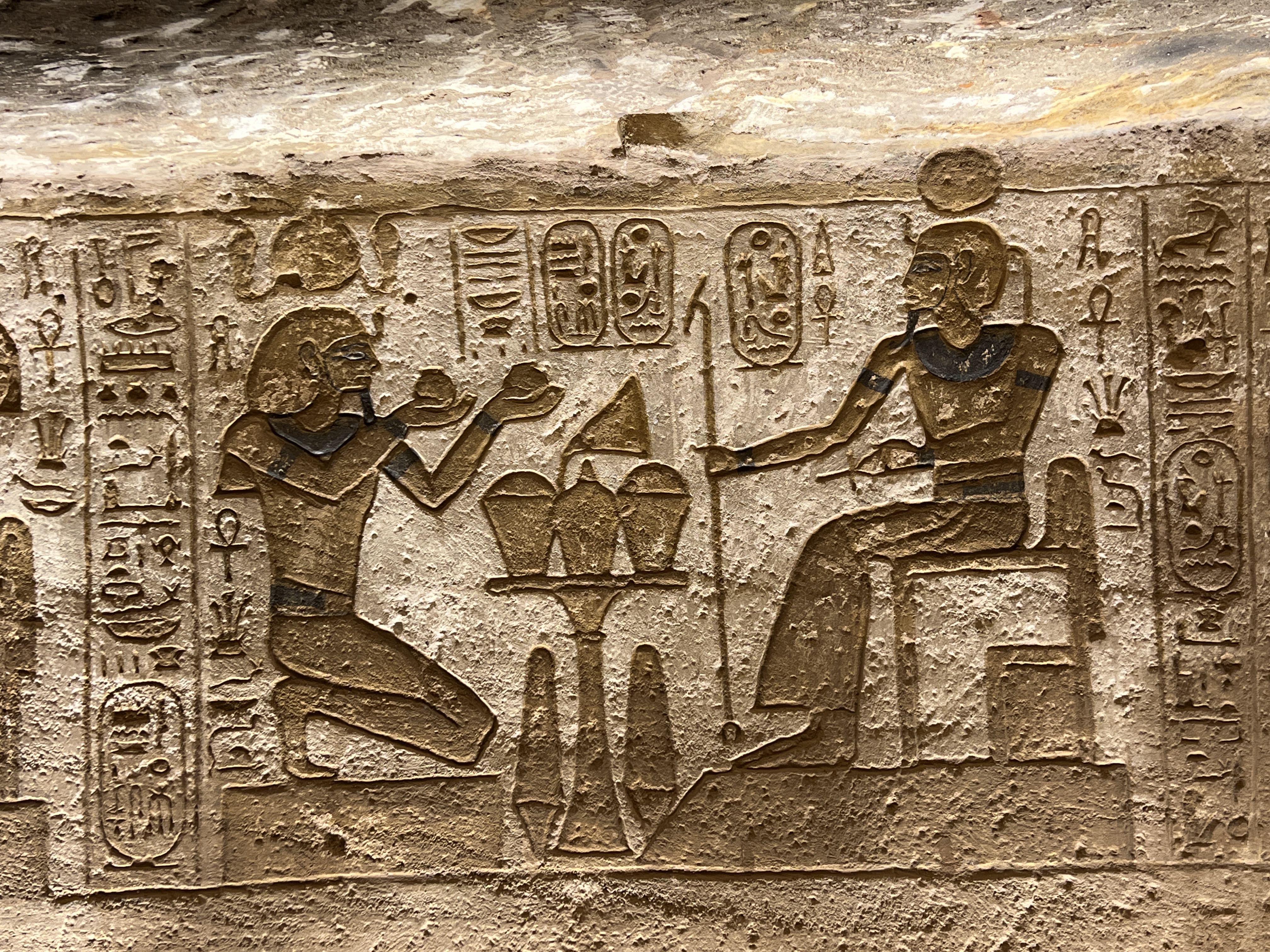
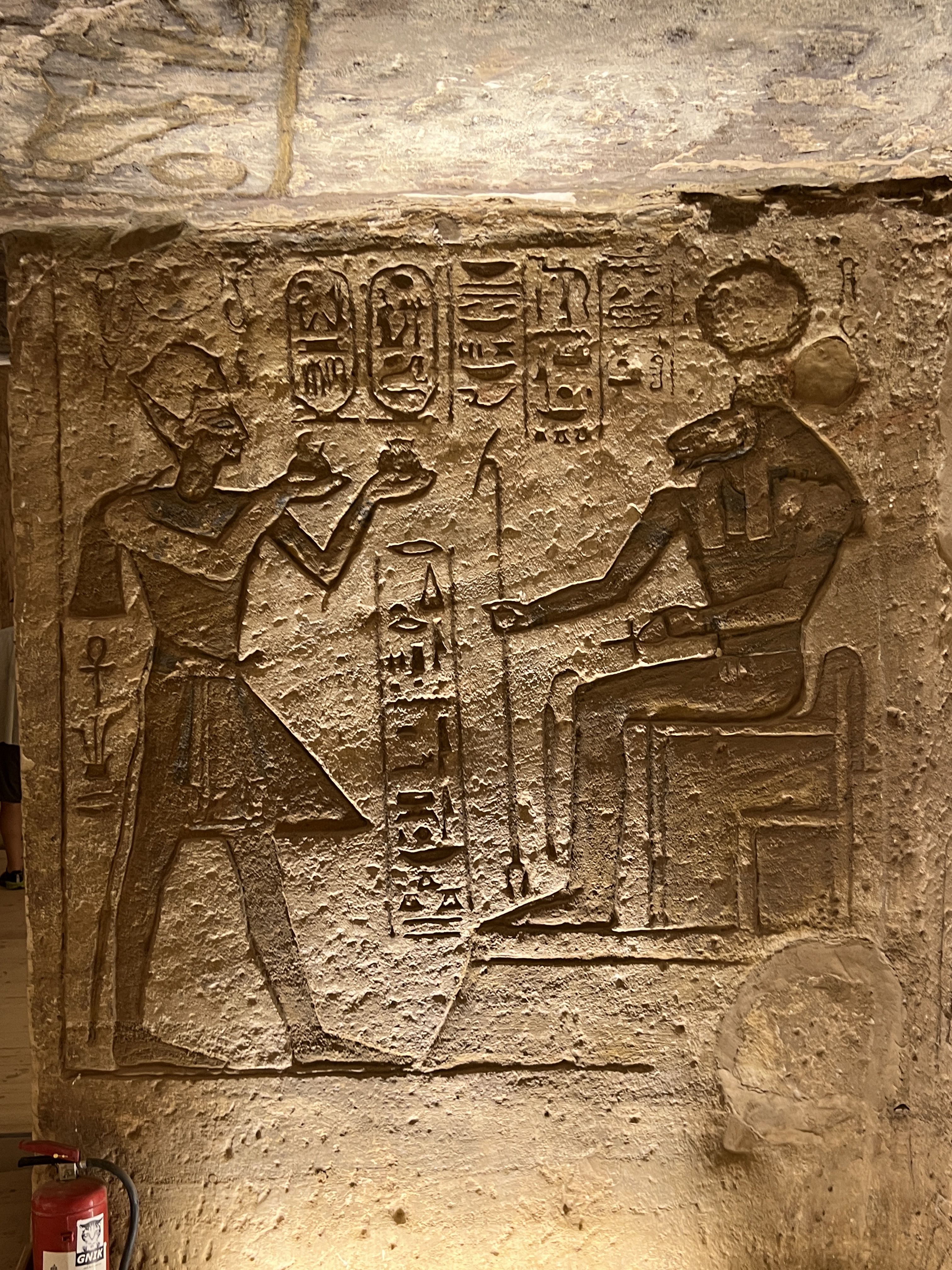
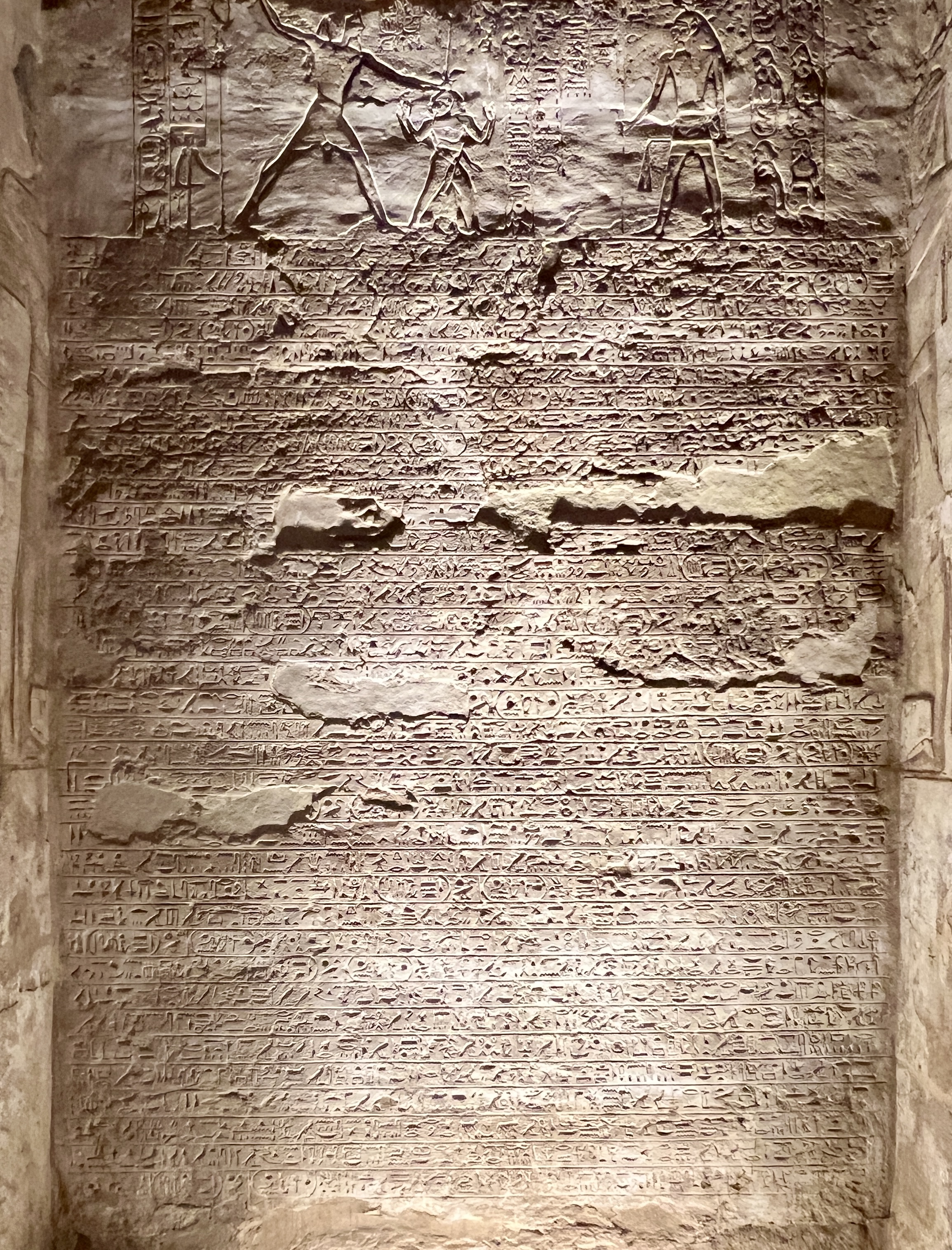
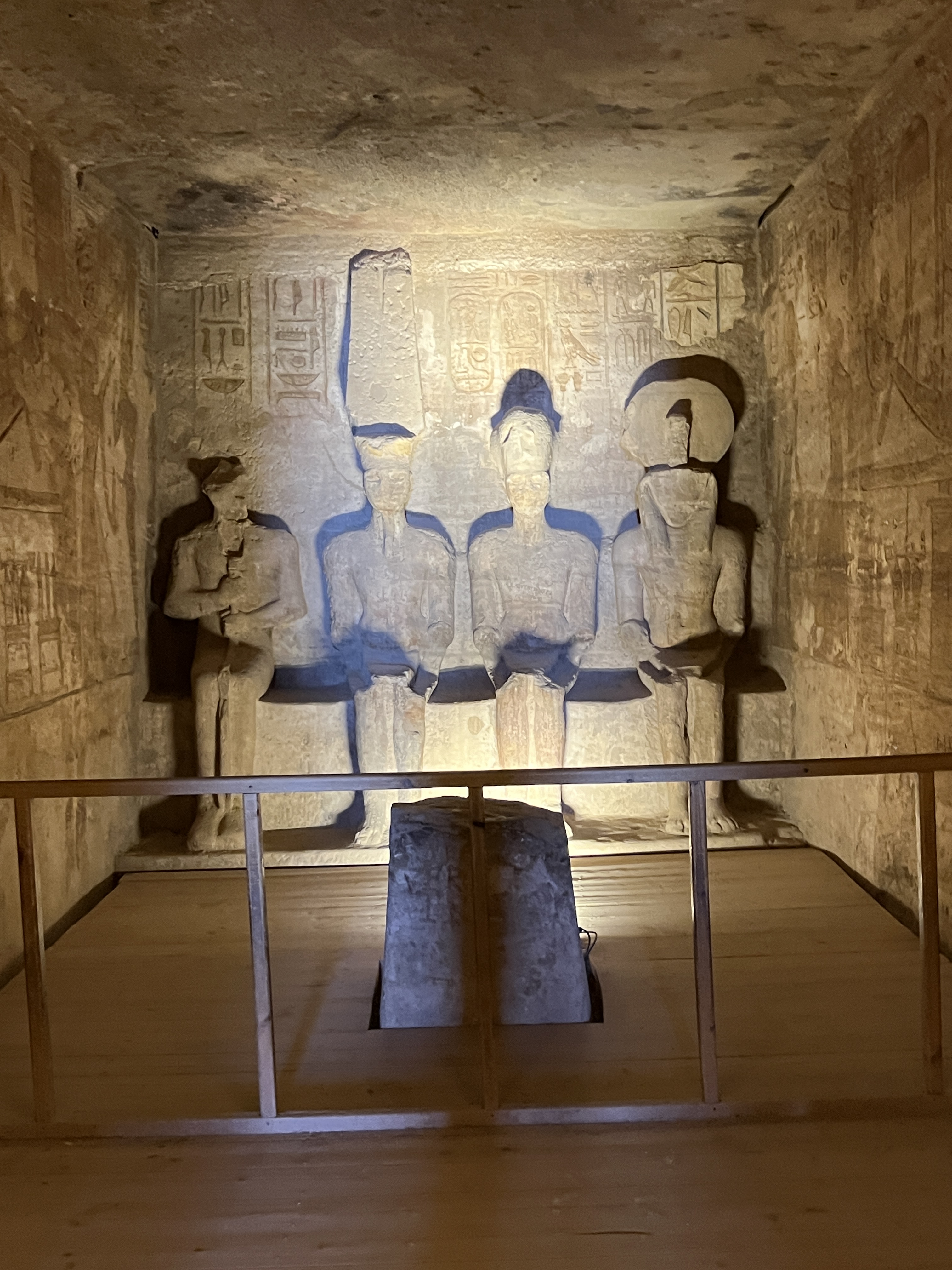
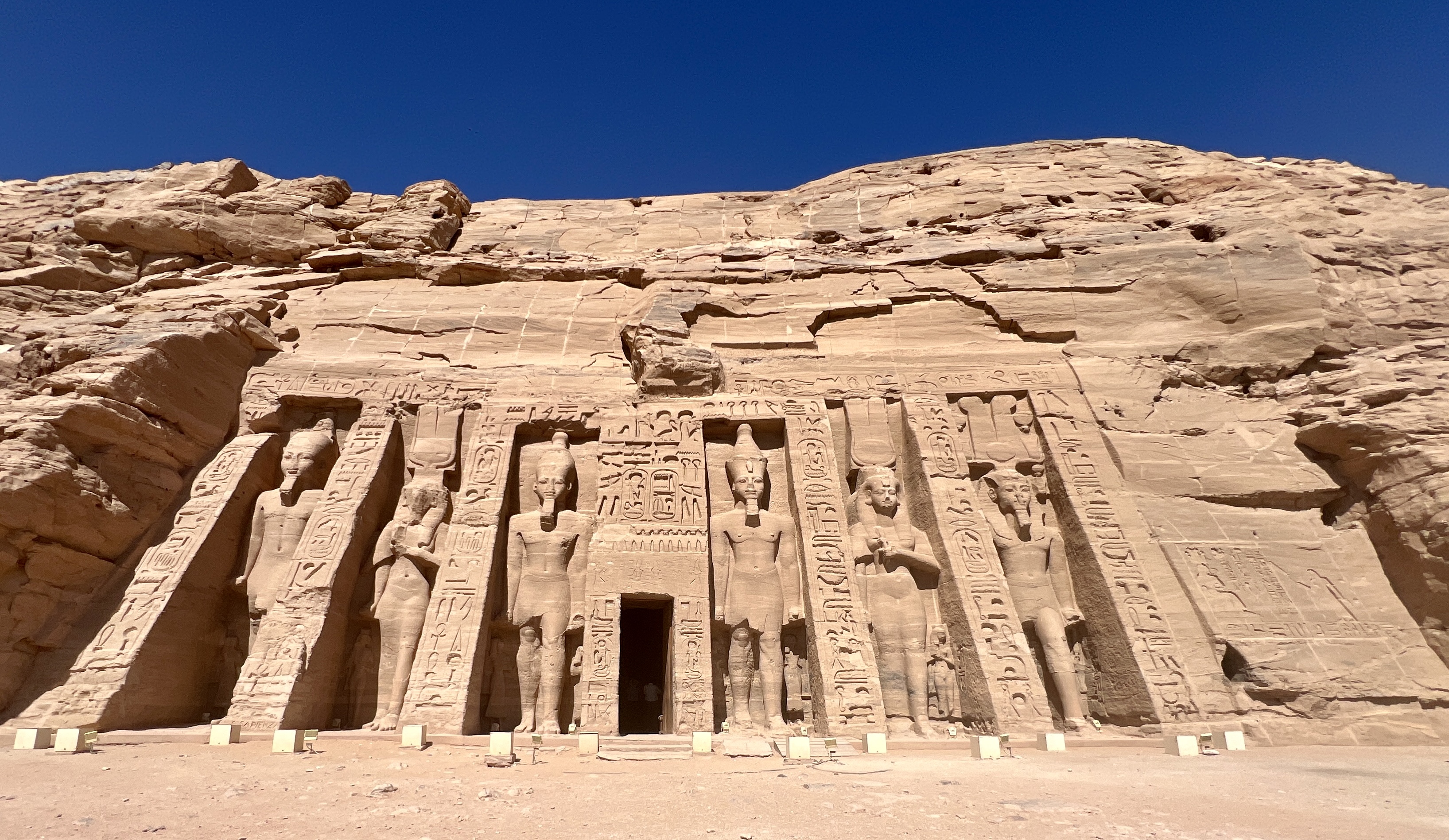
Ramesses II not only constructed his own temple but also one for his favoured wife, Nefertari, he had numerous wives and something like a 130 children. Lived into his nineties.
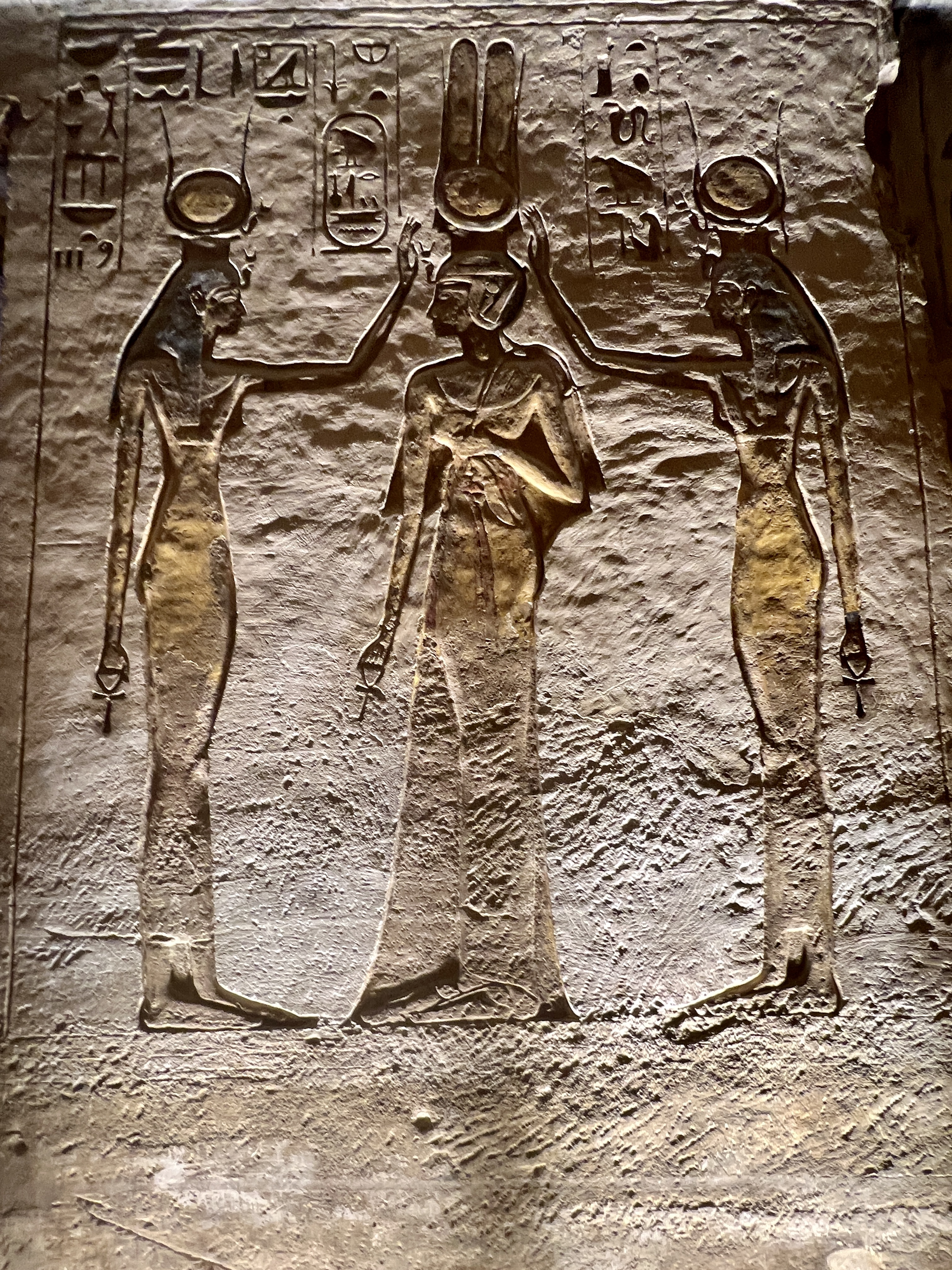


Nefertari’s temple is dominated by reliefs of her, her children and the gods. Ramesses II is ever present!
We returned to Aswan, around 5.30, after a pleasant late lunch at a local Nubian restaurant in the nearby township.
Aswan interlude
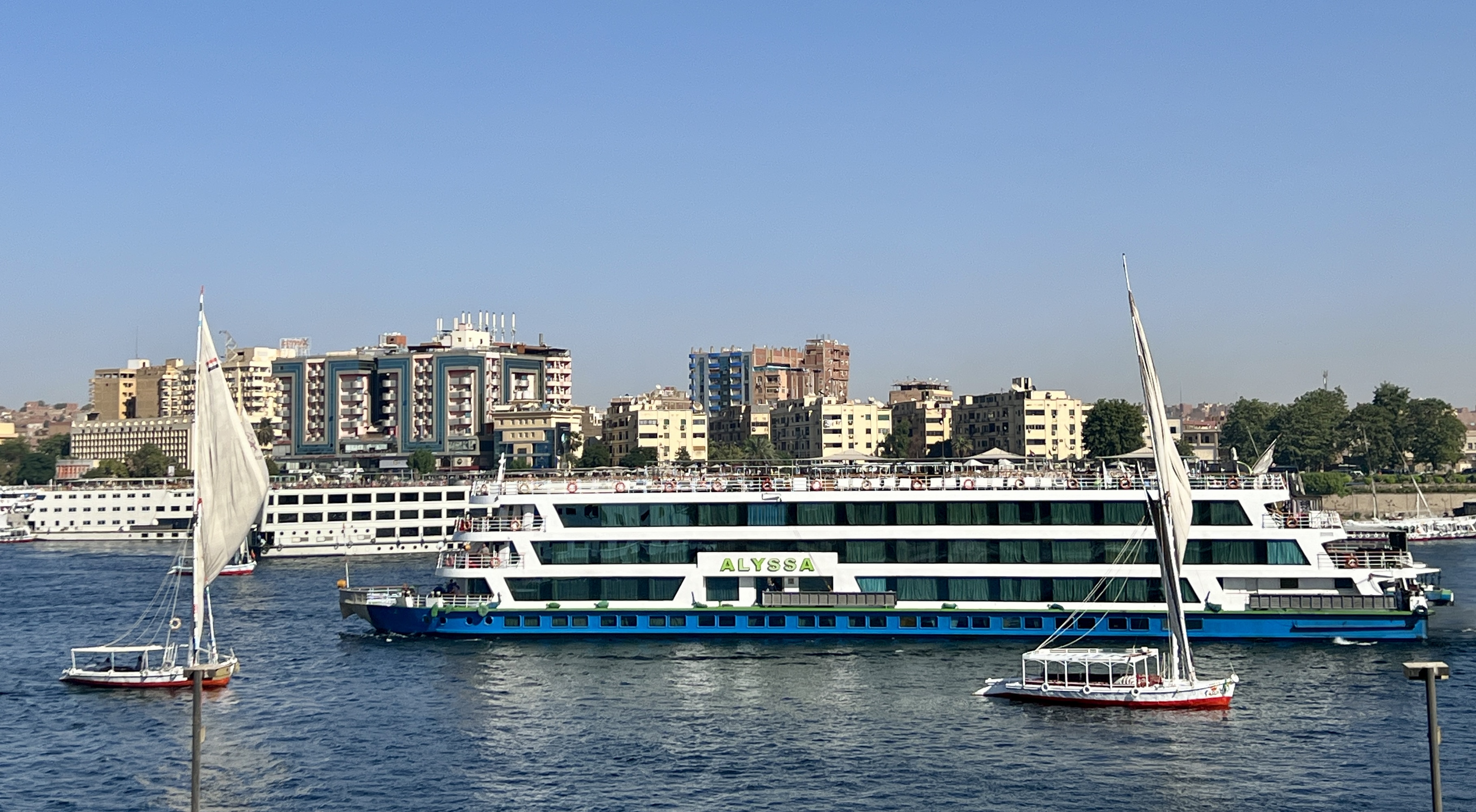
The Movenpick on Elephantine Island is very comfortable. The Island sits in the middle of the Nile, with a few smaller islands and rocks jutting up from the river bed. Prior to the building of the ‘Aswan low dam’ (it was completed in 1902 and subsequently raised over the years) this stretch of water, known as the first Nile cataract, was wider and wilder. At the time of the Pharaohs it was the end of civilization. Lots of civilization here now.
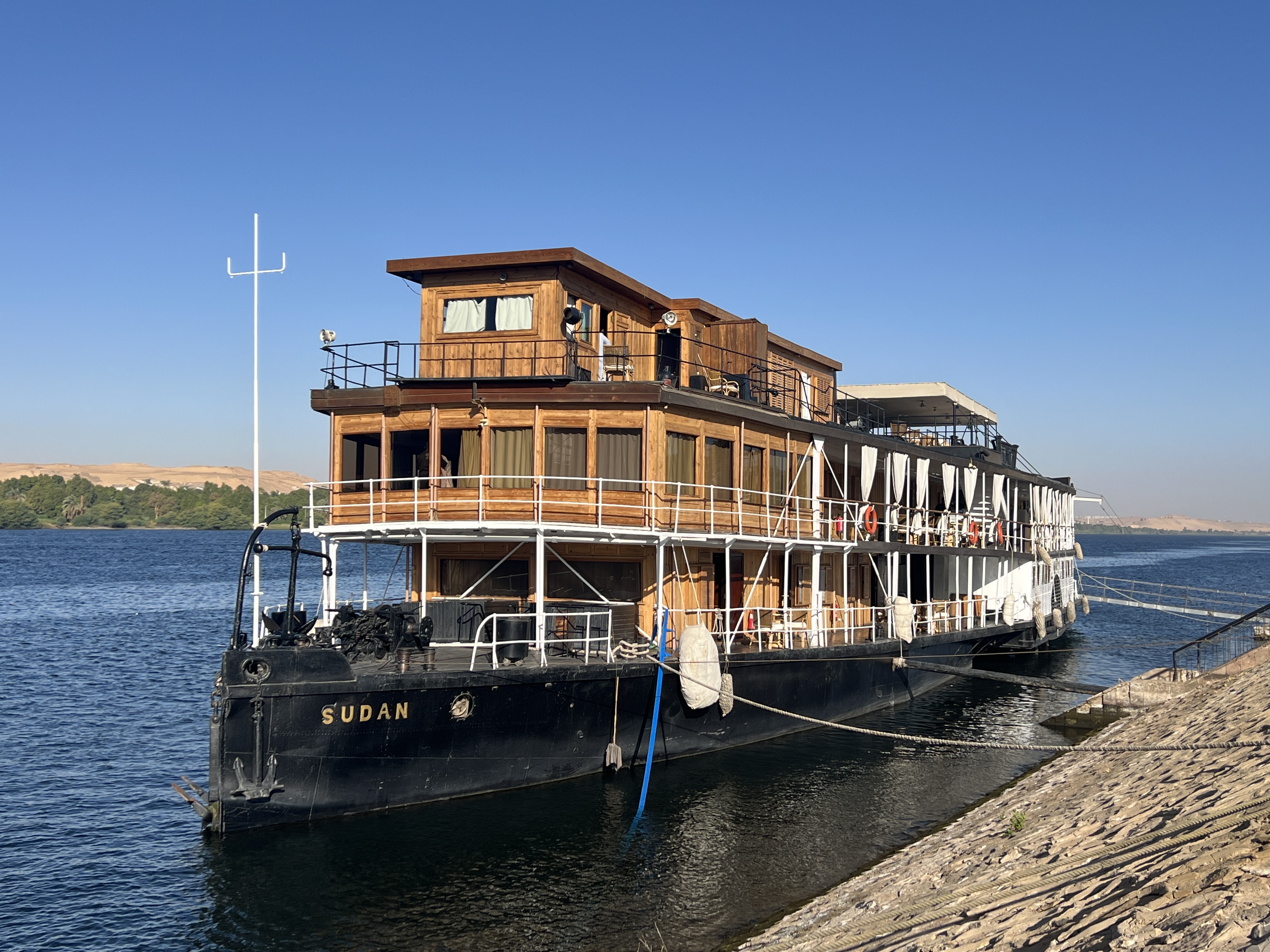
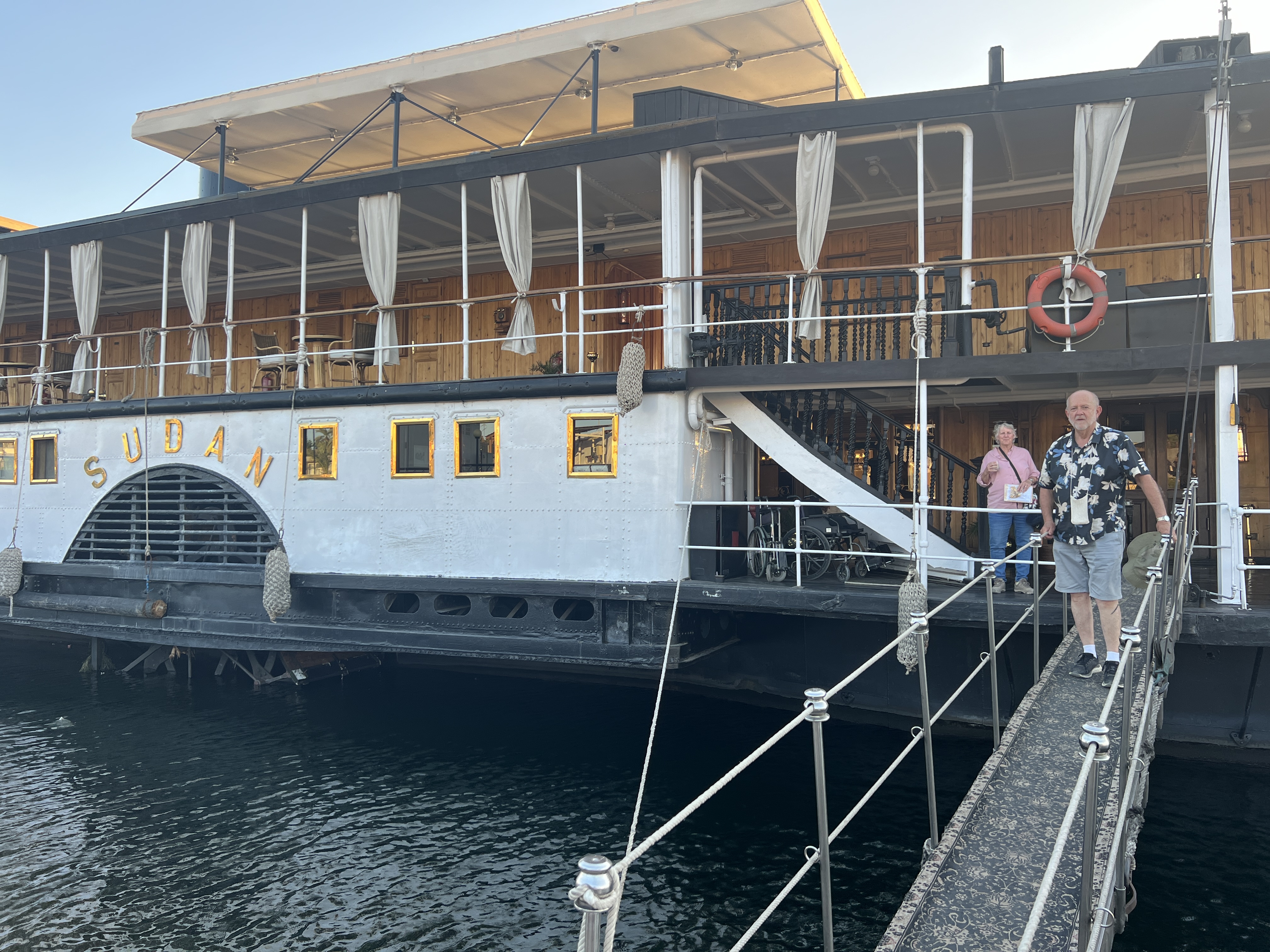
SS Sudan had tied up at the docks a little to the north of the main berthing areas, which are quite crowded, for the night prior to the end of the cruise. In the morning we were taken to the Movenpick on a felucca (small sail boat), via Kitchener Island on which are the Aswan Botanical Gardens, dating from the 1800s.

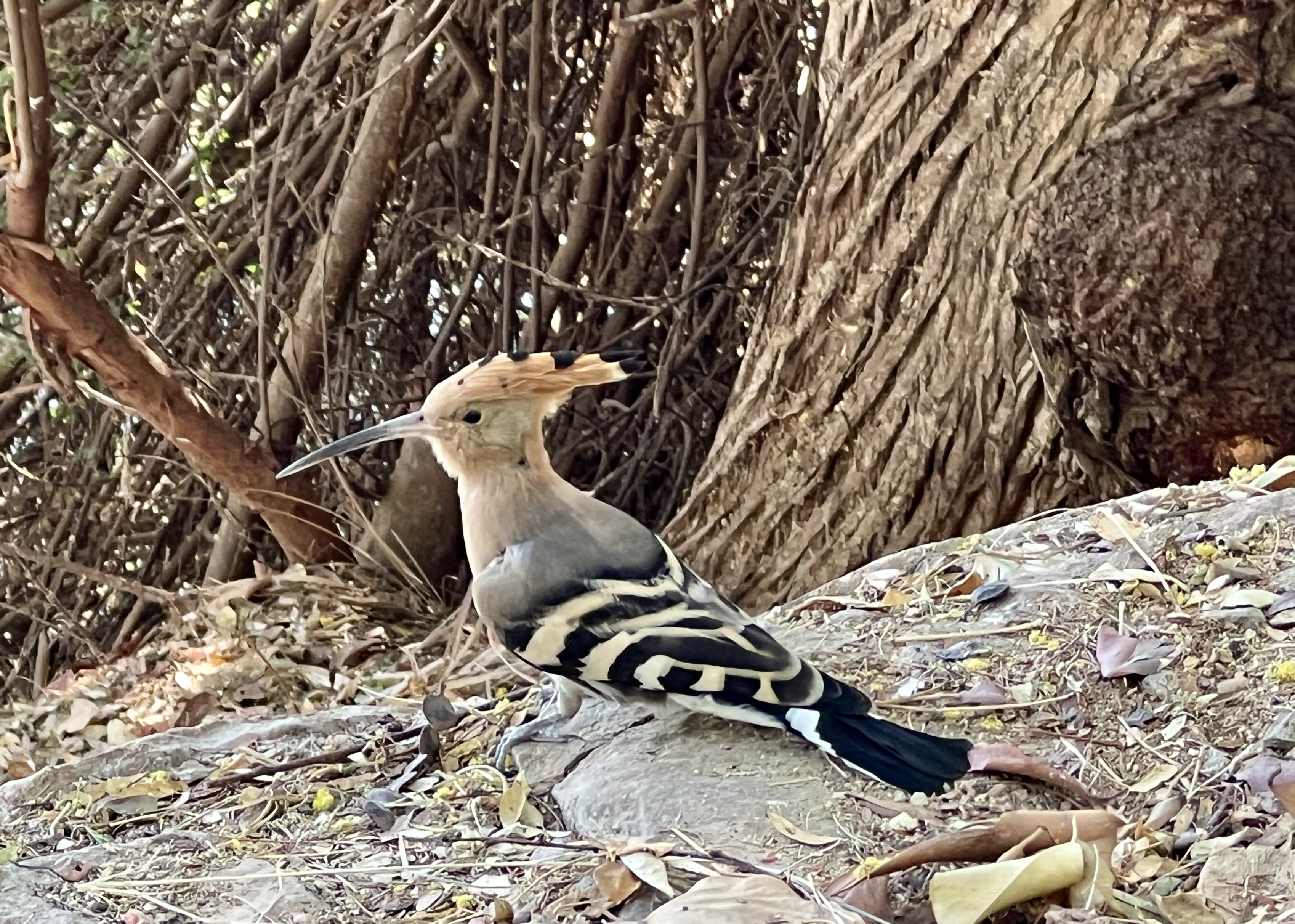
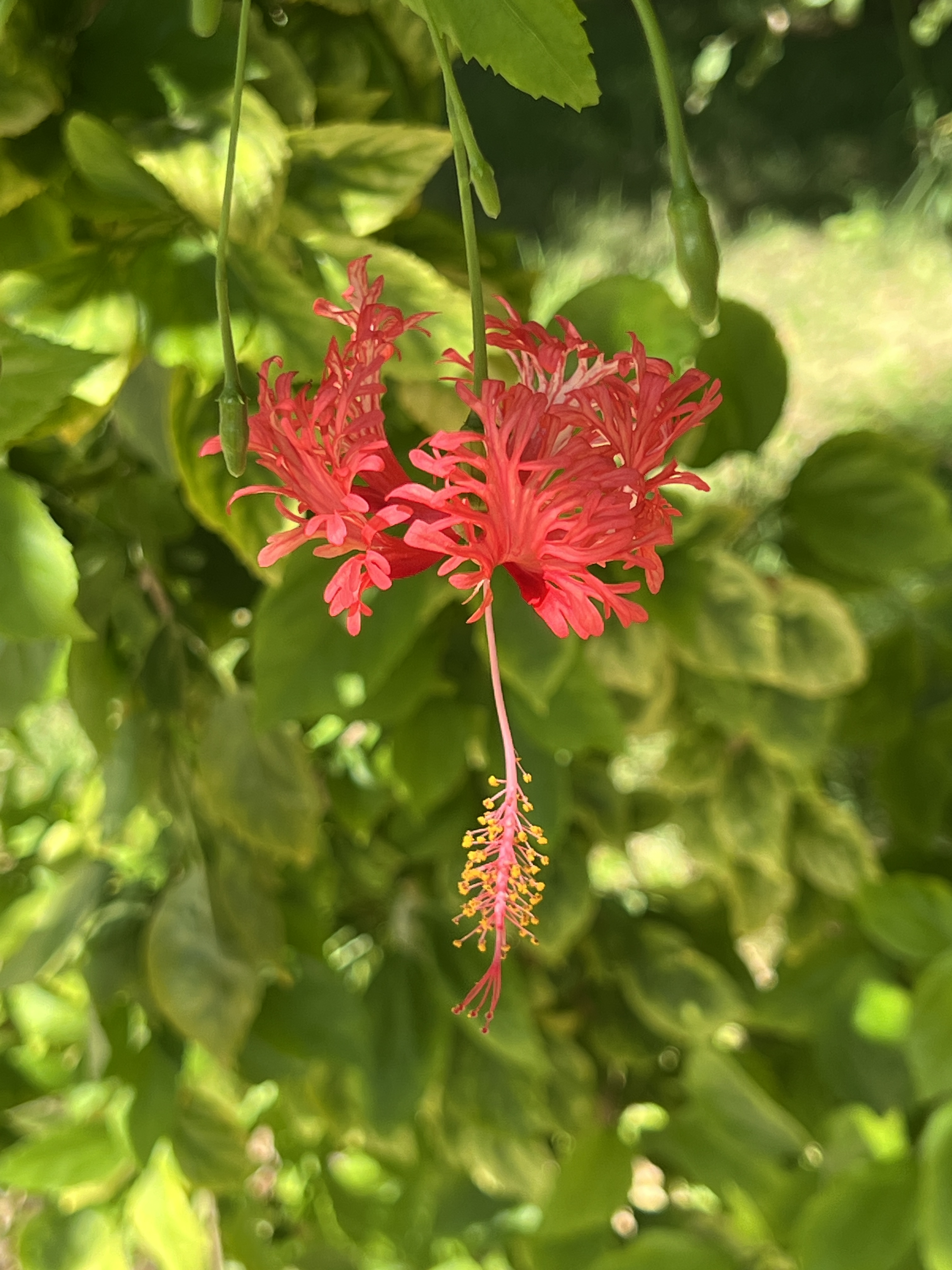
It was cool there under the tree canopy, very green with a few late blooming hibiscus of various types.
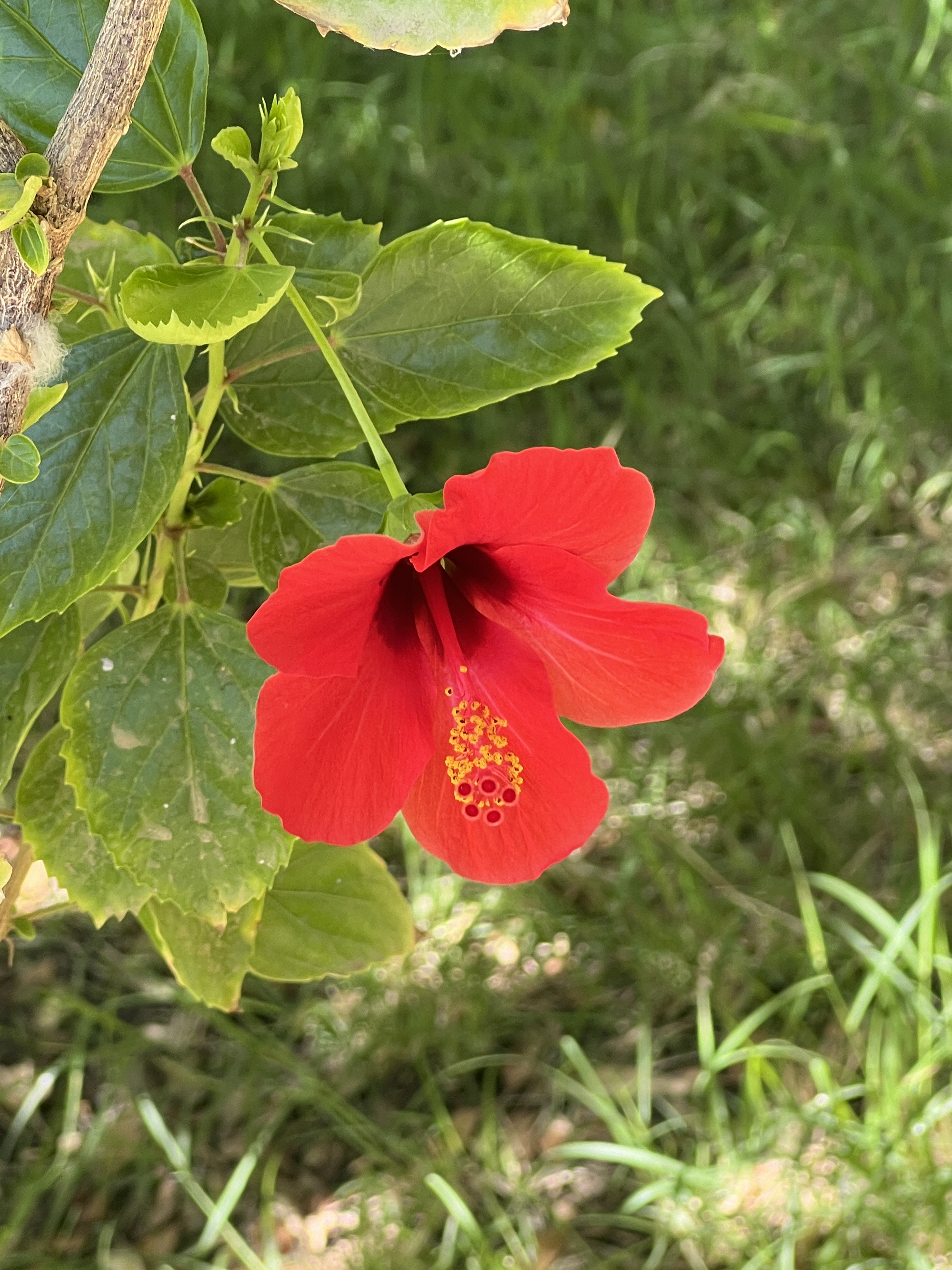
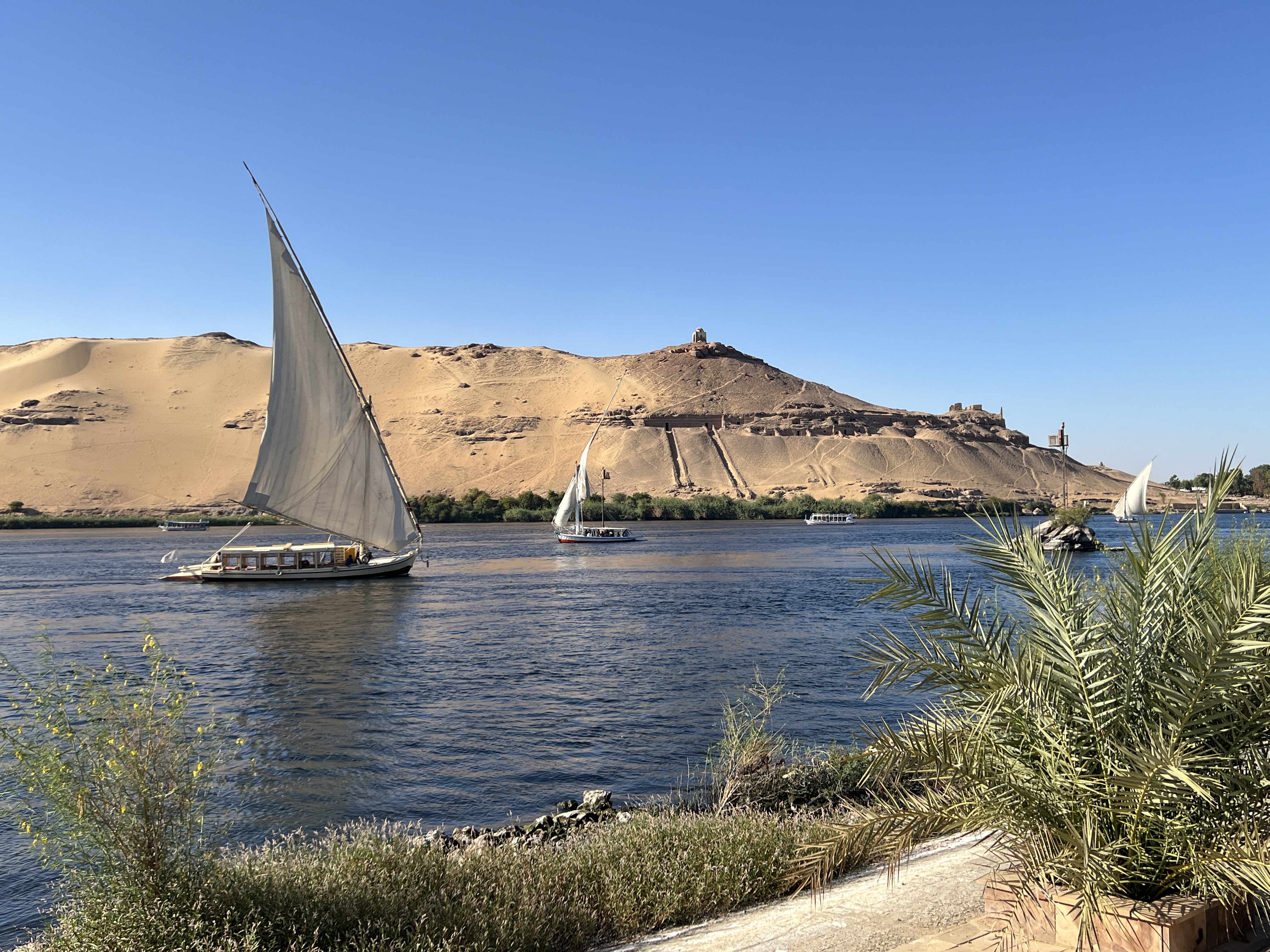
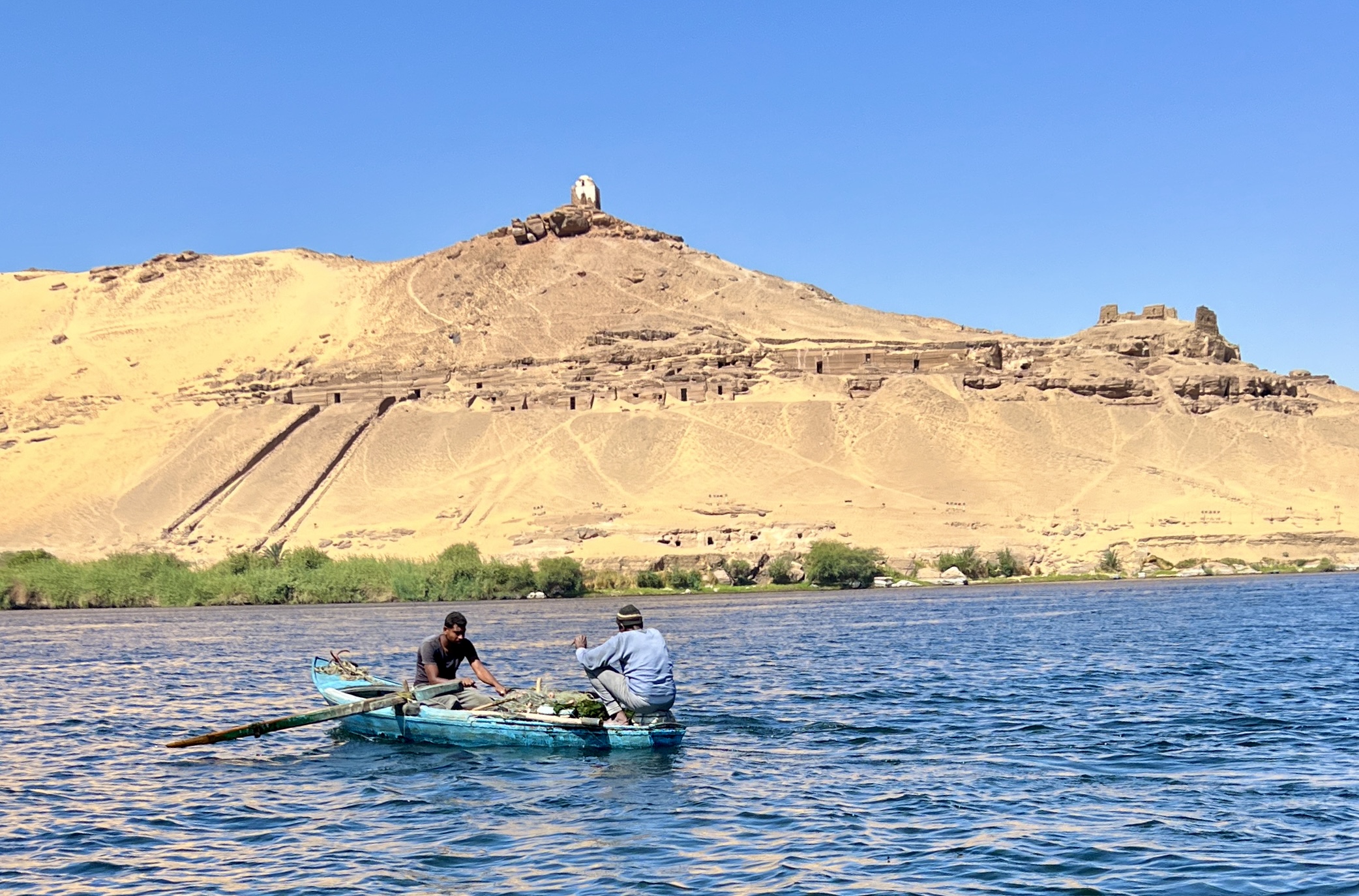
We had about an hour among the plants, dodging more bric a brac offerings from the locals. Great views of life on the water.
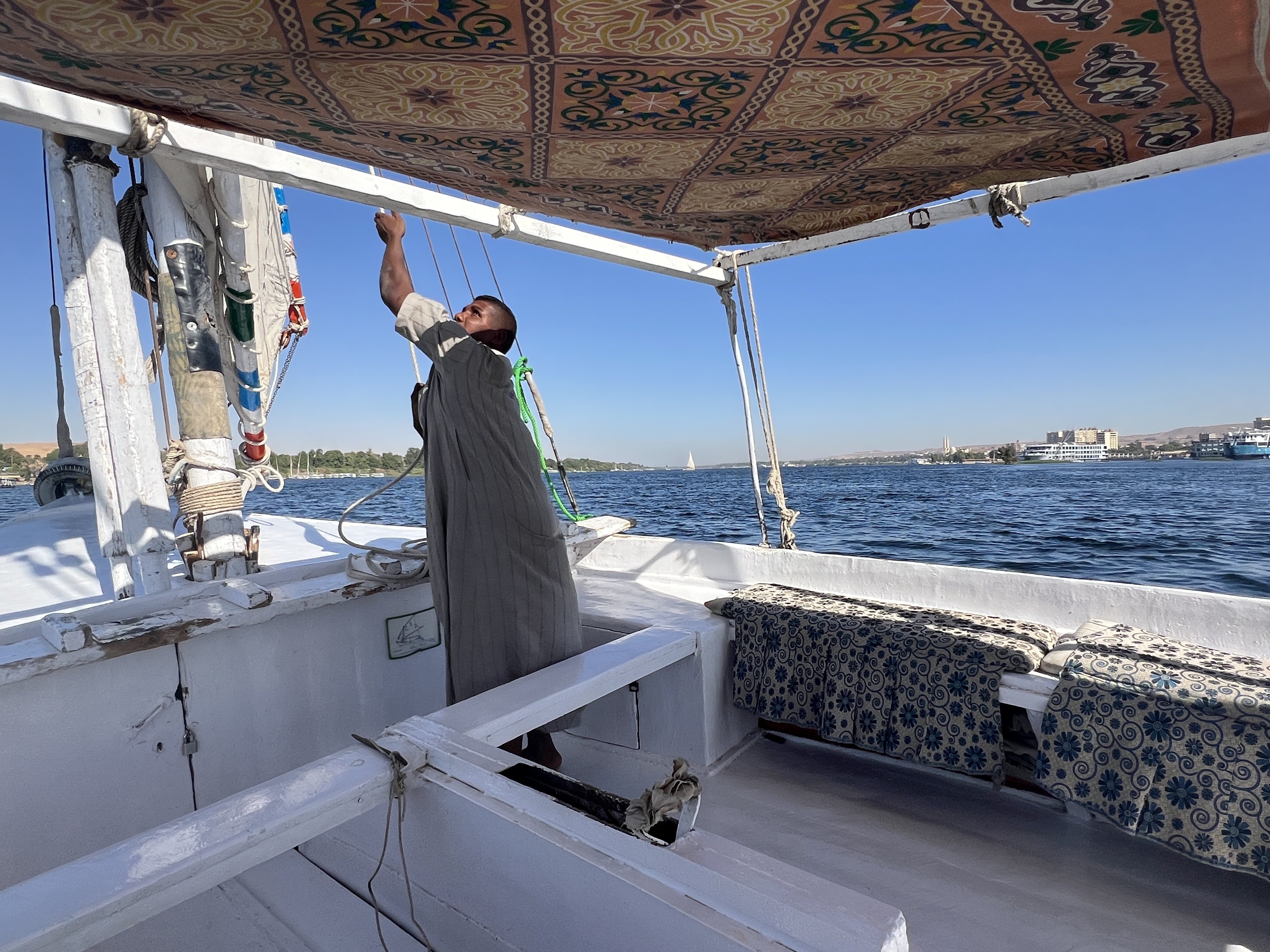
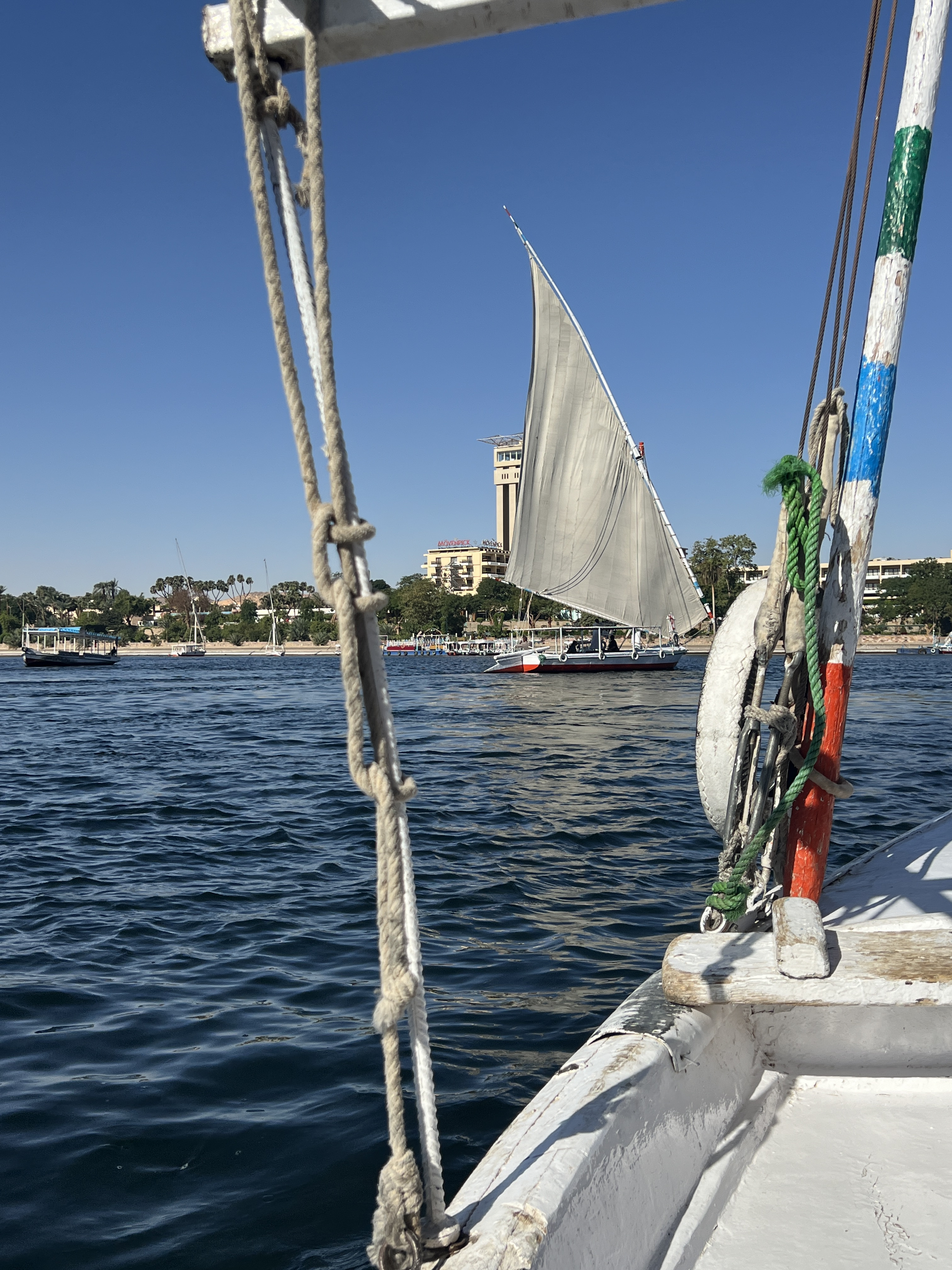
Earlier, the felucca captain had trapped us with a bag of ‘genuine’ trinkets. Allthego is a bit of an easy catch for this type of stuff, so we acquired a few dollars worth of Egyptian trinkets. The highlight among the trinkets is a small stuffed camel for the shelf at home.
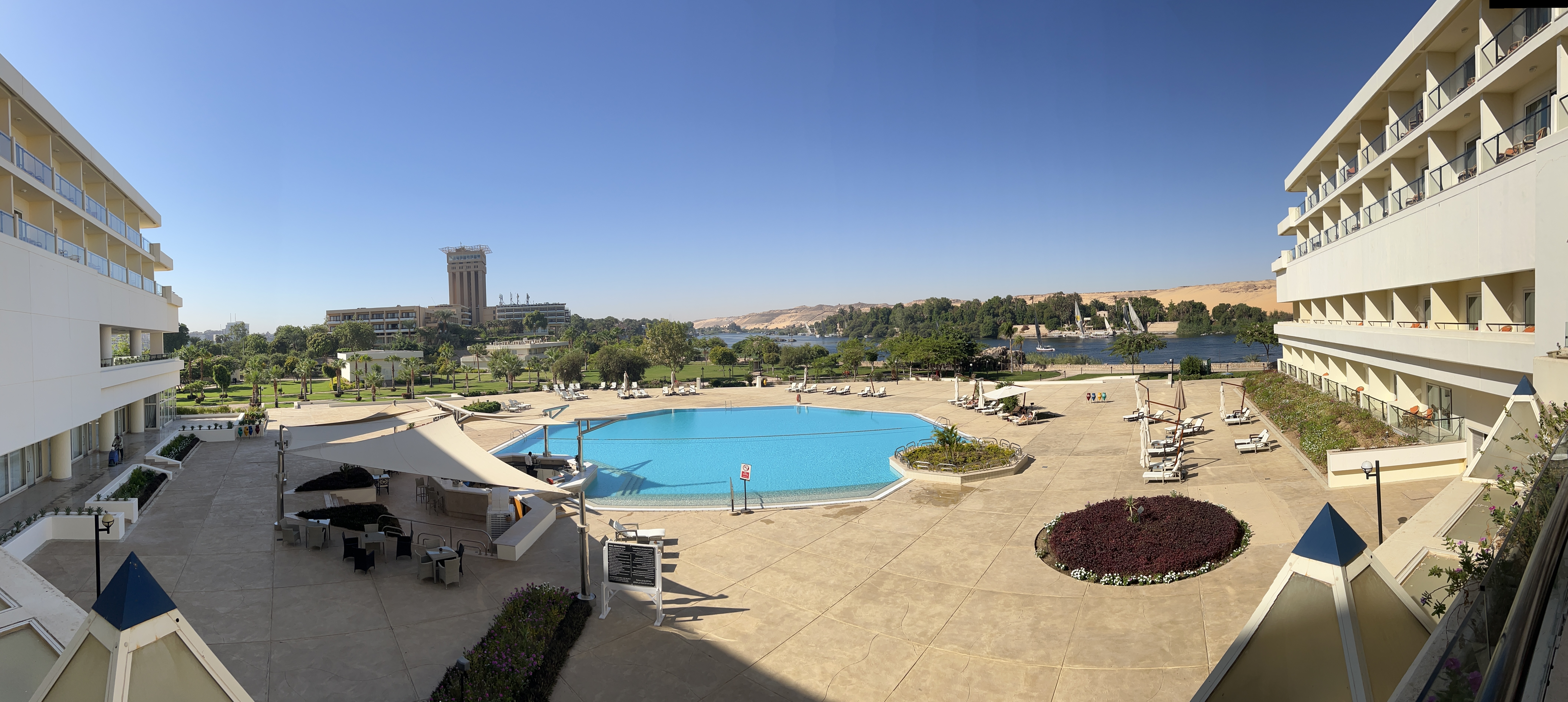
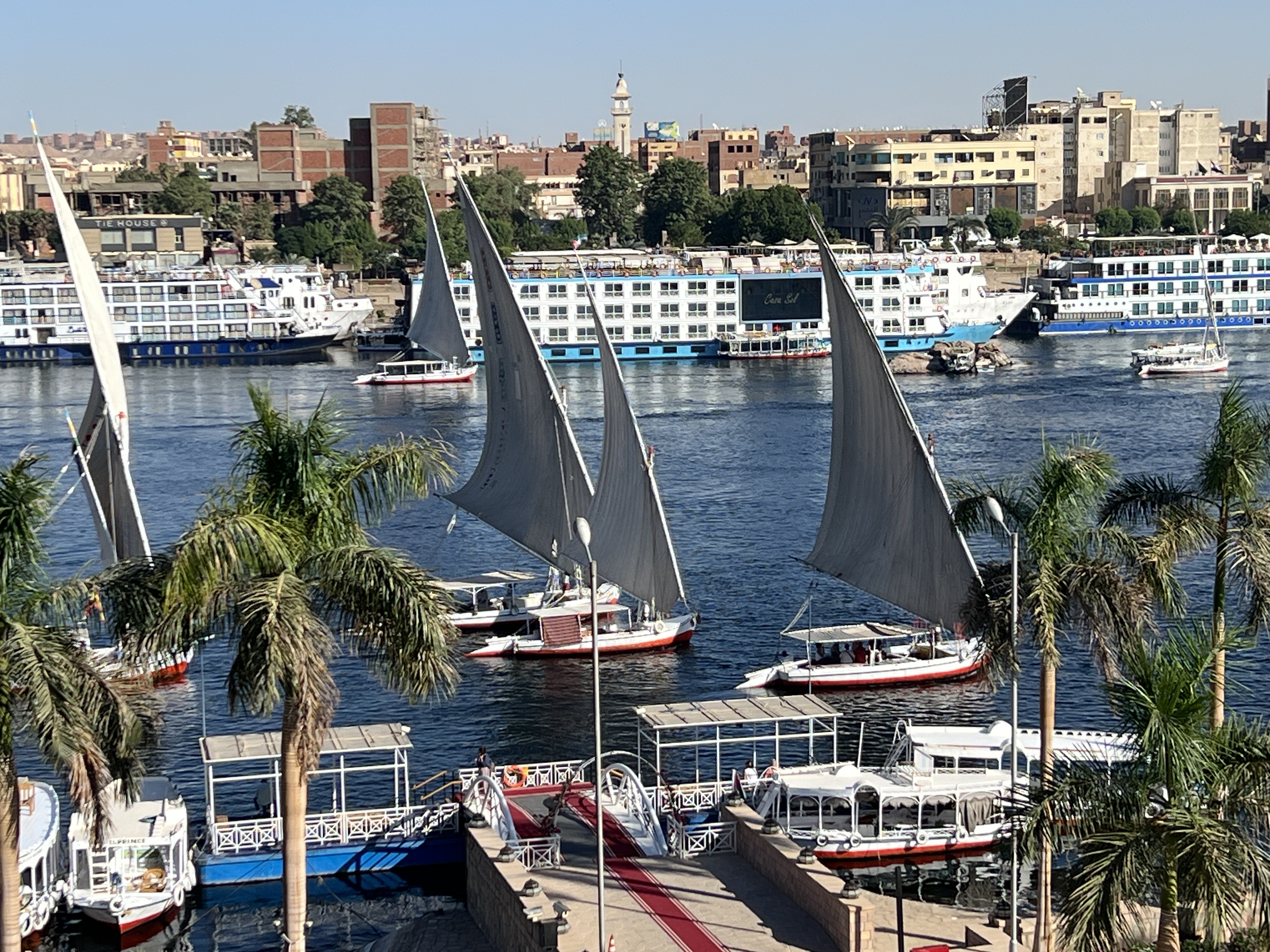
Some great views from our balcony at the Movenpick over the swimming pool and across the Nile to the ‘city side’.
Back to Temples, Tombs and Tales next time.
Temples, Tombs and Tales IV
At last Mahamod got us into some tombs, a welcome change after the temples. The Valley of the Kings and the Valley of the Queens is probably one of the most, if not the most, well known of all the Egyptian sites.
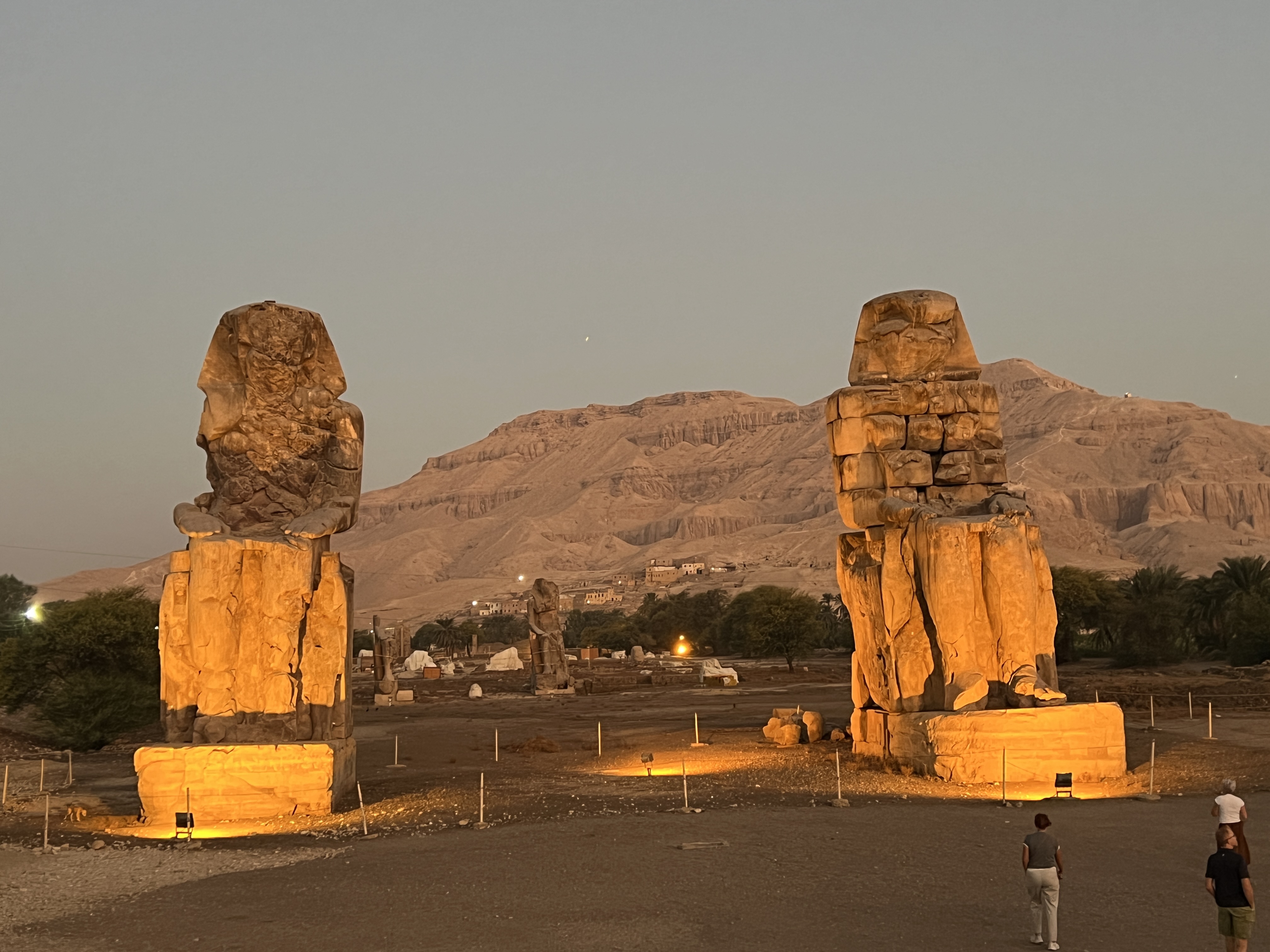
The road to the tombs took us past the great Colossi of Memnon and Amenhotep III standing all out in the open among former agricultural land, they are bit worse for wear but still an impressive sight in the early morning. They are all that remain of a temple complex destroyed by an earthquake, the site was then used as a quarry by later kings.
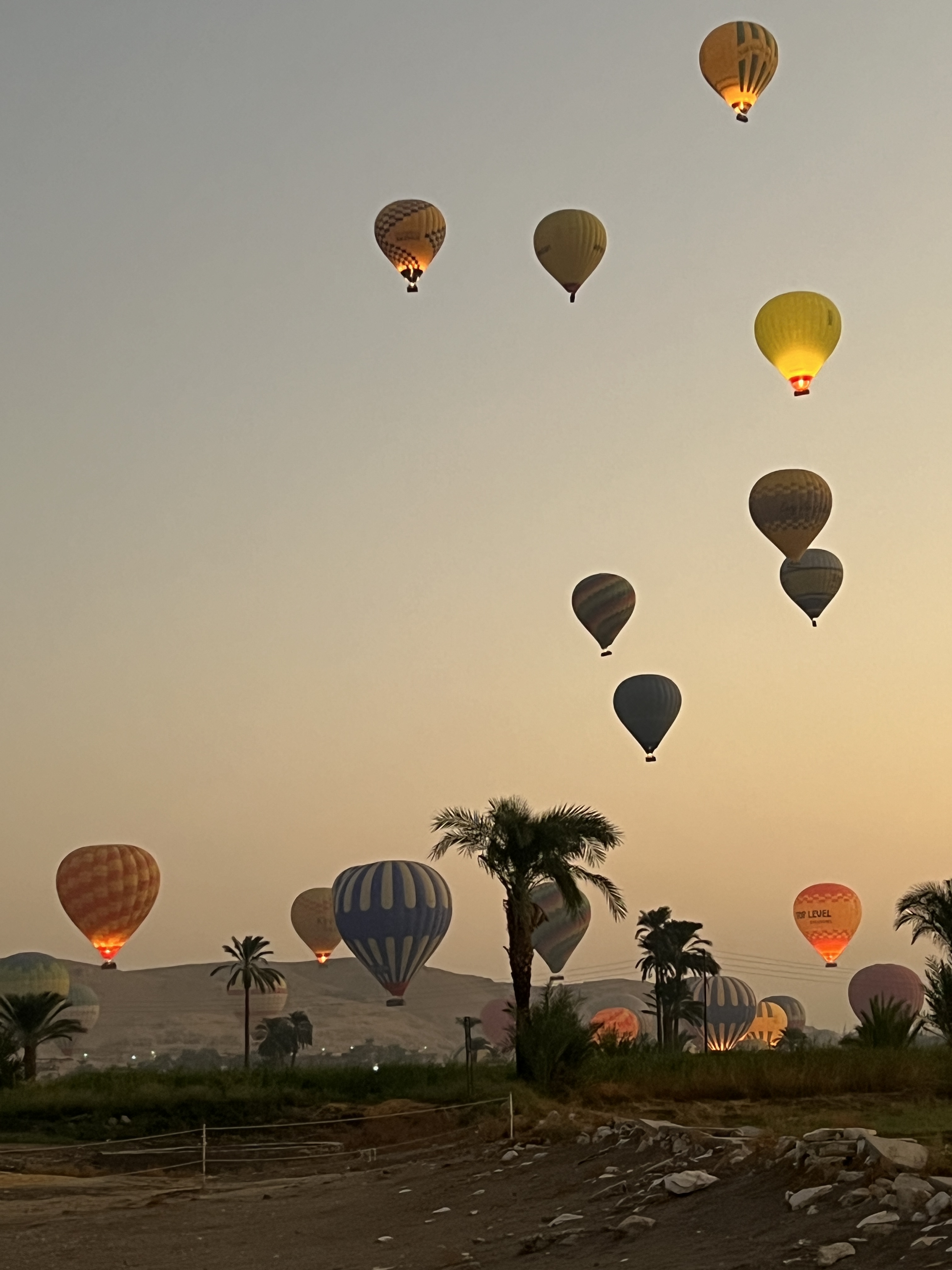
Nearby was the launch site for the balloon rides, getting air born pre sun rise.
Finally, making it into the Valley we then spent the morning looking through a number of tombs.
The interesting thing about these tombs is that they are built under a mountain, not a pyramid. Up on the Giza plateau near Cairo the tombs of the Old Kingdom were built inside or under the great pyramids.
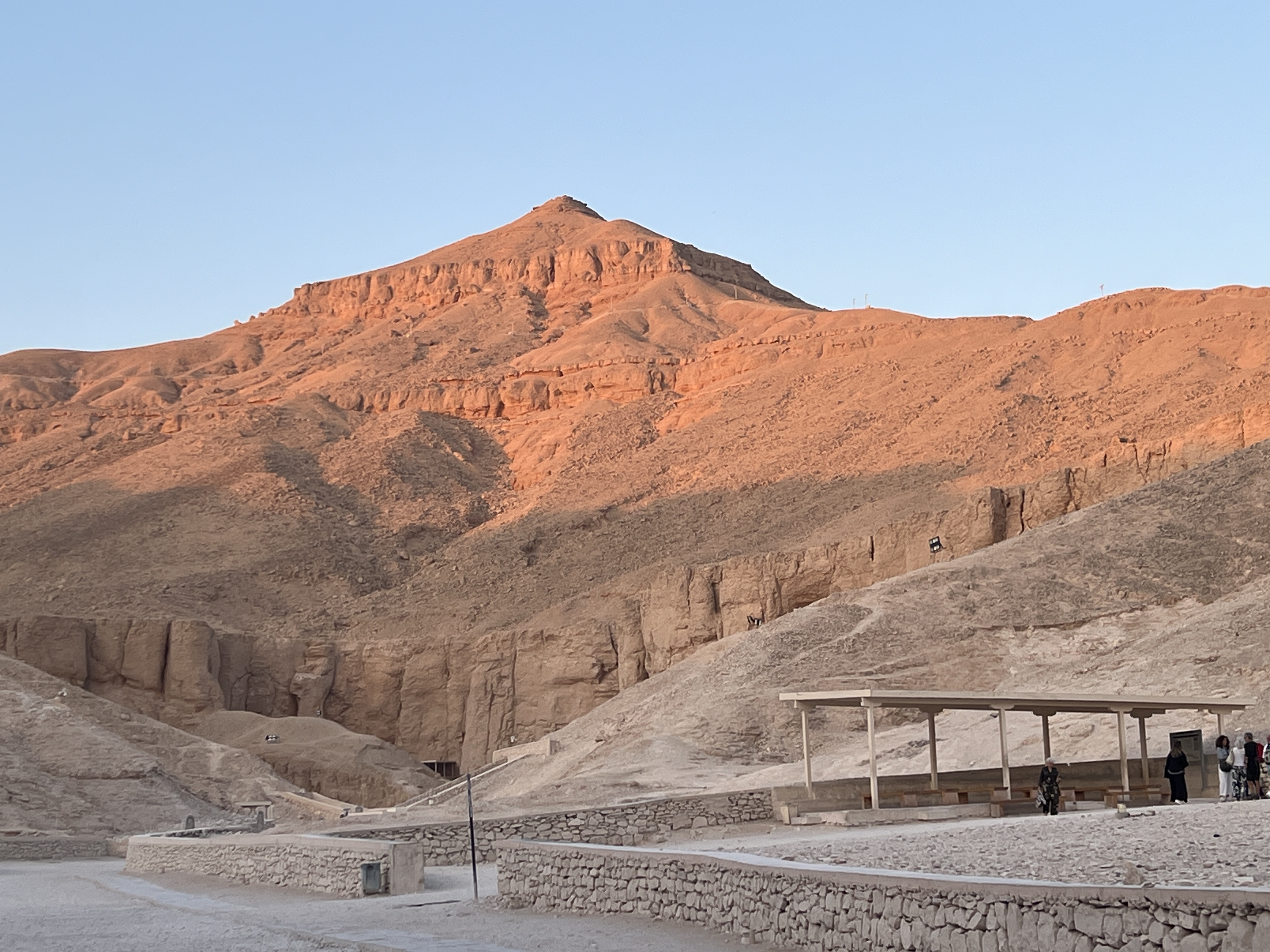
However, down in Thebes (Luxor) during the later Middle Kingdom period there were no pyramids. Pyramids connected the sky to the earth. The Giza Plateau was flat, hence the need for the pyramids. In the Valley of the Kings the tombs are under a mountain, shaped not unlike a pyramid. So, no need for a pyramid!
The tombs are entered through lengthy corridors, generally there are a number of sections as the corridor slopes down past various rooms until reaching the burial chamber. Plenty of steps. Each section marks various processional stages of the King’s journey to the after life. The walls are covered with carvings, paintings and hieroglyphs telling the story.
Here are a few photos from some of the tombs.
Ramesses IV
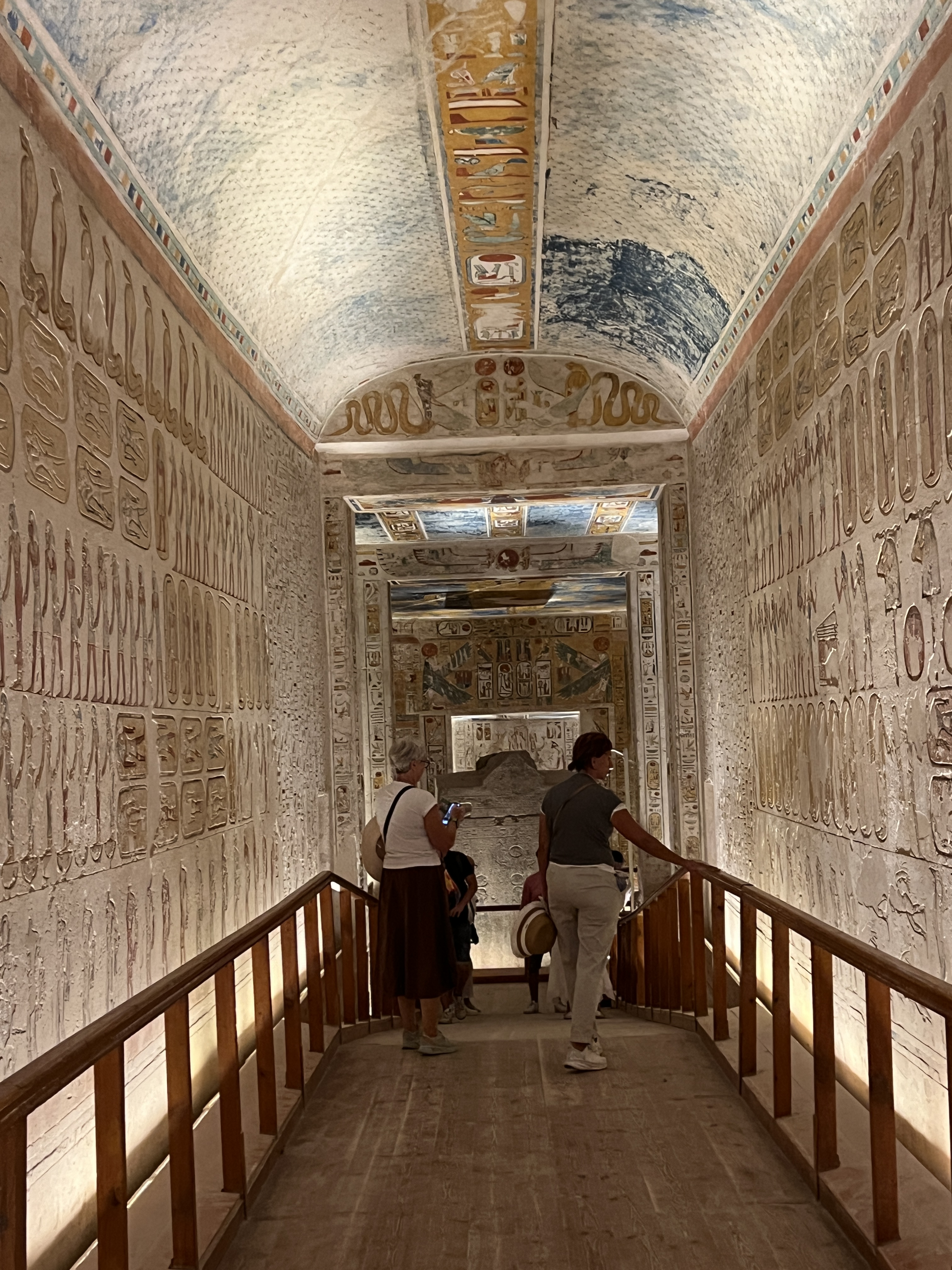
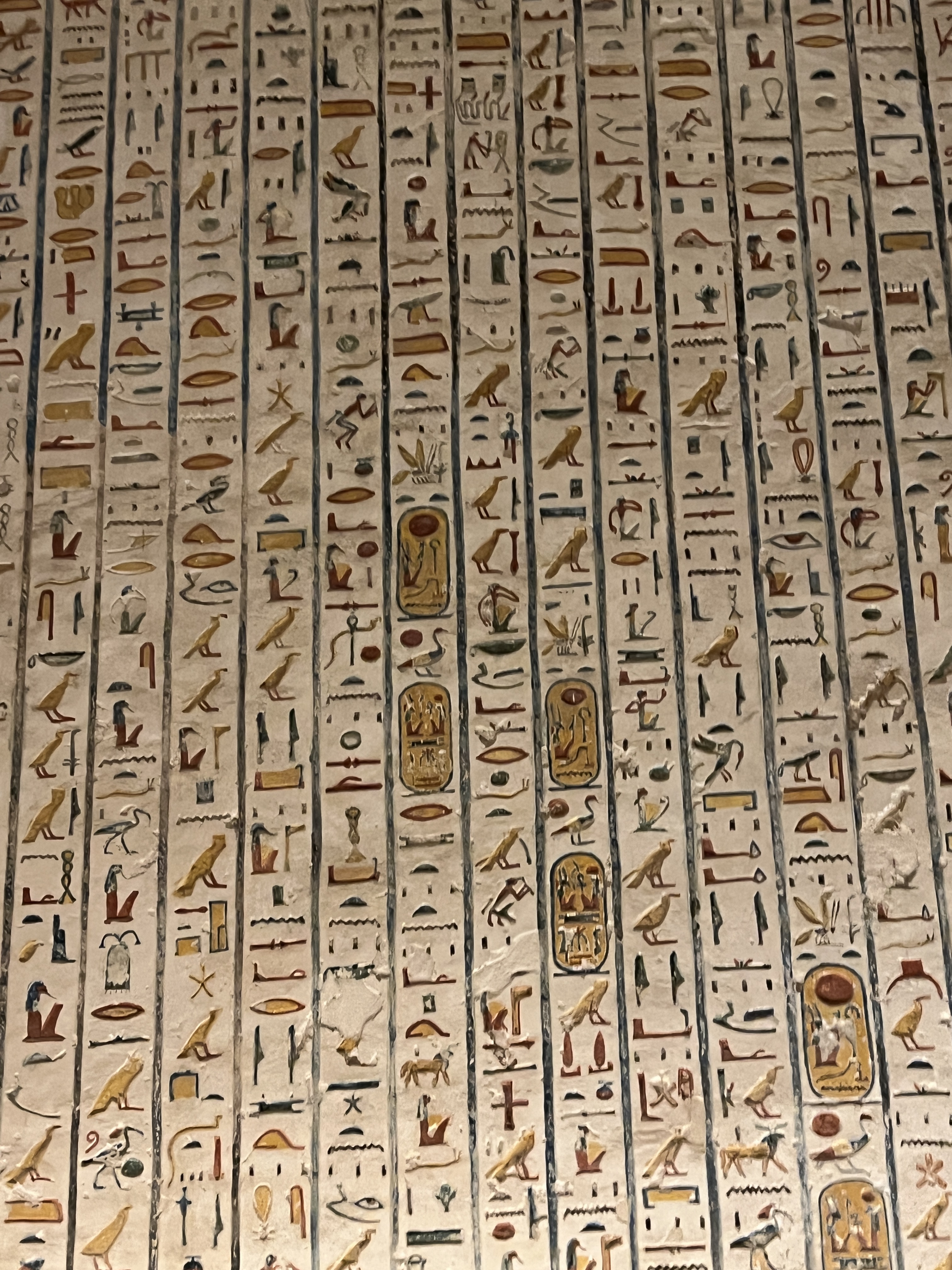
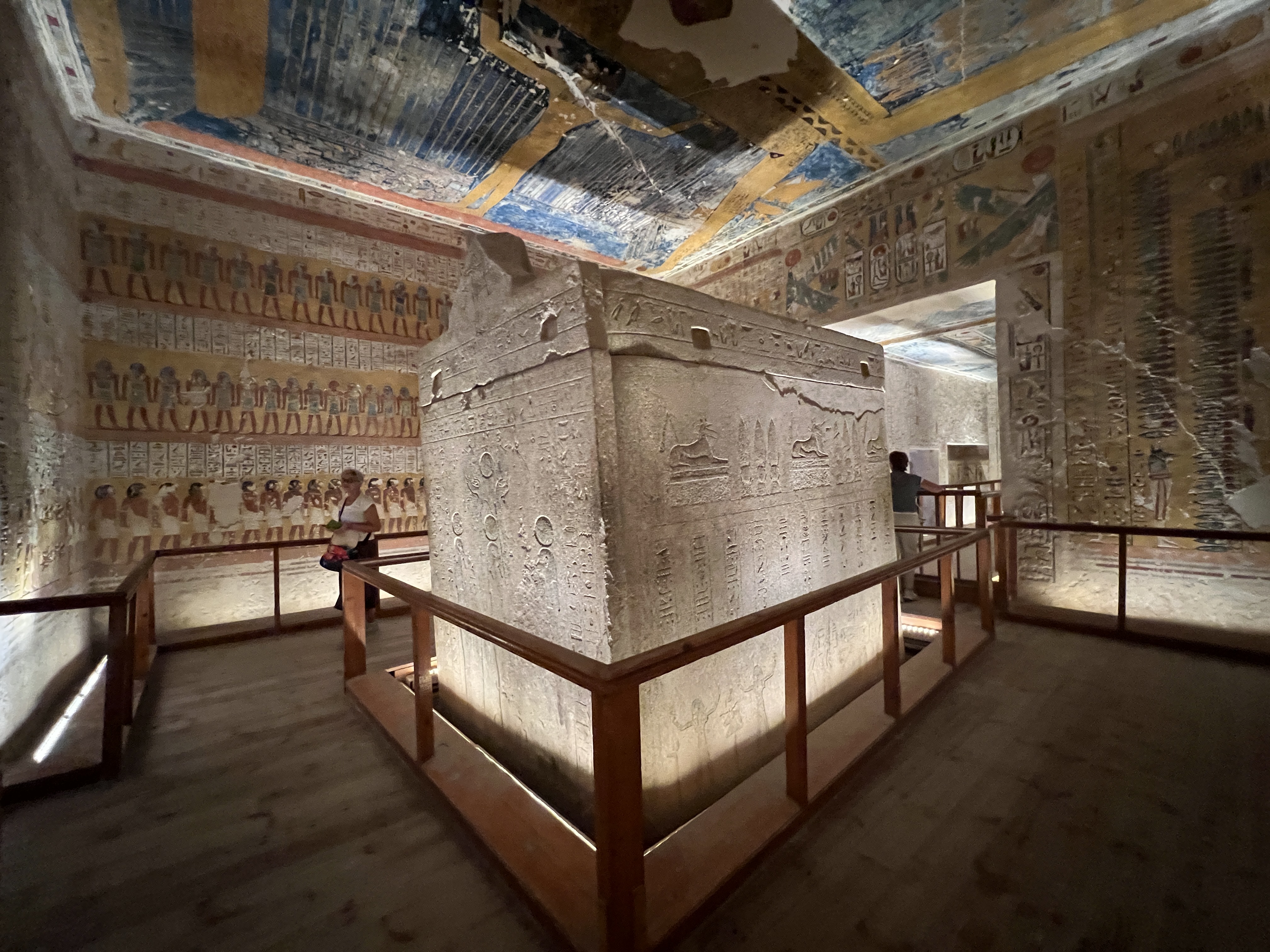
Seti I
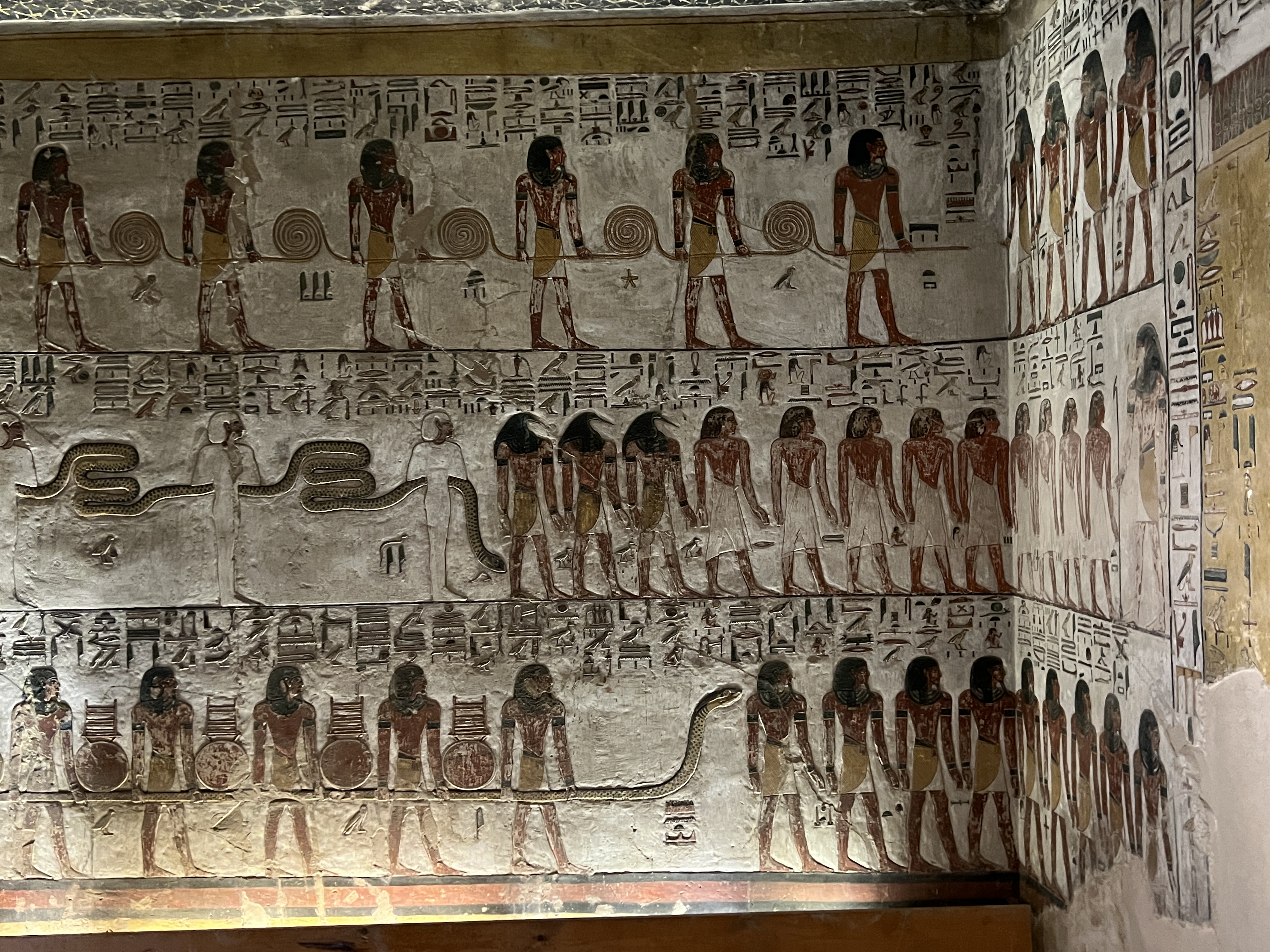
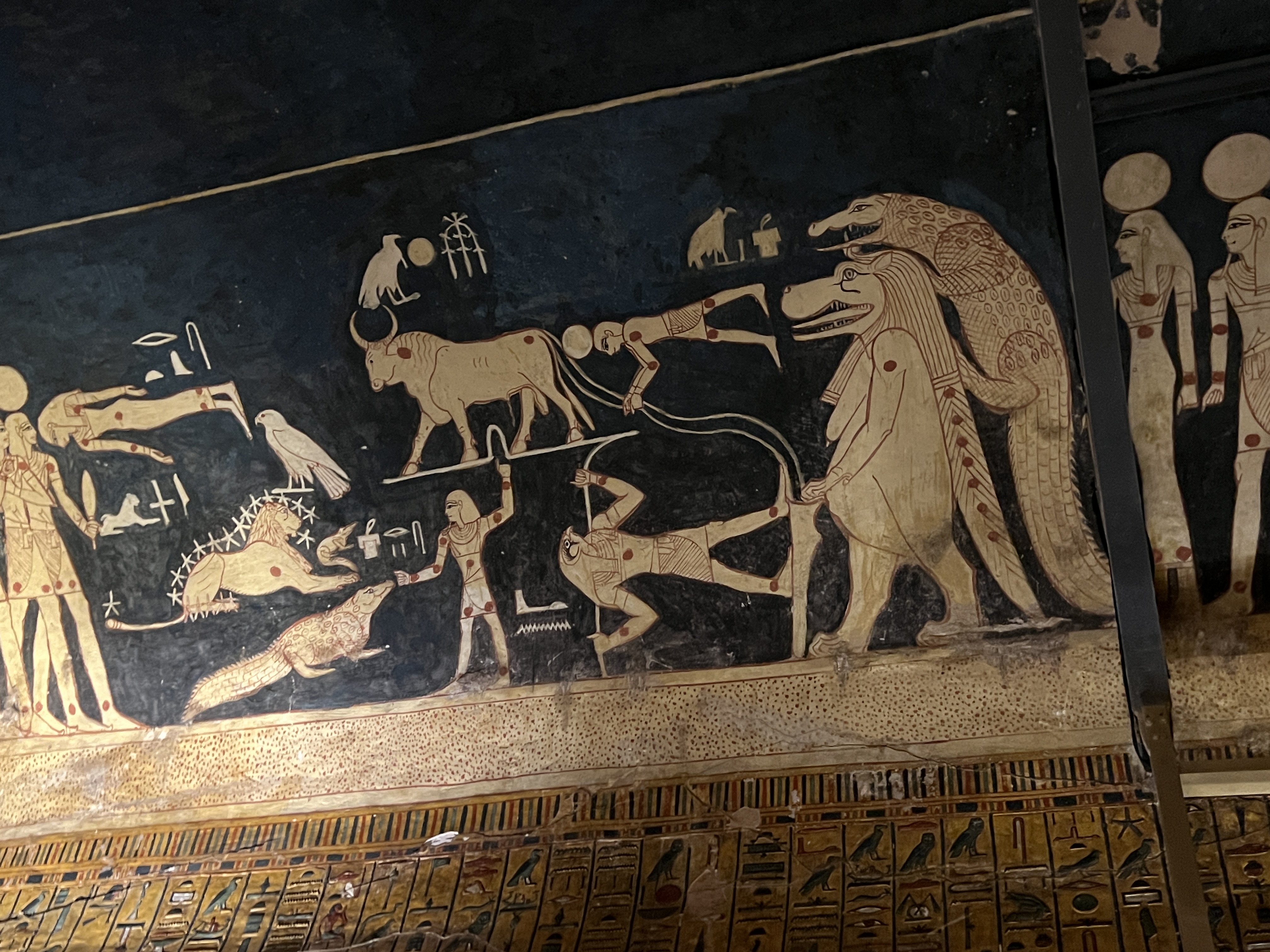
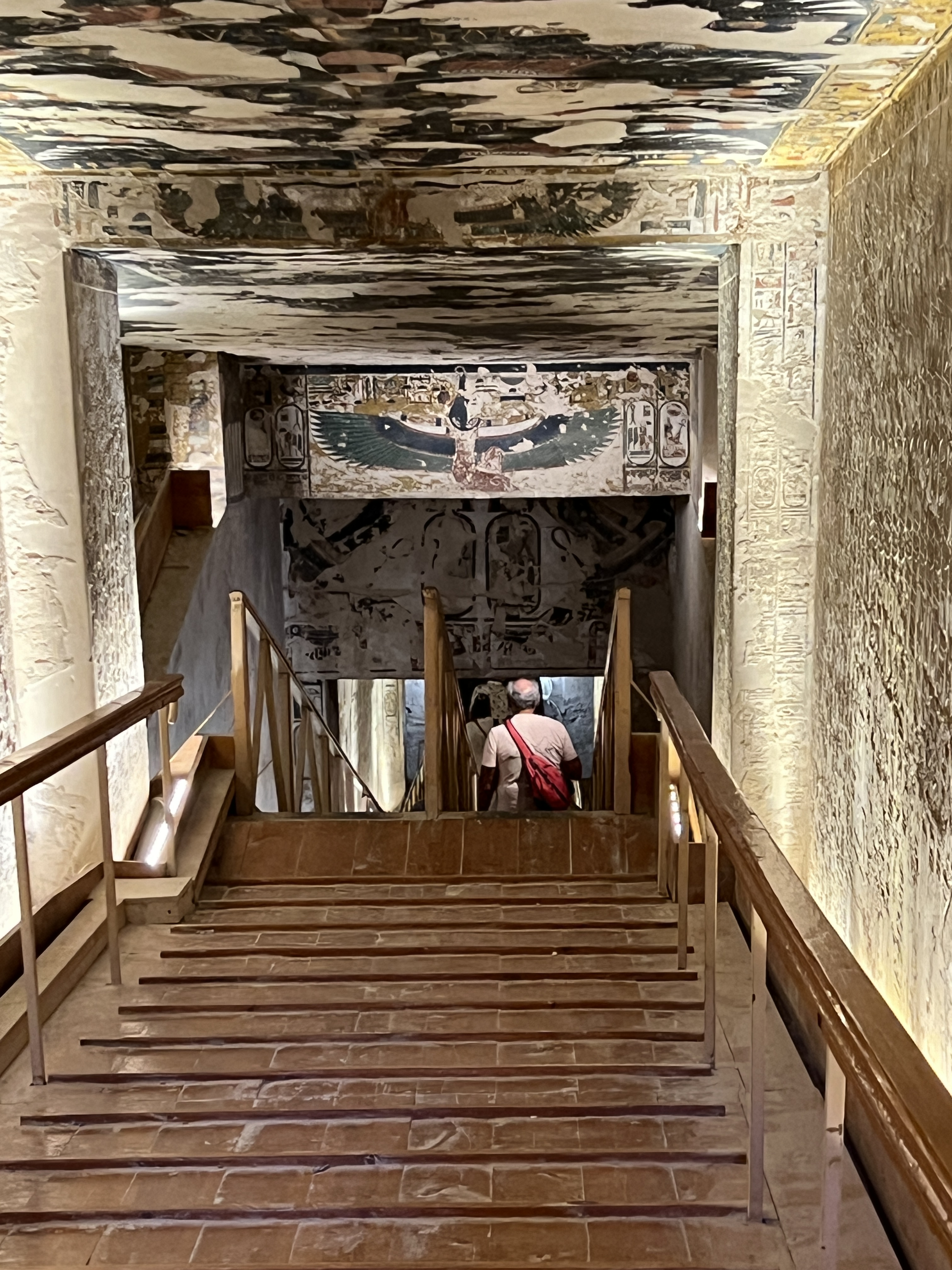
Ramesses V/VI

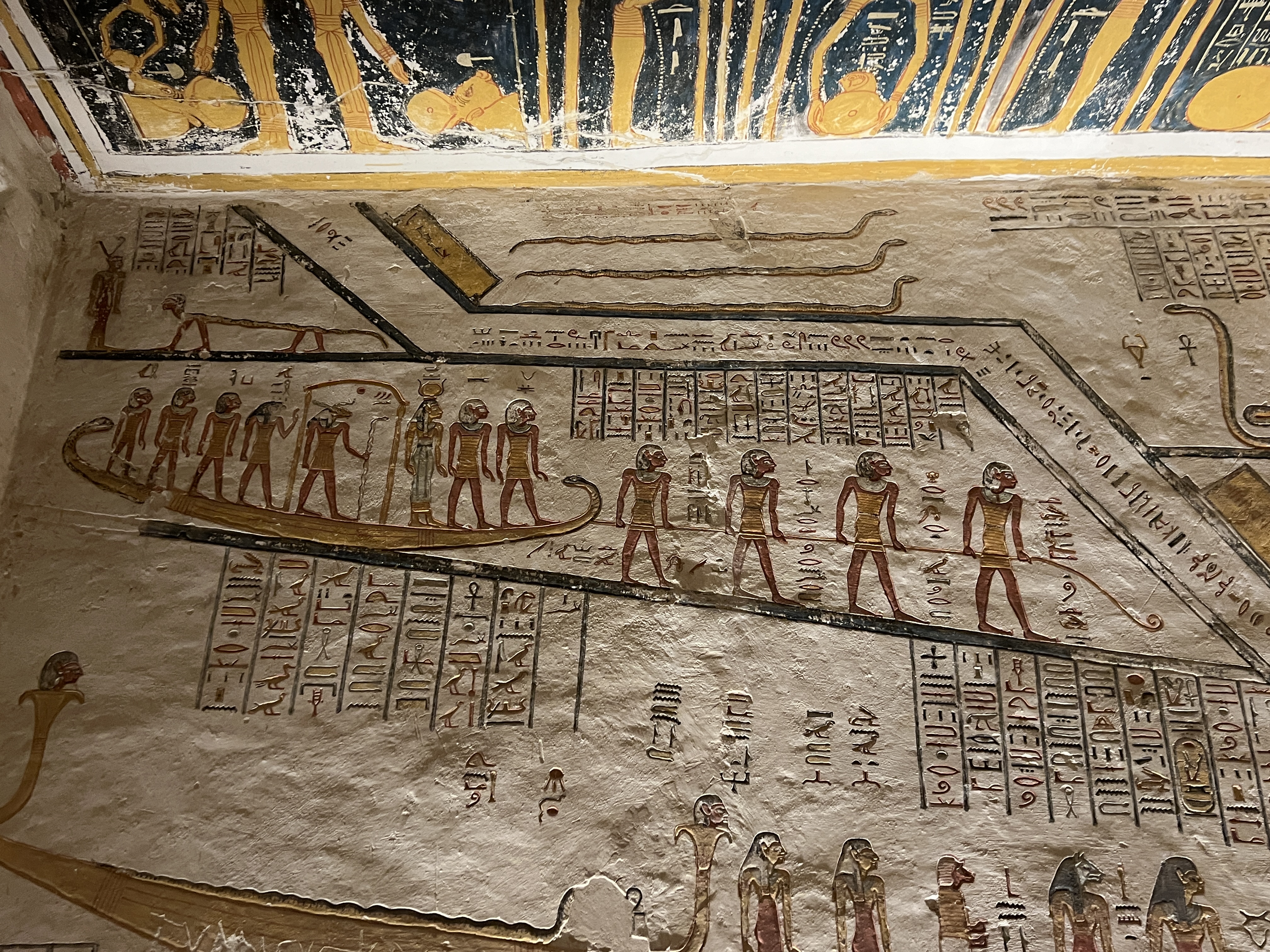

Ramesses IX

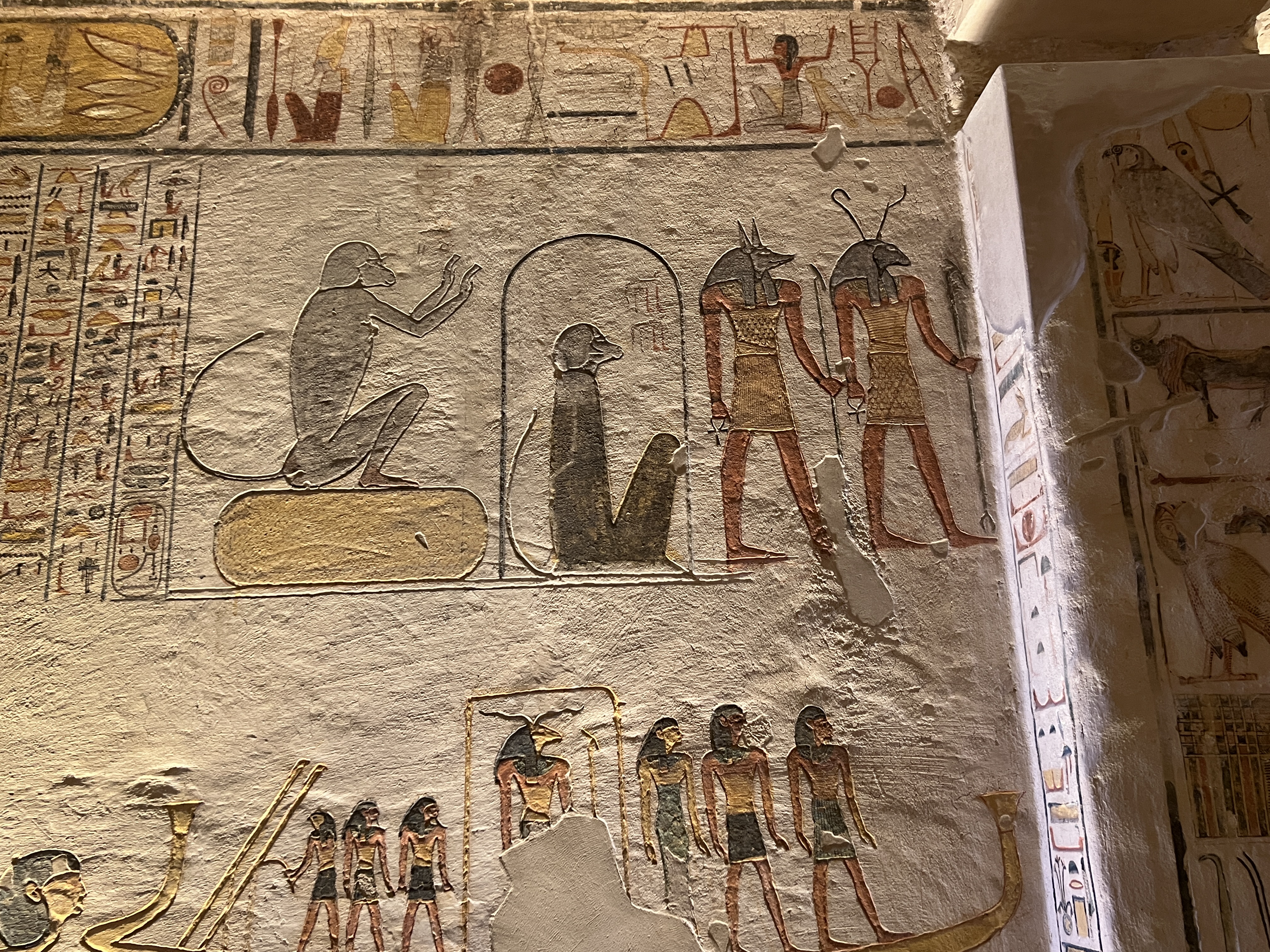
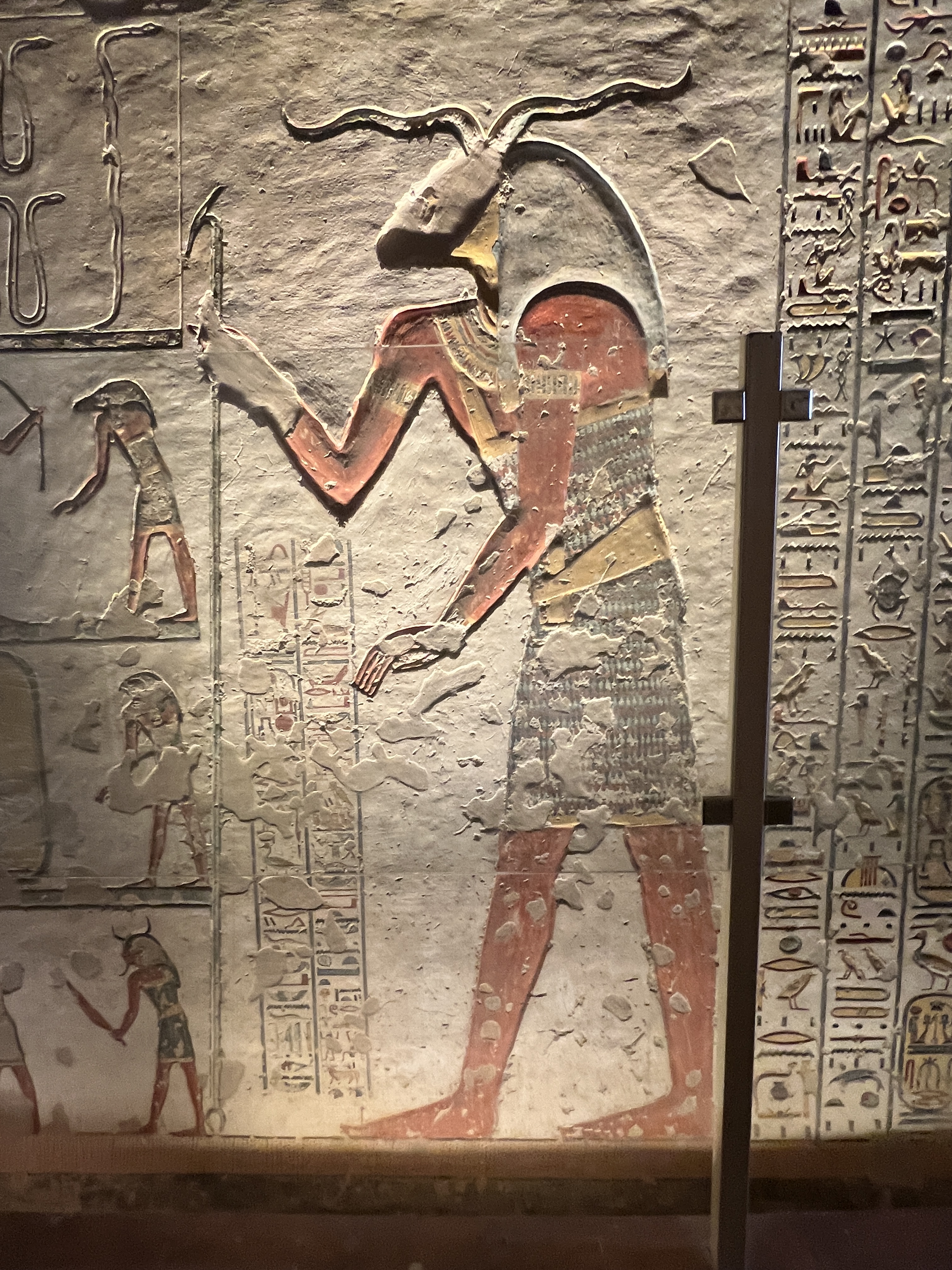
Amen-Khopshef son of Ramesses III
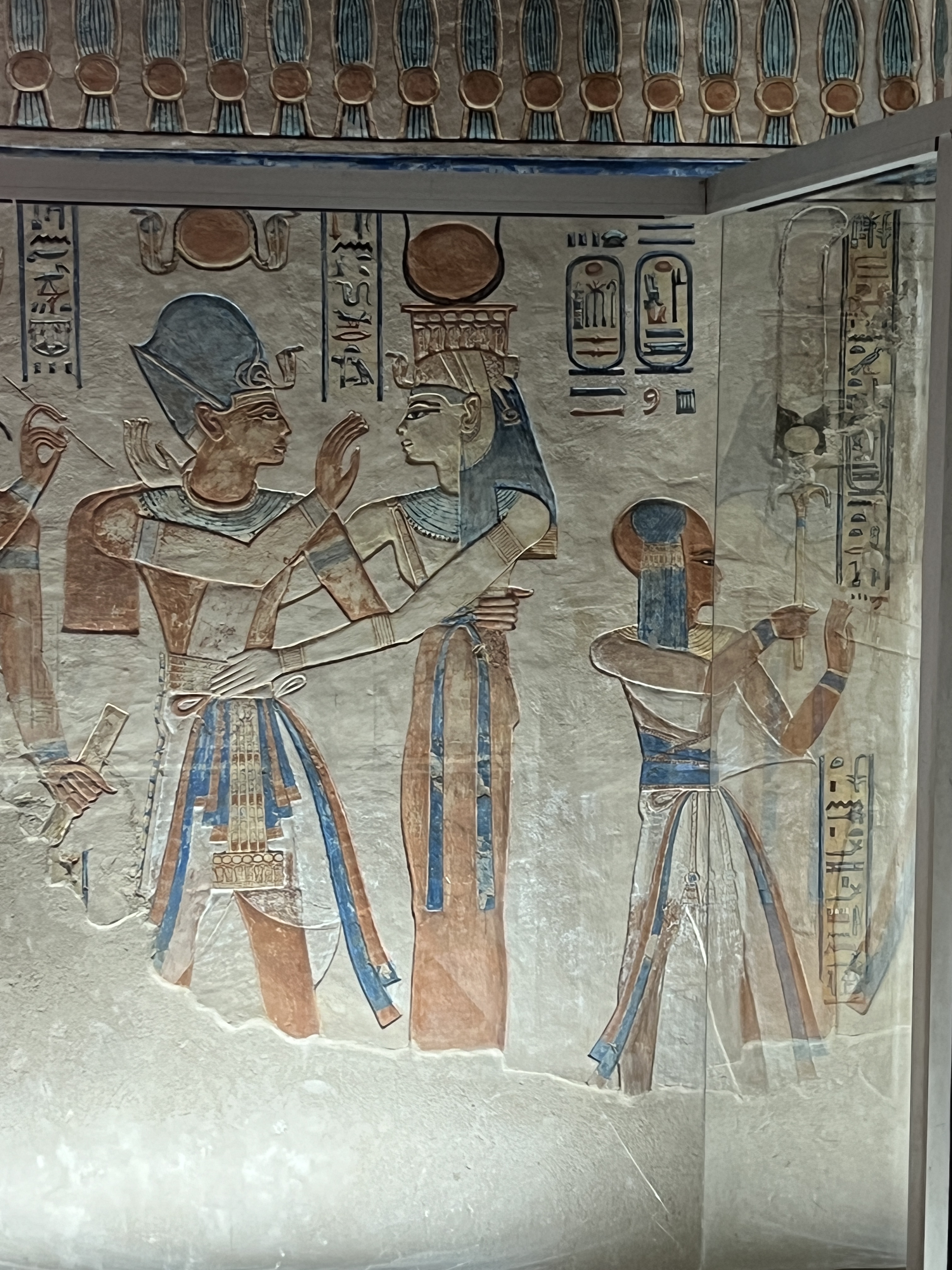
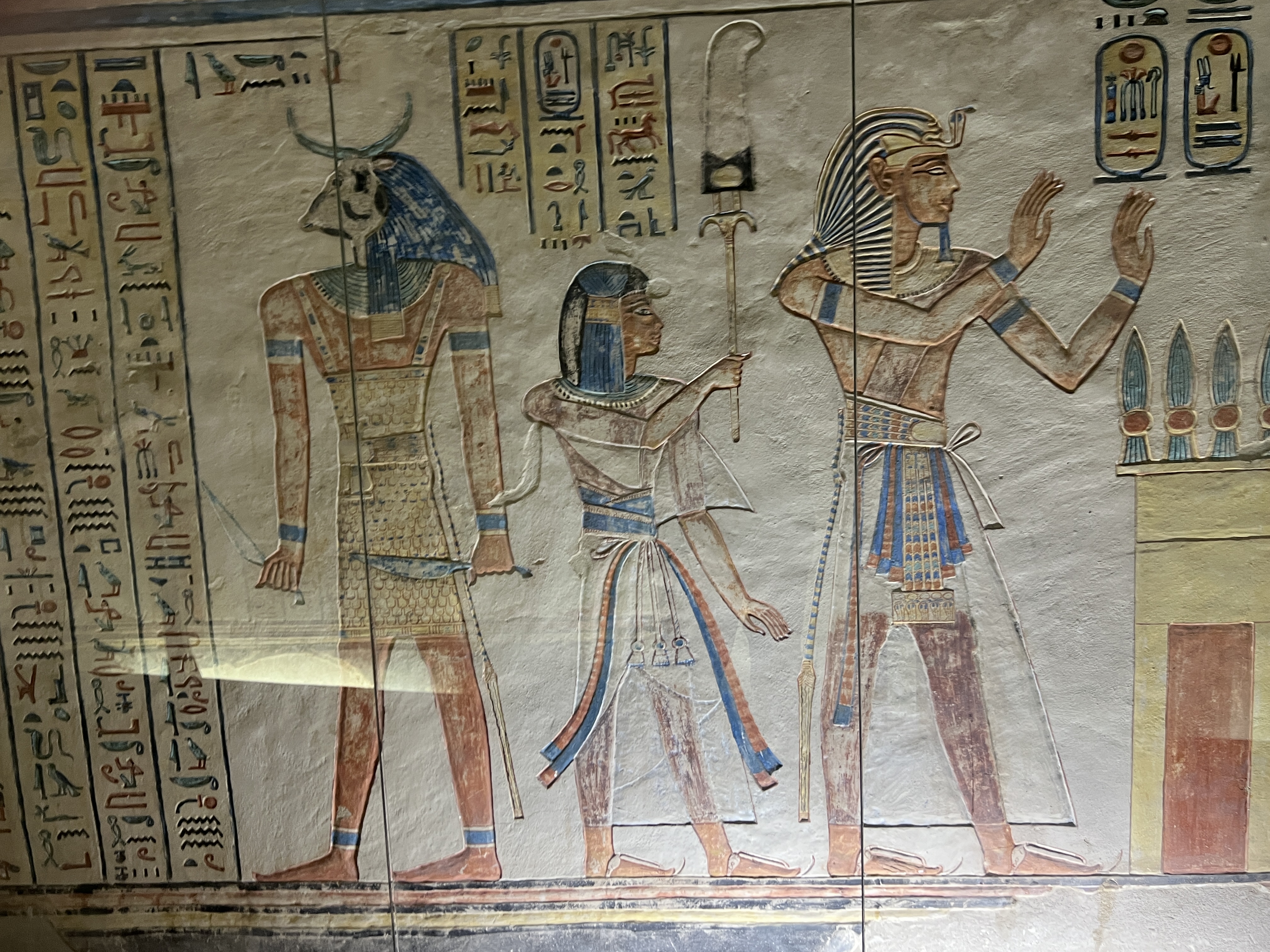
Unless you have a good understanding of the various gods, follow the imagery and can work out some of the hieroglyphics it is all a bit overwhelming. But also fascinating to look up and wonder!
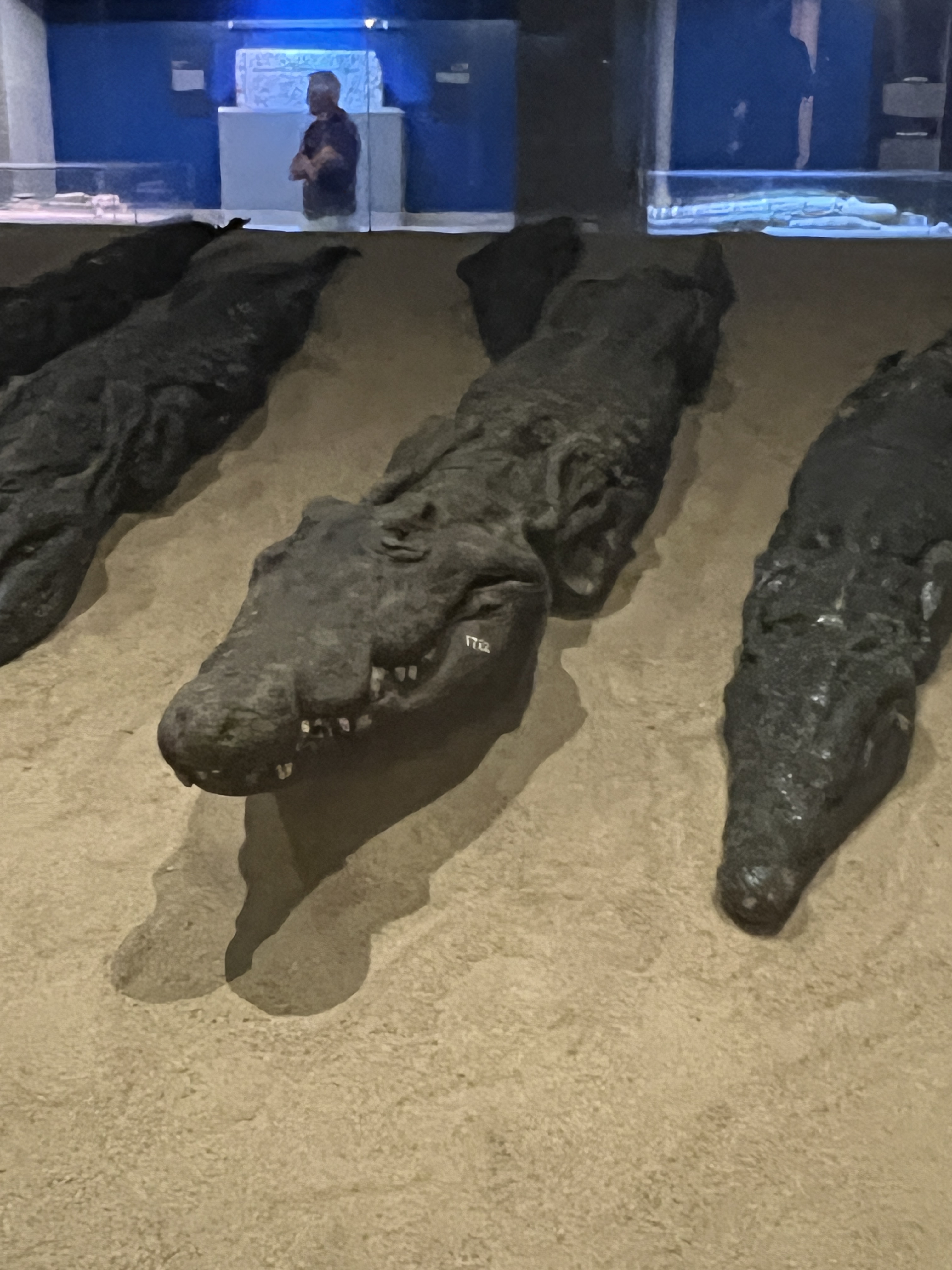
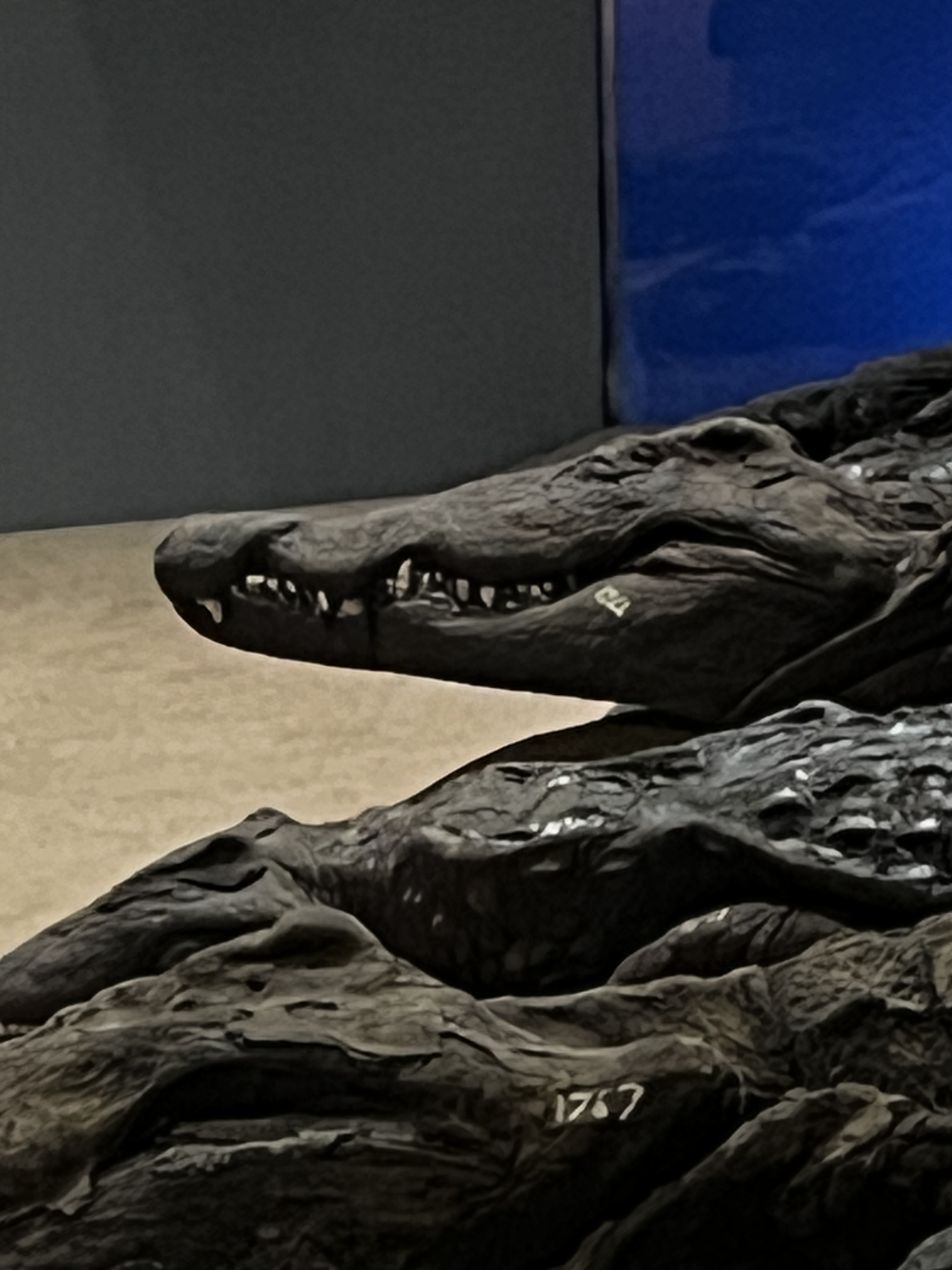
Can’t resist slipping in here photos of mummified crocodiles, one of the gods had the head of a crocodile, from the museum in Kom Ombo. Memorable!
We have now finished the journey up the Nile to Aswan and have decamped to the Movenpick Hotel on Elephantine Island, away from the hustle and bustle of the city.

